Barn Cat Dry Cat Food 32lb Bag: Label, Portions, and How Long It Lasts
A barn colony goes through kibble fast. That makes Kent Nutrition Group’s Barn Cat dry cat food 32lb bag a common farm store pick. This guide reads Kent’s label line by line. Then it covers portions for kittens and adults, how long a bag lasts, and barn storage.
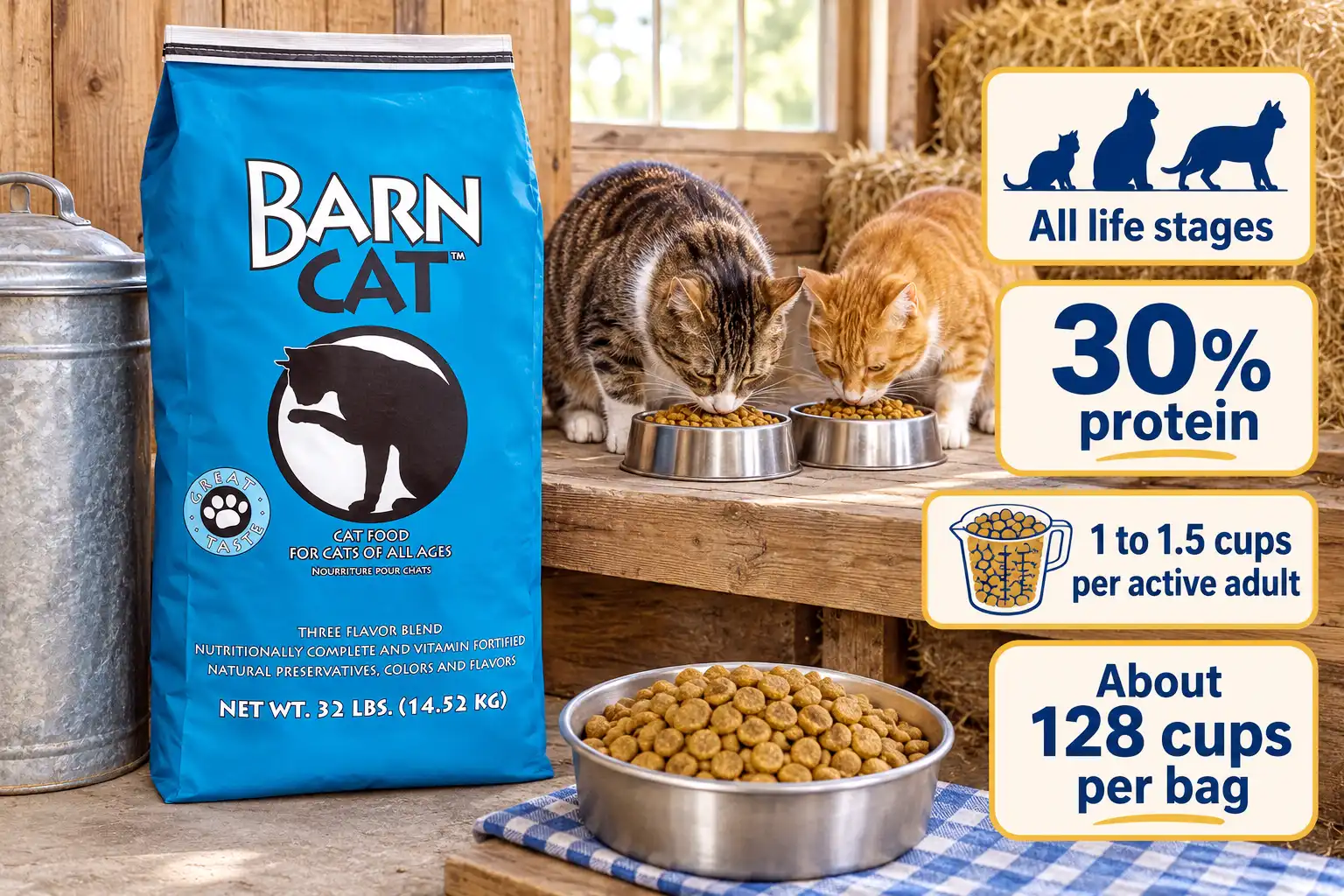
Kent Nutrition Group‘s Barn Cat dry cat food 32lb bag meets AAFCO all life stages profiles: 30% protein, 8.5% fat. Kent gives active adults 1 to 1.5 cups daily, so one bag lasts three of them four to six weeks.
What Is Barn Cat Dry Cat Food?
Barn Cat cat food is a dry kibble from Kent Nutrition Group. The family-owned company formed in 2010 around the Kent Feeds and Blue Seal brands, and it runs from Muscatine, Iowa. Kent sells Barn Cat for outdoor cats, farm cats, and working cats that patrol barns for mice. The recipe blends poultry, pork, and fish proteins into a star-shaped kibble. Kent markets it as made in the USA.
Dealers sell Kent Barn Cat as a 32 lb bag. Still, listings disagree on the weight. One farm store page shows 31 lb in its specs, while another listing shows 32.5 lb. At least one store also sells the same bag under Kent’s Blue Seal name, with a matching UPC. So go by the net weight printed on your bag. Label rules put it on the front panel, in the bottom third, according to the Merck Veterinary Manual.
Is “Barn Cat” a Special Type of Cat Food?
No. “Barn Cat” is a product name, not a food category. AAFCO publishes two cat nutrient profiles: one for growth and reproduction, and one for adult maintenance. Neither has a barn or outdoor version. So judge any barn cat food like any other bag. Cornell Feline Health Center calls cats obligate carnivores that rely on nutrients found only in animal products. That makes the complete and balanced statement the first thing to check. AAFCO’s cat profiles also set a taurine minimum, and Barn Cat lists added taurine.
Who Barn Cat Suits, and Who Should Pick Another Food
Most of outdoor and barn cat feeding comes down to who eats from the bowl. So start with your cats, not the bag.
Barn cat dry cat food from Kent fits one setup especially well. That’s a barn colony where litters, a nursing queen, and adults share one feeder. Its all life stages statement means it meets AAFCO’s growth profile as well as adult maintenance. That matters, because an adult maintenance bag can leave kittens and queens short. Cornell also notes that all life stages foods simplify the choice when cats of different ages share a home. Spayed and intact adults can eat it too, with portions set by body condition. It fits best when the colony finishes a bag in about a month, as the bag life section shows.
Three groups should look at another bag:
- Cats prone to weight gain. Without a calorie statement, you can’t set portions from calories.
- Cats on a veterinary diet. That food is the vet’s choice, and no store food replaces it.
- Owners who want meat listed first. Ground corn leads the ingredient list, ahead of poultry by-product meal.
Barn Cat 32 lb Label, Read Line by Line
Five parts of Kent’s label shape how you feed this bag.
The Life Stage Statement
Kent’s statement reads “formulated to meet” the AAFCO Cat Food Nutrient Profiles for all life stages. An all life stages food must clear the growth profile, AAFCO’s stricter standard, so it can feed kittens and queens. The wording also names the method. It means the recipe meets the profile by calculation or lab analysis. No AAFCO feeding trial with cats stands behind it, although AAFCO accepts either route.
Guaranteed Analysis on a Dry Matter Basis
The Barn Cat guaranteed analysis lists minimums for crude protein and crude fat, and maximums for crude fiber and moisture. AAFCO sets its cat profiles on a dry matter basis, so take the water out first. Divide each nutrient by 100 minus the moisture, then multiply by 100.
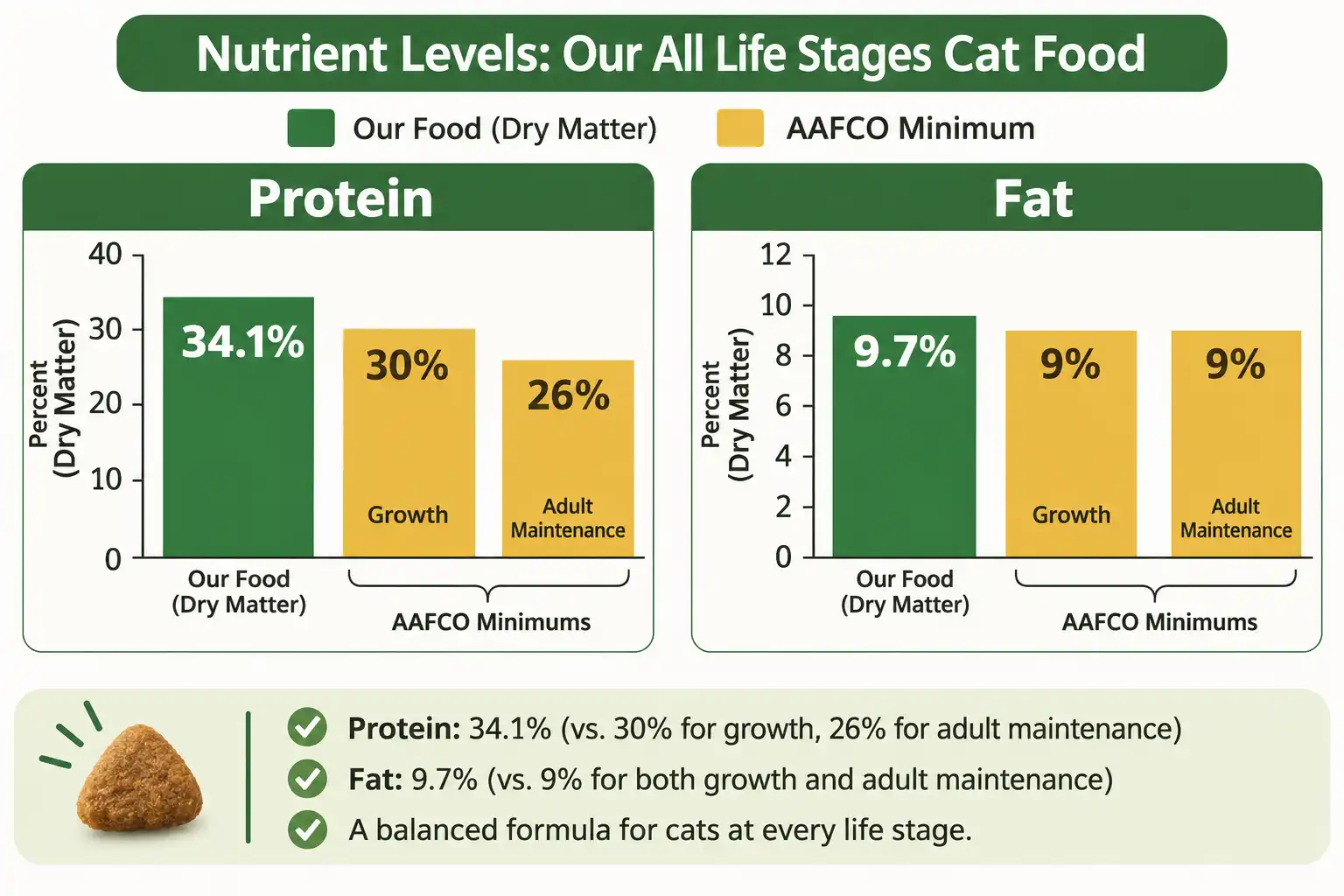
For this all life stages food, protein comes to about 34.1% of dry matter and fat to 9.7%. Protein clears AAFCO’s growth minimum of 30% and its adult maintenance minimum of 26%. Fat clears the 9% minimum for growth and adult maintenance, but only by 0.7 points. Some store copy prints 8% fat instead, which is only 9.1% of dry matter for an all life stages food. These figures use the 12% moisture ceiling, so treat them as estimates and check your own bag. The same math works for comparing protein on a dry matter basis between bags.
| Nutrient | Label (as fed) | Dry matter | AAFCO minimum, growth | AAFCO minimum, adult maintenance |
|---|---|---|---|---|
| Crude protein | 30.0% min | 34.1% | 30% | 26% |
| Crude fat | 8.5% min | 9.7% | 9% | 9% |
| Crude fiber | 4.0% max | 4.5% | None set | None set |
| Moisture | 12.0% max | Not applicable | Not applicable | Not applicable |
Ingredients, Read With FDA Naming Rules
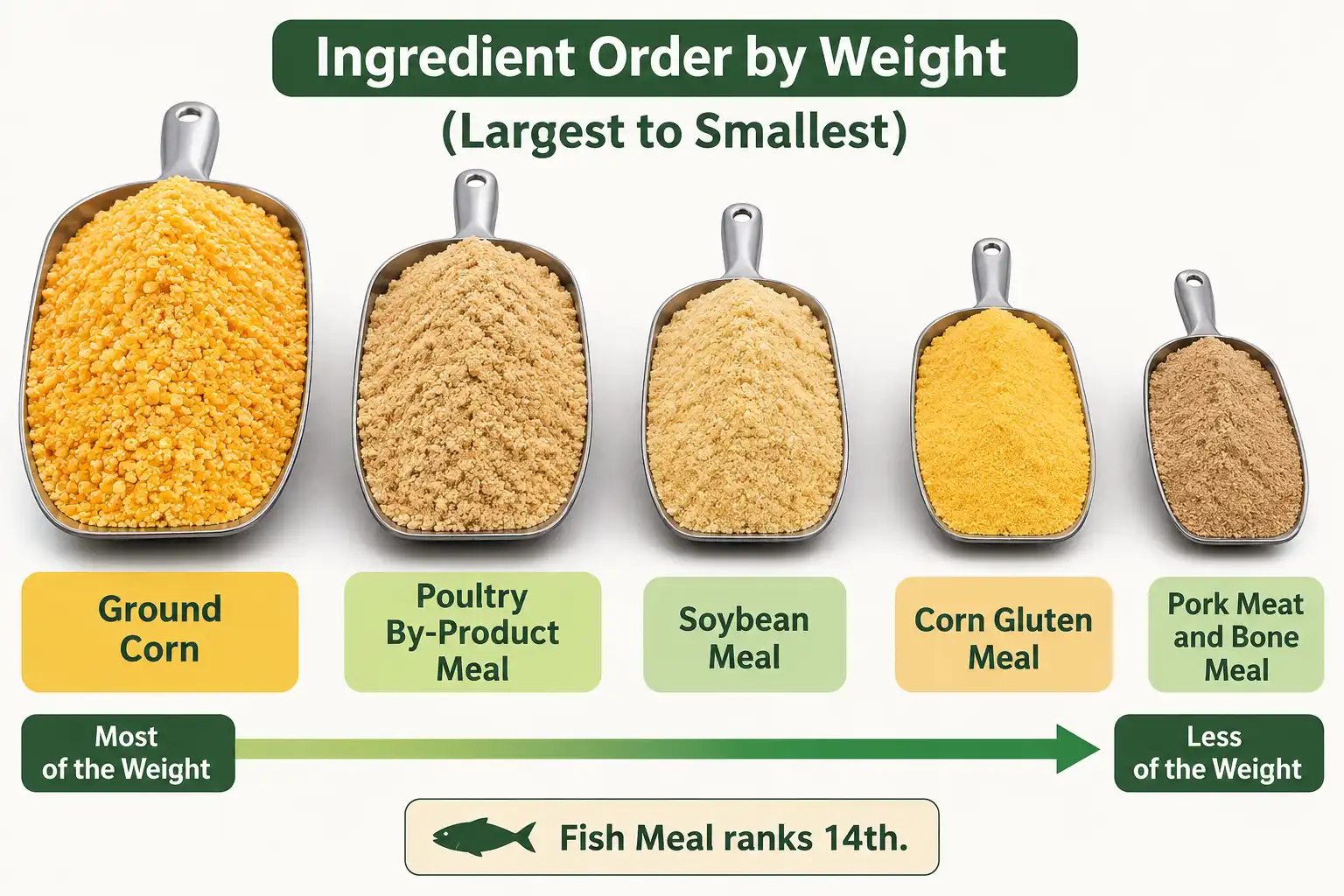
FDA rules require ingredients in descending order of weight. So the Barn Cat ingredients open with ground corn. Next come poultry by-product meal, soybean meal, corn gluten meal, and pork meat and bone meal. Under AAFCO definitions, poultry by-product meal consists of rendered poultry parts such as necks, feet, and intestines, without feathers. Meat and bone meal covers rendered mammal tissue, bone included, and this one comes from pork. The soybean and corn gluten meals are plant proteins that also count toward crude protein. Still, an animal protein sits second. That fits Cornell’s advice to look for meat or by-products among the first few ingredients. Fish meal comes 14th, behind salt and added taurine, so it is a minor ingredient by weight. Mixed tocopherols preserve the chicken fat, and no artificial colors appear on the list.
The Missing Calorie Statement
The Barn Cat label copy published online shows no calorie statement: no kcal per cup and no kcal/kg. Without it, a cat’s calorie needs can’t become cups, so Kent’s chart is the only guide. Kent’s own website doesn’t list Barn Cat either. Check your bag first. If it’s missing there too, call Kent Nutrition Group at 866-647-1212 and ask for the figure. While you’re on the line, ask who formulates the food and how Kent checks each batch.
The Teeth Claim
Kent’s copy says the star-shaped kibble helps clean and whiten teeth. Treat that as the maker’s claim. VOHC accepts dental products that meet its plaque or tartar standards, and it publishes the list. Barn Cat is not on VOHC’s cat list, last updated in August 2026. So look for the VOHC seal before counting on a dental benefit.
Kent Barn Cat All Life Stages, 32 lb: At a Glance
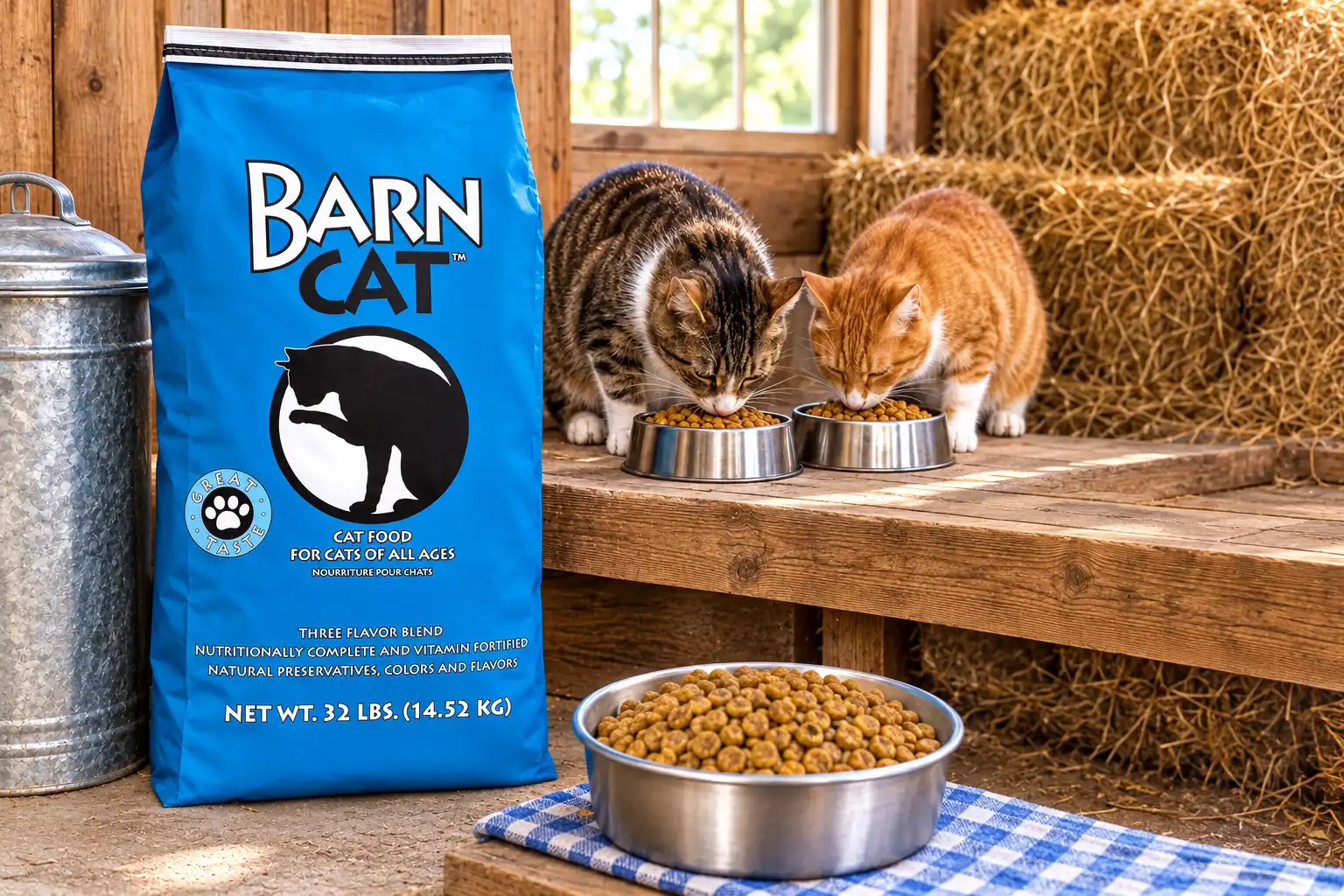
Kent Barn Cat All Life Stages, 32 lb is Kent Nutrition Group’s dry food for all life stages, so kittens, queens, and adults can share one bag. The family-owned Iowa maker traces its feed roots to 1927. A Kent Barn Cat 32 lb bag is the simplest pick for a mixed colony.
PROS
- All life stages formula
- Clears AAFCO growth protein
- Poultry, pork and fish proteins
- No artificial colors listed
CONS
- No calorie statement published
- Fat guarantee near AAFCO floor
Specifications
- Life stage: All life stages (AAFCO, by formulation)
- Calories: kcal per cup not published
- Crude protein (all life stages): 30% as fed, 34.1% dry matter
- First ingredient: Ground corn
What owners report: Owner feedback, the usual backbone of a Barn Cat cat food review, is thin and mostly positive. One owner says outdoor cats skipped it when other food was around.
How Much Barn Cat to Feed Each Day
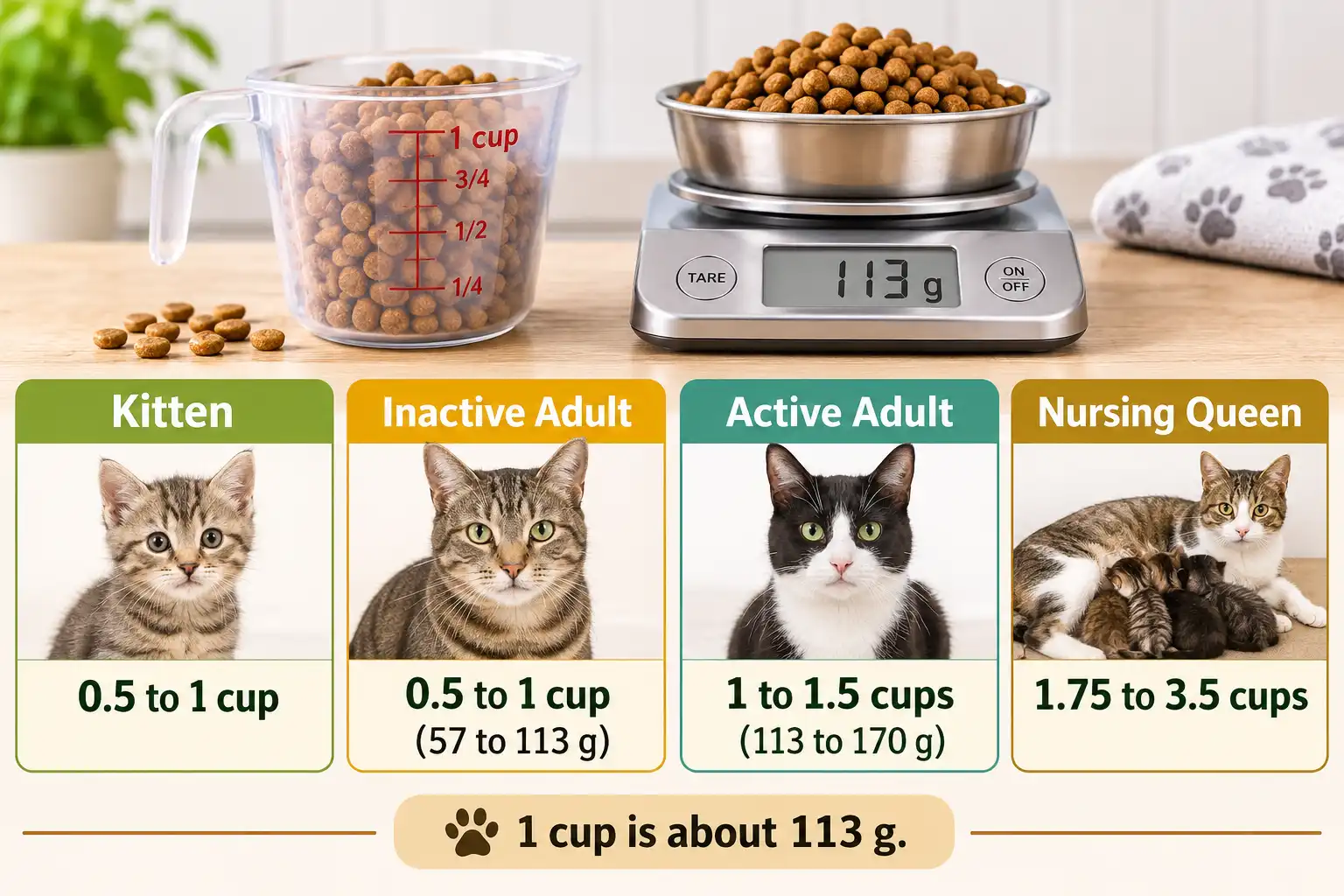
For inactive adults of 4.75 to 10 lb, Kent’s chart gives 0.5 to 1 cup a day. Active adults of the same weight get 1 to 1.5 cups per day. Kent also says a standard 8 oz measuring cup holds about 4 oz of food. That puts one level cup near 113 grams, so a kitchen scale can replace the scoop. The Barn Cat feeding chart below adds grams to Kent’s cups.
| Cat | Body weight | Cups per day | Grams per day |
|---|---|---|---|
| Kitten, 10 weeks | 0.75 to 2.25 lb | 0.5 to 0.75 | 57 to 85 g |
| Kitten, 20 weeks | 2.5 to 4.5 lb | 0.5 to 0.75 | 57 to 85 g |
| Kitten, 30 weeks | 3.25 to 6 lb | 0.5 to 1 | 57 to 113 g |
| Kitten, 40 weeks | 4.75 to 8.5 lb | 0.75 to 1 | 85 to 113 g |
| Adult, inactive | 4.75 to 10 lb | 0.5 to 1 | 57 to 113 g |
| Adult, active | 4.75 to 10 lb | 1 to 1.5 | 113 to 170 g |
| Pregnant | 5.5 to 9 lb | 0.75 to 1.5 | 85 to 170 g |
| Nursing | 4.75 to 9 lb | 1.75 to 3.5 | 198 to 397 g |
Checking the Chart Against Calorie Needs
A chart covers a weight band and a typical cat, while a calorie estimate covers one cat. AAHA’s 2021 guidelines start with resting energy (RER): 70 times body weight in kg, raised to the 0.75 power. A 10 lb adult cat weighs 4.54 kg, so its RER is about 218 kcal. AAHA’s factor of 1.0 to 1.2 puts a spayed or neutered 10 lb adult’s daily need (MER) at about 220 to 260 kcal. The Merck Veterinary Manual uses 1.4 for an intact adult, which comes to about 305 kcal. Neither source gives a separate factor for outdoor or working cats. Without a calorie statement, though, none of these figures can become cups of Barn Cat. So treat the chart as a starting point, check body condition monthly, and ask your veterinarian before big changes. The daily food calculator runs this math for any weight. Once you know a food’s kcal per cup, cups by body weight turns the result into a scoop.
Kittens, Pregnant and Nursing Queens
Barn Cat also works as a barn cat food for kittens from weaning age. Kent starts a kitten on it at 3 to 5 weeks, moistened if you like. Kent lets kittens eat all they want, about every 4 hours. At 4 to 5 months, Kent shifts them to two meals a day. Nursing queens need the most: 1.75 to 3.5 cups a day for lactation, against 0.75 to 1.5 cups for gestation. Kent allows milk or water for moistening. Water is the simpler choice, since Cornell notes many cats are lactose intolerant. Because the bag covers growth, kittens need no formula switch at a year. That sets it apart from the usual choice between kitten and adult formulas.
Winter and Working Cats
Kent’s directions say environment can change a cat’s needs, and a cold barn counts. None of these sources gives a fixed amount to add for winter, though. So go by touch every few weeks. Run your hands along the ribs and hips. Cornell’s body condition score puts the ideal at ribs you can feel under a slight fat cover. Add a little to the ration when bones feel sharper, and cut back when they feel padded. If a cat keeps losing condition, call your veterinarian.
How Long a Barn Cat Dry Cat Food 32lb Bag Lasts
A 32 lb bag lasts one active adult 85 to 128 days at Kent’s 1 to 1.5 cups a day. Three active adults finish it in 28 to 43 days. The math starts with about 128 cups per bag. Kent puts a level cup at about 4 oz, and 32 lb is 512 oz. A bag that reads 31 lb drops to about 124 cups, so use 124 in the formula below.
To run your own colony size, use this formula:
Days = 128 ÷ (cups per cat per day × number of cats)
Count every cat that eats at the station, strays included. Cost per day works the same way: divide your bag’s price by the days it lasts.
| Cats | Inactive adults (0.5 to 1 cup each) | Active adults (1 to 1.5 cups each) |
|---|---|---|
| 1 | 128 to 256 days | 85 to 128 days |
| 2 | 64 to 128 days | 43 to 64 days |
| 3 | 43 to 85 days | 28 to 43 days |
| 4 | 32 to 64 days | 21 to 32 days |
| 6 | 21 to 43 days | 14 to 21 days |
| 8 | 16 to 32 days | 11 to 16 days |
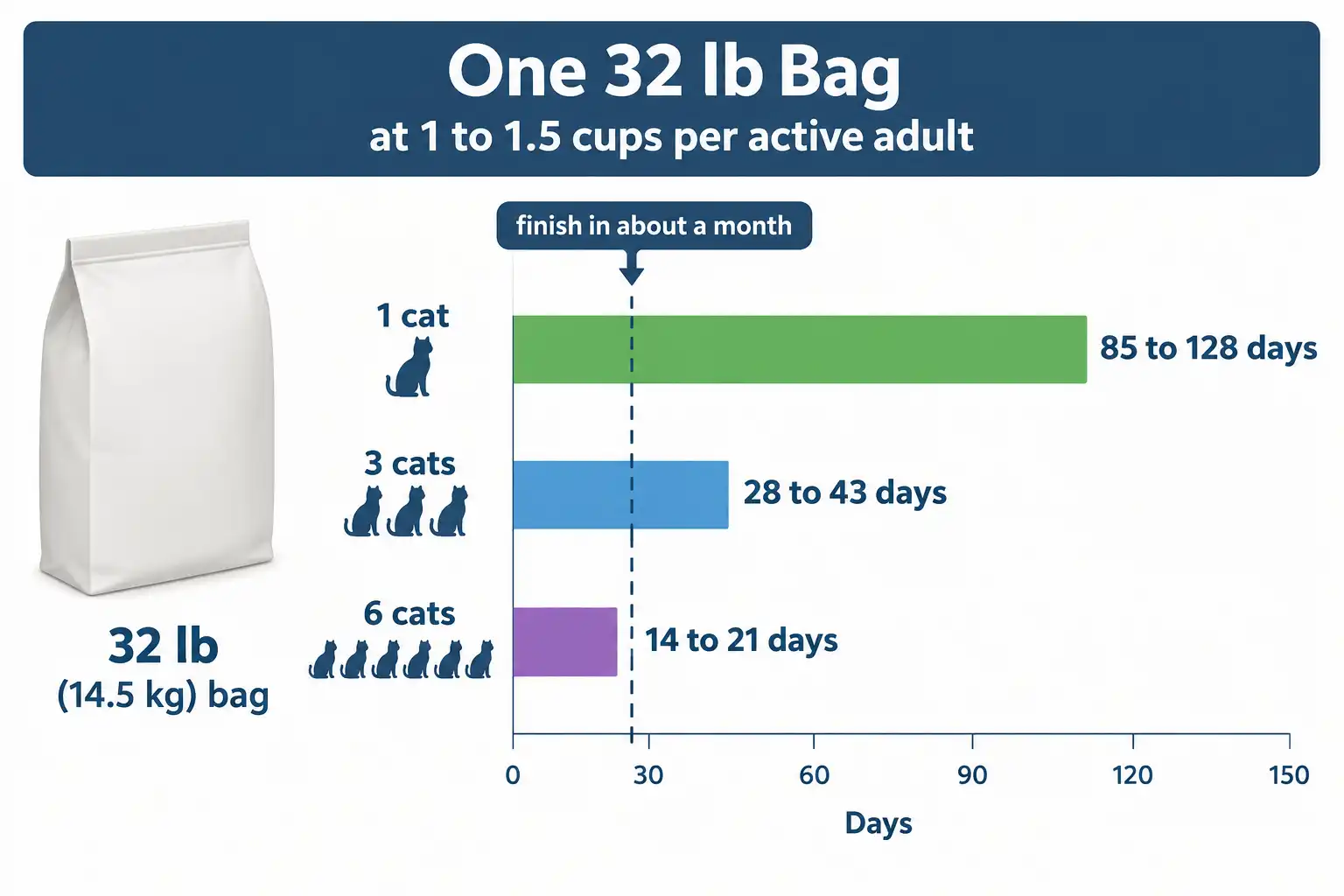
So how long does a bag of cat food last before freshness sets the limit? The Catnip newsletter from Tufts Cummings School advises buying a bag size you can use up in about a month. A 32 lb bag of cat food fits that rule for 3 to 4 active adults or 4 to 8 inactive adults. Smaller colonies take far longer, so check the best by date before you buy and store the bag well.
Buying a 32 lb Bag: What to Check
Before you buy Barn Cat cat food, run three checks:
- Net weight. Listings for this bag show 31, 32, and 32.5 lb, so read the front panel.
- Best by date and lot number. Find both on the bag before you open it. The FDA says these details matter when you report a problem with a food.
- Seller. Online listings often come from third-party sellers, so check the bag’s date when it arrives.
Listings also stretch the claims. One calls Barn Cat a “veterinary diet” and tags it for adults only. Go by the AAFCO statement on the bag, which covers all life stages.
Storing a 32 lb Bag in a Barn
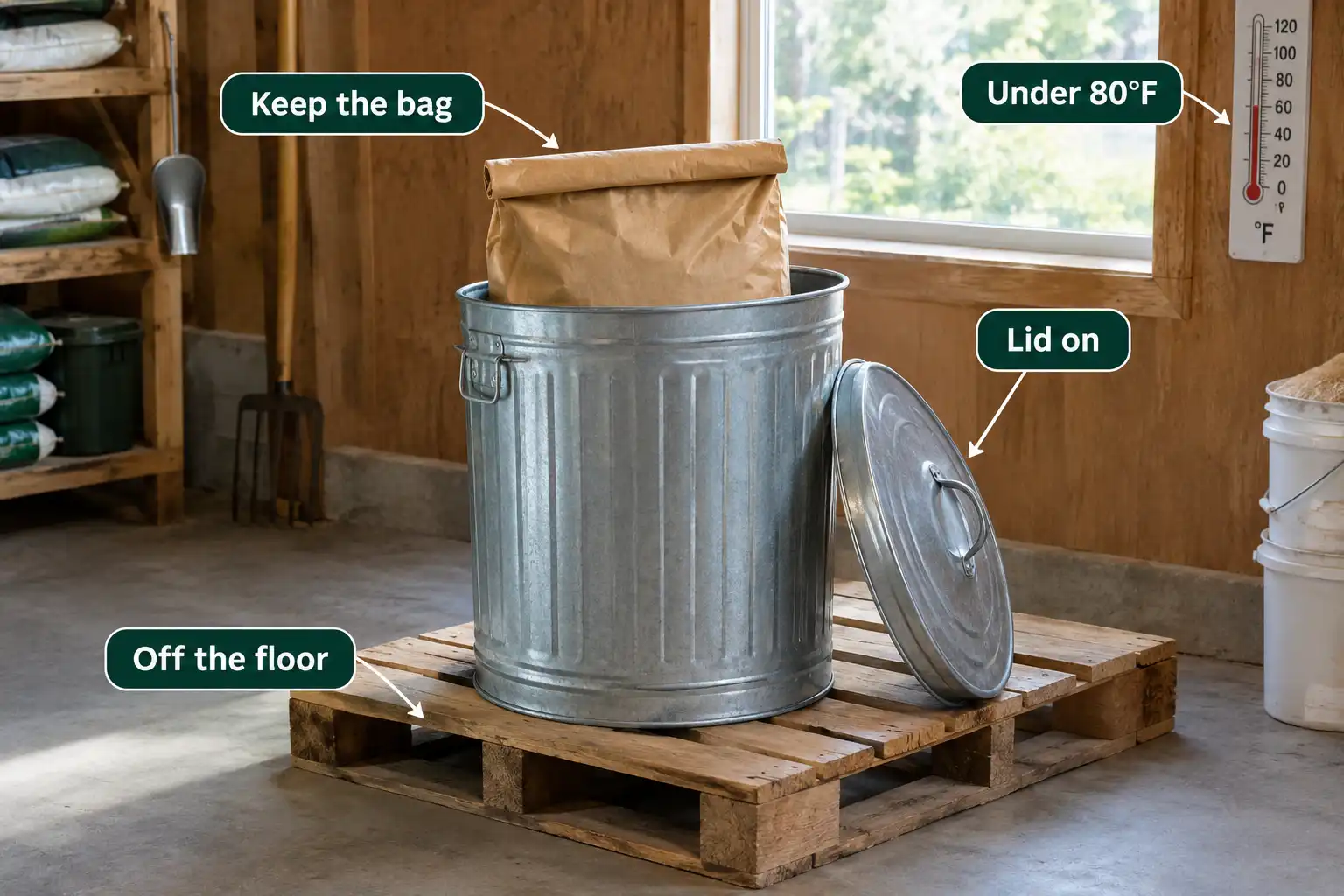
Storing cat food in a barn follows kitchen rules, just with more pests. The FDA says to keep dry food in its original bag, which carries the UPC, lot number, and best by date. Set the whole bag inside a clean container with a lid, rather than pouring the kibble in. Keep it dry and under 80°F, since heat and moisture break down nutrients. Tufts Petfoodology adds that food belongs indoors, with low humidity.
A barn makes that harder, so choose the driest room you have. A feed room or tack room beats an open aisle. Put the bag in a lidded metal can, since rodents can gnaw through plastic. Then set the can on a pallet or shelf, off the floor. Cornell notes that long storage makes fat more likely to turn rancid, and damp kibble can grow mold. An airtight lid helps on both counts. Pick one of the storage containers big enough to hold the whole 32 lb bag with its top folded shut.
Keeping Raccoons, Rodents, and the Farm Dog Out
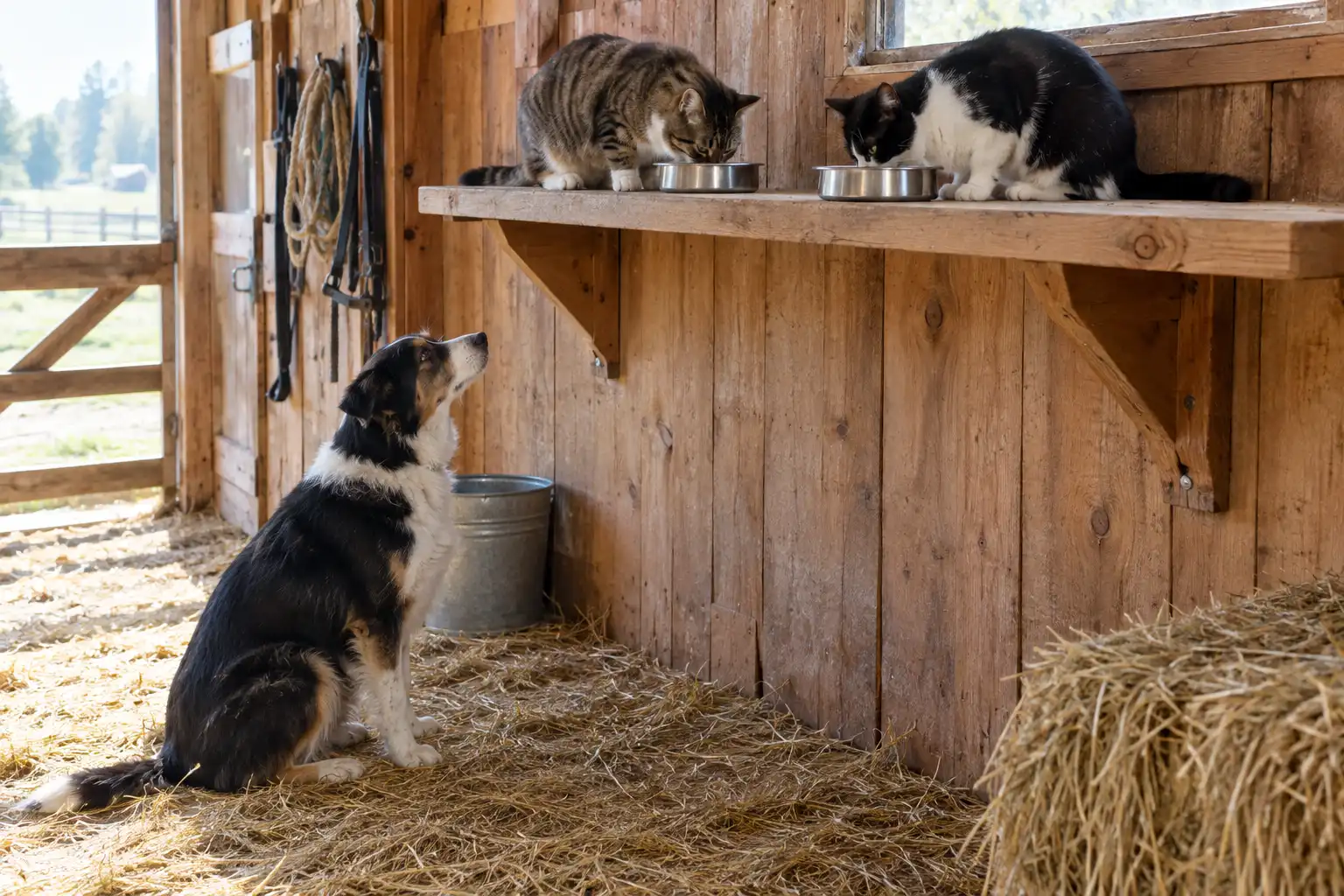
Food left out overnight draws raccoons, opossums, and other wildlife. So feed measured meals in daylight, then pick up leftovers once the cats finish. Daylight feeding also shows you who came to eat. Set the feeding station on a shelf or platform the cats can jump to and the farm dog can’t reach. The FDA also advises washing bowls after each use. Keep the dog’s bowl away from the cats, too. Dog food meets AAFCO’s dog profiles, not the cat profiles, so it can leave a cat short of taurine.
Switching, Water, and Skipped Meals
Measured meals double as a daily headcount, and that habit helps in all three situations below.
Switching Your Cats to Barn Cat
Go slowly. AAHA’s 2021 guidance for cats starts by replacing about 25% of the old food. Then the share of new food rises as the cat accepts it. AAHA notes that a food transition can take some cats up to 40 days. Reset portions to Kent’s chart as you go, rather than keeping the old food’s scoop. If a cat refuses Barn Cat, call your veterinarian instead of waiting it out.
Water in Every Season
Sources disagree on how much water dry food holds. Cornell Feline Health Center puts it at 6 to 10 percent, while the FDA says 10 to 12 percent. Barn Cat’s label caps moisture at 12 percent. Either way, kibble-fed barn cats get most of their water from the bowl. So in freezing weather, use a heated bowl or refill with fresh water twice a day.
When a Barn Cat Skips Meals
A cat that stops eating needs a veterinarian the same day. Cornell Feline Health Center reports that hepatic lipidosis, a serious liver disease, almost always follows or comes with a cat refusing food. It can strike healthy-looking cats as well as overweight ones. Call the same day for any of these signs: not eating, repeated vomiting, straining to urinate, labored breathing, or sudden weakness. The daily headcount is how you catch appetite loss early.
FAQs on Barn Cat Dry Cat Food 32lb Bag
Who makes Barn Cat dry cat food?
Kent Nutrition Group makes Barn Cat, and the company has its headquarters in Muscatine, Iowa. Farm stores, hardware dealers, and online sellers carry it under the Kent name, and some stores use Kent’s Blue Seal name.
Can kittens eat Barn Cat?
Yes, since the label covers all life stages, growth included. Kent starts kittens on moistened food at 3 to 5 weeks, then moves them to two meals a day by 4 to 5 months.
Is Barn Cat cat food grain-free?
No, ground corn is the first ingredient, and corn gluten meal and rice hulls appear further down. Corn is the largest single ingredient by weight, so owners avoiding grains need another food.
Is Barn Cat made with real meat?
Not fresh meat: its animal protein comes from poultry by-product meal, pork meat and bone meal, and a little fish meal. AAFCO defines all three as rendered meals, cooked down with most of the water and fat removed.
Does Barn Cat clean cats’ teeth?
Only by Kent’s own claim: the maker says its star-shaped kibble helps clean and whiten teeth. Barn Cat is not on VOHC’s accepted list for cats, so look for that seal before counting on a dental benefit.
How many cups are in a 32 lb bag of Barn Cat?
About 128 cups, or about 124 if your bag reads 31 lb. Kent says an 8 oz measuring cup holds about 4 oz of Barn Cat, and 32 lb equals 512 oz.
Should barn cats be free-fed or fed meals?
Measured meals suit most adult barn cats, since they let you count cats, spot a skipper, and keep raccoons away. Young kittens are the exception, because Kent lets them eat all they want.
Can barn cats live on mice alone?
Don’t plan on it, because you can’t measure what a cat catches or how often. Feed a measured ration of a complete and balanced food every day, and treat hunting as extra.
What to Check Before You Buy
Before you pick up a Barn Cat dry cat food 32lb bag, check four things:
- Life stage fit. Kittens or queens at the feeder call for AAFCO all life stages, which this bag covers.
- Colony size. You want to finish a bag in about a month, which means 3 to 4 active adults.
- Calories. If any cat needs exact portions, ask Kent Nutrition Group for the calorie content.
- Storage. You need a sealed, lidded spot that stays dry and under 80°F.
Happy pet owners, and good luck.