Kitten vs Adult Dry Food: 6 Differences That Actually Matter
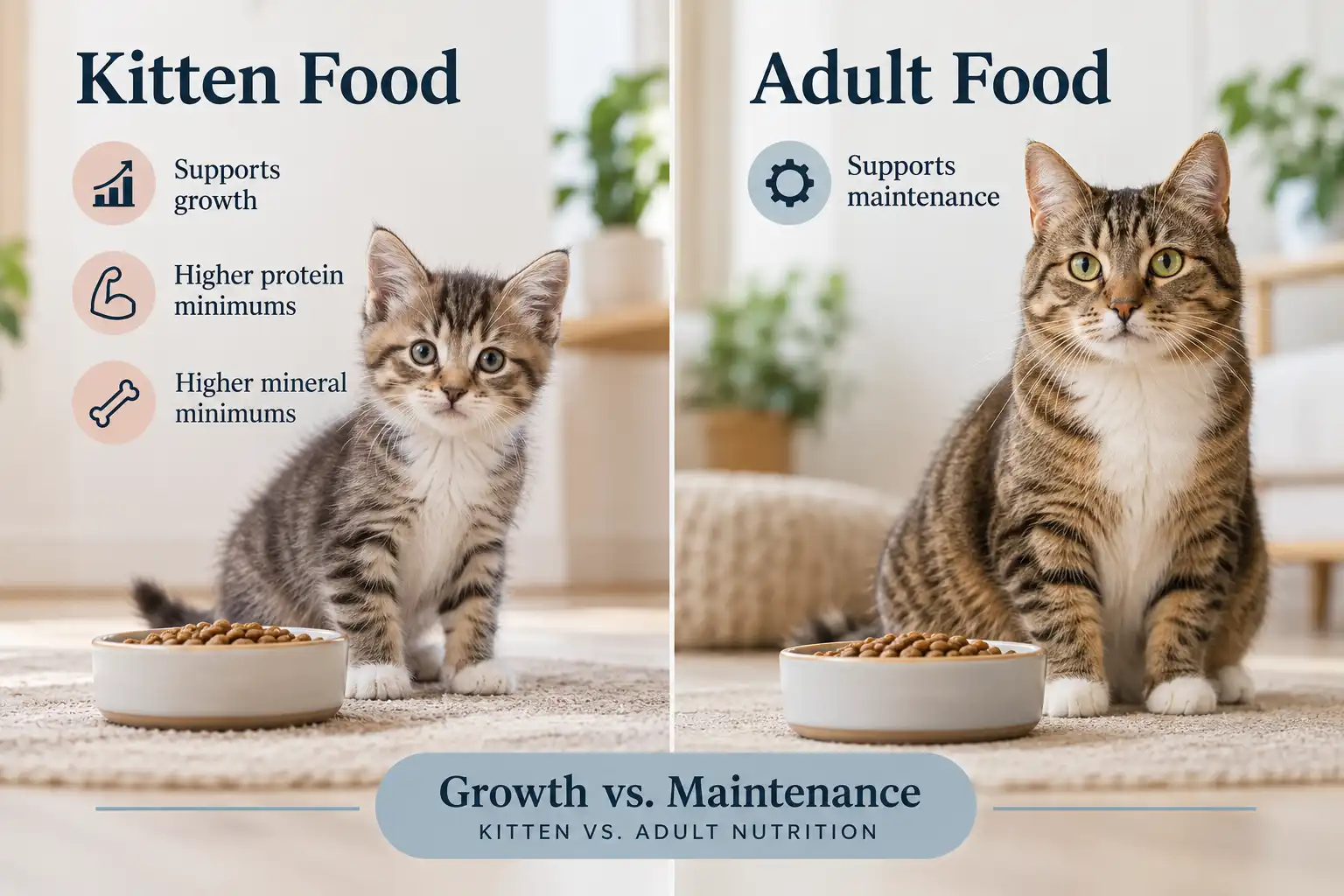
Kitten vs adult dry food differs in more than kibble size. Growing kittens need nutrients that support developing bones, muscles, and tissues. Adult cats need balanced nutrition for maintenance. Understanding those differences helps you choose the right formula and avoid unnecessary feeding changes.
The main difference in kitten vs adult dry food is nutritional balance for growth versus maintenance. Kitten formulas must meet growth requirements, including higher protein and mineral minimums. Most healthy cats transition to adult dry food around 12 months, with portions adjusted to their calorie needs.
What Actually Changes Between Kitten and Adult Dry Food?
Kitten dry food is formulated to support growth. Adult dry food is formulated to maintain a mature cat’s body.
The AAFCO Cat Food Nutrient Profiles establish different minimum nutrient levels for growth and adult maintenance.
| Nutritional difference | Growing kittens | Adult cats |
|---|---|---|
| Life-stage purpose | Growth and development | Body maintenance |
| Minimum crude protein | 30% | 26% |
| Minimum crude fat | 9% | 9% |
| Minimum calcium | 1.0% | 0.6% |
| Minimum phosphorus | 0.8% | 0.5% |
| Combined EPA and DHA | 0.012% minimum | No minimum established |
All percentages are AAFCO dry-matter nutrient-profile minimums, not the actual amounts in every product. Feeding trials provide another accepted method of establishing nutritional adequacy.
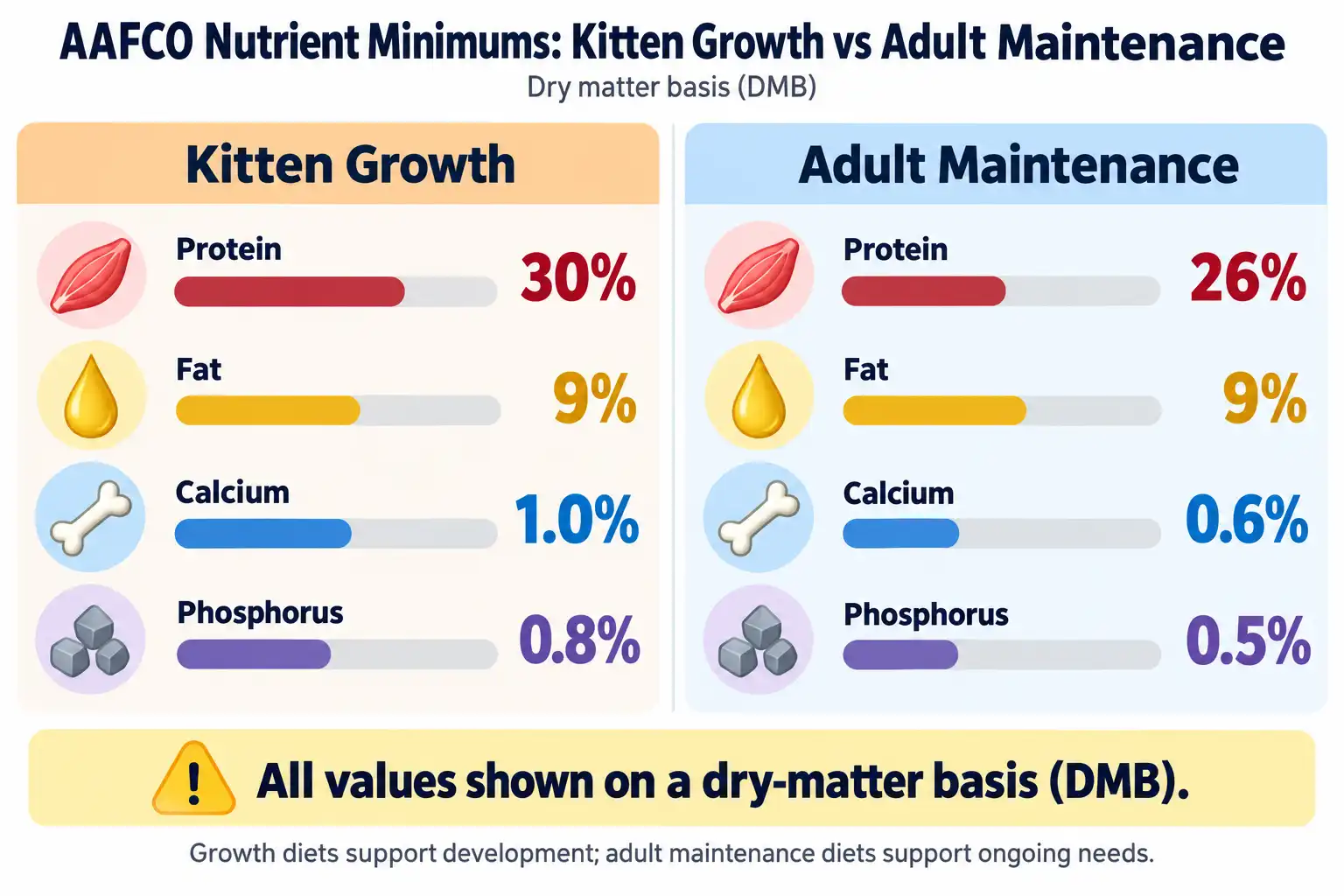
The difference is not simply that every kitten formula contains more of everything.
Some nutrients have higher growth minimums, while others have identical minimums. Actual calorie density and nutrient concentrations vary between products.
Why Does Kitten Dry Food Need More Protein?
Growing kittens need protein to build and maintain developing body tissues. AAFCO sets a minimum crude protein concentration of 30% dry matter for growth formulas, compared with 26% for adult maintenance formulas.
However, these are minimum formulation standards, not ideal protein targets for every individual cat.
A particular adult formula may contain more protein than a particular kitten formula. That does not automatically make the adult product appropriate for growth.
Protein quality, essential amino acids, nutrient availability, and the complete formula also matter.
For example, lysine and arginine have higher AAFCO minimums for growing kittens than for adult cats. These amino acids contribute to normal protein metabolism and tissue development.
Therefore, a high protein percentage cannot replace an appropriate growth-stage nutritional adequacy statement.
You can learn more about these nutrient differences through the site’s cat protein nutrition section.
Are Kitten Dry Foods Always Higher in Fat and Calories?
No. Kitten dry food is not required to have a higher crude fat percentage than adult dry food. AAFCO specifies a 9% dry-matter minimum crude fat concentration for both growing kittens and adult cats.
However, growth formulas also have a minimum for combined EPA and DHA fatty acids that adult maintenance formulas do not have.
Calories are a separate consideration. A growing kitten generally needs more calories per pound of body weight than an adult cat because growth requires additional energy.
According to the AAHA/AAFP feline life-stage guidelines, a growing kitten at 10 weeks may require approximately 200 kcal/kg body weight daily, compared with approximately 80 kcal/kg daily at 10 months. These are age-specific reference figures, not individual feeding prescriptions.
Many kitten formulas are calorie-dense, but this is not universal.
Compare the actual kcal/cup and kcal/kg figures on the packages. The word “kitten” does not establish how many calories each cup contains.
Why Are Calcium and Phosphorus Different?
Calcium and phosphorus support normal skeletal development, making their balance particularly relevant during kitten growth. AAFCO establishes higher minimum concentrations of both minerals for kitten growth formulas than for adult maintenance formulas.
However, more calcium or phosphorus is not automatically better.
The overall formulation must provide appropriate quantities and proportions of nutrients. Adding calcium supplements to adult dry food does not turn it into a balanced kitten diet. It may instead disrupt the nutritional balance.
As the Cornell Feline Health Center explains, additional supplements are generally unnecessary when cats receive complete and balanced food. Supplements can also cause harm without veterinary guidance.
For a healthy growing kitten, choose an established growth formula rather than trying to modify an adult formula.
How Can You Tell Whether Dry Food Is Suitable for a Kitten?
Check the nutritional adequacy statement on the package. This statement is more useful than product names, pictures, or claims about premium ingredients.
The FDA’s complete-and-balanced guidance explains that manufacturers can establish nutritional adequacy through AAFCO nutrient profiles or AAFCO feeding trials.
| Label statement | Suitable for |
|---|---|
| Growth or growth and reproduction | Growing kittens |
| Adult maintenance | Adult cats |
| All life stages | Growing kittens and adult cats |
| Intermittent or supplemental feeding | Not a complete daily diet |
A food labeled “all life stages” must substantiate nutritional adequacy for growth, not just adult maintenance.
The statement may say the food is formulated to meet AAFCO nutrient profiles or that feeding tests substantiate its nutritional adequacy. These describe different ways of supporting the claim. AAFCO sets standards but does not individually approve or certify cat food products.
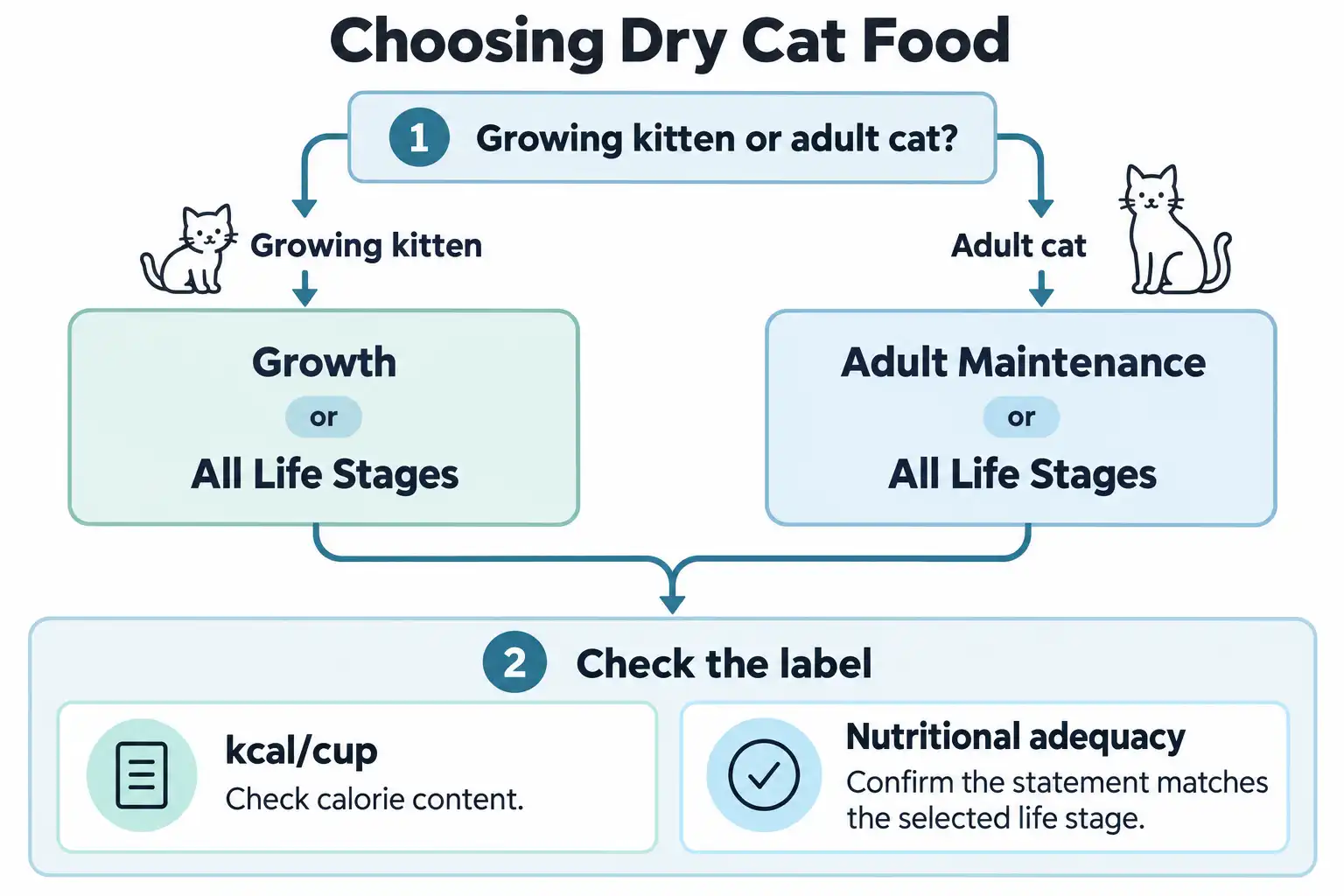
For more label terminology, see the cat-food labeling section.
Does the Guaranteed Analysis Tell the Whole Story?
No. The guaranteed analysis provides useful nutrient information, but it cannot establish complete nutritional suitability by itself. Most US dry cat food labels show protein and fat as minimum percentages. Moisture and crude fiber are generally shown as maximum percentages.
These are presented on an as-fed basis. AAFCO nutrient-profile percentages are commonly expressed on a dry-matter basis. To estimate dry-matter protein:
Dry-matter protein % = protein % ÷ (100 – moisture %) × 100
For example, if a hypothetical adult dry food actually contains 36% protein and 10% moisture:
36 ÷ 90 × 100 = 40% protein on a dry-matter basis.
However, guaranteed minimums and maximums do not reveal exact nutrient concentrations. Even an adult food with 40% dry-matter protein is not necessarily complete for kitten growth. For accurate comparisons, request typical nutrient analyses from manufacturers.
The WSAVA nutrition guidelines also emphasize manufacturer expertise, nutritional quality control, and evidence supporting product formulation. Ingredient lists alone do not establish nutritional quality.
Is Kitten Kibble Always Smaller Than Adult Kibble?
No. Kibble size and shape are product characteristics, not fixed nutritional standards. Some kitten formulas use smaller pieces to accommodate smaller mouths. However, adult dry foods can also contain small pieces.
Similarly, larger kibble does not automatically mean a product is formulated for adult cats.
Check the individual product rather than relying on appearance.
If your kitten struggles to chew, drops food, or shows discomfort while eating, contact a veterinarian. Meal frequency also changes with age.
According to Cornell’s feeding-frequency guidance, growing kittens under six months generally do well with three meals daily. Kittens from six to twelve months generally do well with two meals daily.
Healthy adult cats can often maintain a schedule of one or two measured meals per day.
Individual needs and veterinary guidance may change these routines.
How Much Dry Food Does a Kitten Need Compared With an Adult Cat?
Use calorie needs and the energy density of the specific food, not equal cup measurements. The AAHA 2021 nutrition guidelines provide this resting energy requirement formula:
RER = 70 × (body weight in kg)^0.75
Convert pounds to kilograms by dividing by 2.2046. Estimated daily calories are then calculated by multiplying RER by an appropriate life-stage factor.
AAHA provides a growth factor of 2.5 for growing kittens and a range of 1.2 to 1.4 for neutered adult cats. Indoor activity, neuter status, age, and body condition can affect actual requirements.
Example: A Growing Kitten and a Neutered Indoor Adult
| Example | Starting calories | Hypothetical food | Daily cups | Daily grams |
|---|---|---|---|---|
| Growing 4 lb indoor kitten | 274 kcal | 450 kcal/cup, 4,500 kcal/kg | 0.61 | 61 g |
| Neutered 10 lb indoor adult cat | 261 kcal | 380 kcal/cup, 3,800 kcal/kg | 0.69 | 69 g |
These are illustrative calculations using the AAHA growth factor of 2.5 for the kitten and 1.2 for the neutered adult. The food calorie densities are hypothetical, not typical values for either category.
To calculate daily portions:
Cups/day = daily kcal ÷ kcal/cup
Grams/day = daily kcal ÷ (kcal/kg ÷ 1,000)
Using those hypothetical foods, a 4 lb bag would last approximately 30 days for the growing kitten and 26 days for the neutered indoor adult cat.
Bag feeding charts are starting estimates. Adjust portions according to growth, body condition, activity, and veterinary advice.
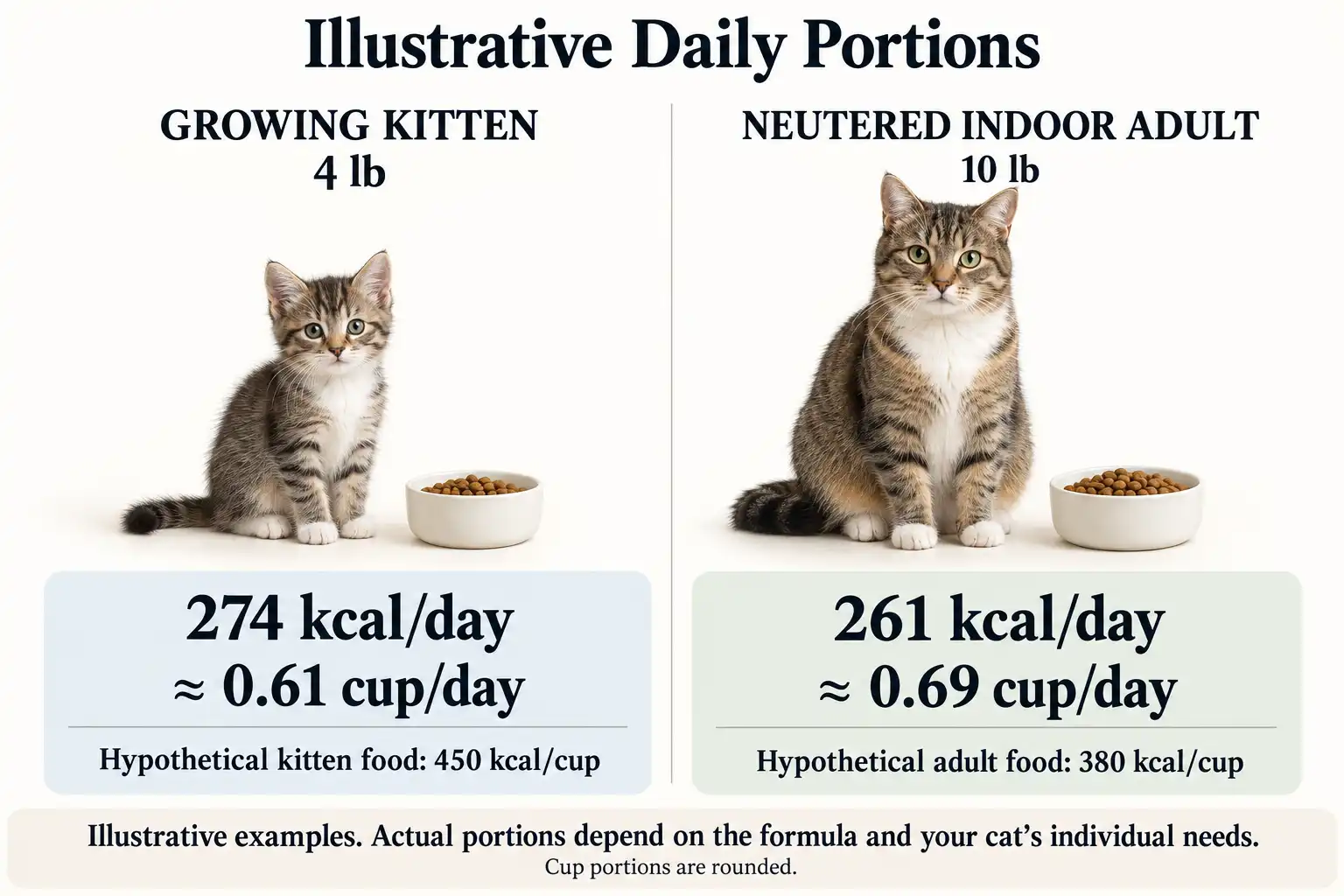
The site’s daily food calculator can help organize portion calculations.
When Should You Switch From Kitten to Adult Dry Food?
Most healthy cats can transition around 12 months of age. According to AAHA’s age-specific nutrition guidance, kittens should receive food appropriate for growth until skeletal maturity, typically around one year.
However, the timing should reflect the individual cat. Consider growth, body condition, overall health, and veterinary guidance.
Does Neutering Mean You Should Switch Earlier?
Not automatically. Neutering can change calorie requirements and increase the risk of weight gain. However, a growing kitten still needs appropriate growth nutrition.
Instead of switching immediately to adult-maintenance food, discuss calorie adjustments and body condition with your veterinarian.
The decision to change formulas should depend on maturity and nutritional needs, not neuter status alone.
How Do You Transition From Kitten Dry Food to Adult Dry Food?
Introduce the new food gradually once your kitten is ready for adult maintenance. The AAHA/AAFP feline life-stage guidelines support transitions over approximately 7 to 10 days. A possible 10-day schedule is:
| Days | Previous kitten food | New adult food |
|---|---|---|
| 1 to 3 | 75% | 25% |
| 4 to 6 | 50% | 50% |
| 7 to 9 | 25% | 75% |
| 10 | 0% | 100% |
The percentages represent shares of the daily food allowance. Recalculate calories because the two products may have different energy densities.
If mild digestive changes appear, contact your veterinarian about slowing the transition. Keep offering food your cat will eat rather than withholding meals to force acceptance.
Seek same-day veterinary care if your kitten or adult cat stops eating, vomits repeatedly, strains to urinate without producing urine, develops breathing trouble, or becomes suddenly weak.
Your cat should continue receiving adequate nutrition throughout the change.
Can a Kitten Eat Adult Dry Food?
Adult-maintenance-only dry food should not serve as a growing kitten’s regular complete diet. It may meet maintenance requirements without establishing that it provides the nutrients needed for growth. A small accidental amount is generally not the same concern as feeding an unsuitable formula every day.
However, prolonged feeding of adult-maintenance-only food can leave gaps in growth-stage nutrition.
An adult product labeled complete and balanced for all life stages is different. It is intended to meet growth requirements as well.
If your kitten has been eating adult-maintenance-only food regularly, ask your veterinarian about an appropriate nutritional plan.
Can Adult Cats Eat Kitten Dry Food?
Adult cats can sometimes eat kitten dry food, but it is not automatically the best long-term choice. The main concern for a healthy adult is whether the formula and portion match their needs. Some kitten foods contain more calories per cup. An adult cat receiving the same cup amount could therefore consume excess calories.
However, higher calorie density is not guaranteed, so check the package rather than assuming.
Adult cats with medical conditions may need specific veterinary-selected diets.
There is also an important exception: pregnant and nursing adult cats have different nutritional requirements. AAFCO’s growth and reproduction profile covers those stages.
For households with cats of different ages, an appropriate all-life-stages food may simplify feeding. Separate measured portions still help prevent overeating and food stealing.
Can You Mix Kitten Wet Food With Adult Dry Food?
A growing kitten’s main diet should provide complete and balanced growth-stage nutrition, whether served wet, dry, or as a combination. If wet and dry foods both contribute substantial calories, choose products suitable for growth or all life stages.
Adult-maintenance-only food should not replace a significant part of a growing kitten’s balanced diet. When combining foods, count the calories from both.
For example, subtract the wet food’s calories from the kitten’s daily calorie target before calculating the dry portion.
Keep fresh drinking water available. See the site’s wet and dry feeding section for related feeding considerations.
What Should You Check Before Choosing Kitten or Adult Dry Food?
Start with the nutritional adequacy statement. Then compare the factors that can affect feeding.
- Life stage: Confirm growth, adult maintenance, or all-life-stages suitability.
- Calorie density: Find both kcal/cup and kcal/kg when available.
- Nutrient information: Compare protein and fat on a consistent basis, and request typical analyses if necessary.
- Ingredients: Check ingredient information without treating the first ingredient as proof of overall quality.
- Manufacturer standards: Look for qualified nutritional expertise, quality-control procedures, and credible formulation information, consistent with WSAVA guidance.
- Kibble characteristics: Consider piece size, texture, and whether your cat can comfortably eat the food.
A suitable formula should match the cat’s life stage and support appropriate body condition.
FAQs about Kitten Food vs Adult Cat Food
Can I Feed My 6-Month-Old Kitten Adult Dry Food?
Adult-maintenance-only dry food is not appropriate as the regular diet for a growing 6-month-old kitten. Choose complete and balanced growth or all-life-stages food because growth continues even after the kitten looks nearly adult-sized.
Is All-Life-Stages Dry Food as Good as Kitten Food?
An all-life-stages food can meet a growing kitten’s nutritional needs when its adequacy claim covers growth. However, that designation does not guarantee a particular kibble size or calorie density, so check feeding directions and your kitten’s condition.
Can I Use High-Protein Adult Dry Food Instead of Kitten Food?
High protein alone does not establish complete growth nutrition. Even an adult formula containing more than the kitten protein minimum may lack appropriate concentrations of other nutrients, so check its nutritional adequacy statement.
Can I Keep Feeding Kitten Food After 12 Months?
A healthy adult cat may tolerate kitten food after 12 months, but its nutritional and calorie needs should guide the choice. Review portions and body condition with your veterinarian before continuing a growth formula long term.
Does Smaller Kibble Mean the Food Is Better for Kittens?
No. Smaller kibble may be easier for some kittens to handle, but piece size does not establish nutritional adequacy. Prioritize a complete growth-stage formula and choose a texture your kitten can comfortably eat.
Should I Change to Adult Dry Food Immediately After Neutering?
Not necessarily. A neutered kitten may need calorie adjustments while still requiring growth-stage nutrition. Monitor growth and body condition, and ask your veterinarian whether the current feeding amount should change.
Can I Feed the Same Dry Food to a Kitten and an Adult Cat?
Yes, if the food is complete and balanced for all life stages and suits both cats’ individual needs. Measure portions separately because growing kittens and adult cats can have very different calorie requirements.
What Matters Most When Choosing the Right Formula?
Kitten and adult dry foods are designed for different nutritional stages.
The most meaningful differences involve growth-stage nutrient standards, especially protein, calcium, phosphorus, and certain fatty acids. Fat minimums are identical, while actual calories and kibble sizes vary by product.
Choose by nutritional adequacy first, calculate portions using the specific food’s calories, and transition when your cat reaches maturity.