How Many Cups of Dry Food Does a Cat Need by Weight
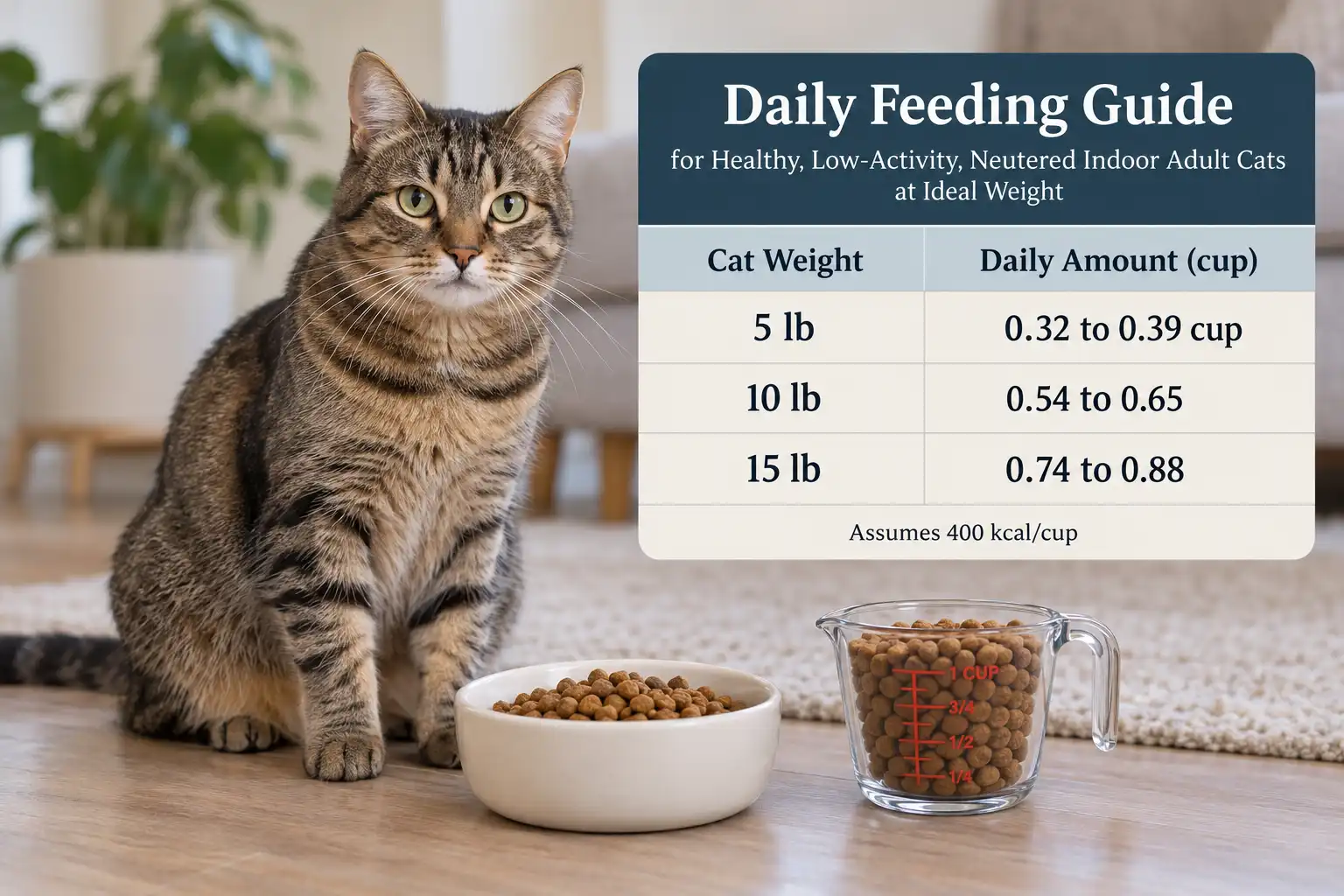
How many cups of dry food a cat needs by weight depends on ideal body weight, life stage, activity, and calories per cup. Use the daily chart below as a starting estimate, then calculate a portion for your specific dry food.
For a healthy, low-activity, neutered indoor adult cat at an ideal 10 lb, about 0.54 to 0.65 cup daily is a starting estimate at 400 kcal/cup. Check your food’s calorie label and your cat’s body condition.
If your cat stops eating, repeatedly vomits, or suddenly becomes weak, contact a veterinarian the same day. Cornell Feline Health Center warns that appetite loss in cats can become serious quickly.
How many cups of dry food should an adult cat eat by weight?
For a healthy, low-activity, neutered indoor adult cat at ideal weight, these daily estimates assume dry food containing 400 kcal/cup.
The American Animal Hospital Association (AAHA) lists a factor of 1.0 for inactive adult cats. It lists 1.2 to 1.4 for neutered adult cats. This table uses 1.0 to 1.2 for lower activity, not weight loss.
| Ideal adult cat weight | Adult cat calories per day | Adult cat dry food per day at 400 kcal/cup |
|---|---|---|
| 5 lb | 129 to 155 kcal | 0.32 to 0.39 cup |
| 7 lb | 167 to 200 kcal | 0.42 to 0.50 cup |
| 8 lb | 184 to 221 kcal | 0.46 to 0.55 cup |
| 10 lb | 218 to 261 kcal | 0.54 to 0.65 cup |
| 12 lb | 249 to 299 kcal | 0.62 to 0.75 cup |
| 15 lb | 295 to 354 kcal | 0.74 to 0.88 cup |
| 18 lb | 338 to 406 kcal | 0.85 to 1.01 cups |
| 20 lb | 366 to 439 kcal | 0.91 to 1.10 cups |
Use the 18 and 20 lb rows only when that is a healthy adult cat’s ideal weight. Otherwise, ask your veterinarian.
WSAVA’s healthy-adult chart gives 240 to 270 kcal/day near 10 lb (9.9 lb) for an ideal-condition adult cat. The lower-activity 10 lb estimate above is 218 to 261 kcal/day. The assumptions differ, so do not average the ranges.
Why can two dry foods require different cup amounts?
Calories per cup determine the portion size. The same adult cat may need noticeably different volumes of two dry foods, even at the same body weight. Tufts Cummings School of Veterinary Medicine explains that dry cat food calorie density varies widely.
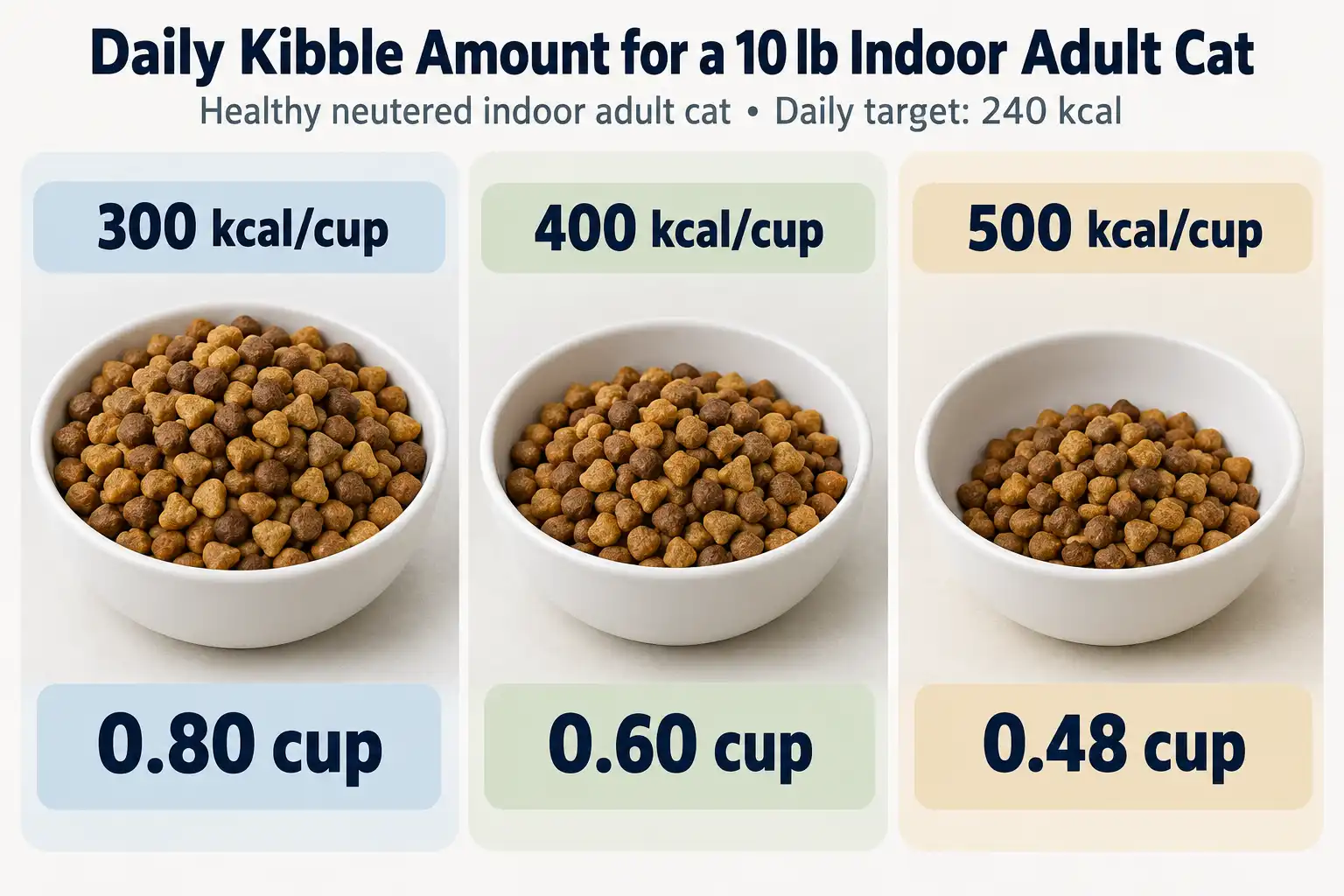
For this healthy, low-activity adult cat with an illustrative target of 240 kcal/day, the portions are:
| Example food calories | Adult cat dry food needed daily |
|---|---|
| 300 kcal/cup | 0.80 cup |
| 400 kcal/cup | 0.60 cup |
| 500 kcal/cup | 0.48 cup |
These are sample label values, not calorie claims about a particular product. A cup estimate only works once you know your food’s actual energy density.
How do you calculate your cat’s daily cups from the bag?
Start with a daily calorie target, then divide by your food’s calories per cup.
- Confirm life stage and ideal weight. The chart fits healthy adult cats in suitable body condition. Ask your veterinarian if uncertain.
- Read the calorie statement. Find kcal/cup and kcal/kg under Calorie Content, as explained by AAFCO. An adult cat’s main food should be complete and balanced for adult maintenance or all life stages.
- Convert calories to food. For a healthy adult cat, cups/day = daily kcal ÷ kcal/cup; grams/day = daily kcal ÷ (kcal/kg ÷ 1,000).
Worked example: A healthy 10 lb indoor adult cat
For a healthy neutered indoor adult cat at an ideal 10 lb, 10 ÷ 2.2046 = 4.54 kg. AAHA’s equation, RER = 70 × (kg ^ 0.75), gives about 218 kcal/day at rest for this adult cat. Using factors of 1.0 to 1.2 gives about 218 to 261 kcal/day as a lower-activity starting estimate.
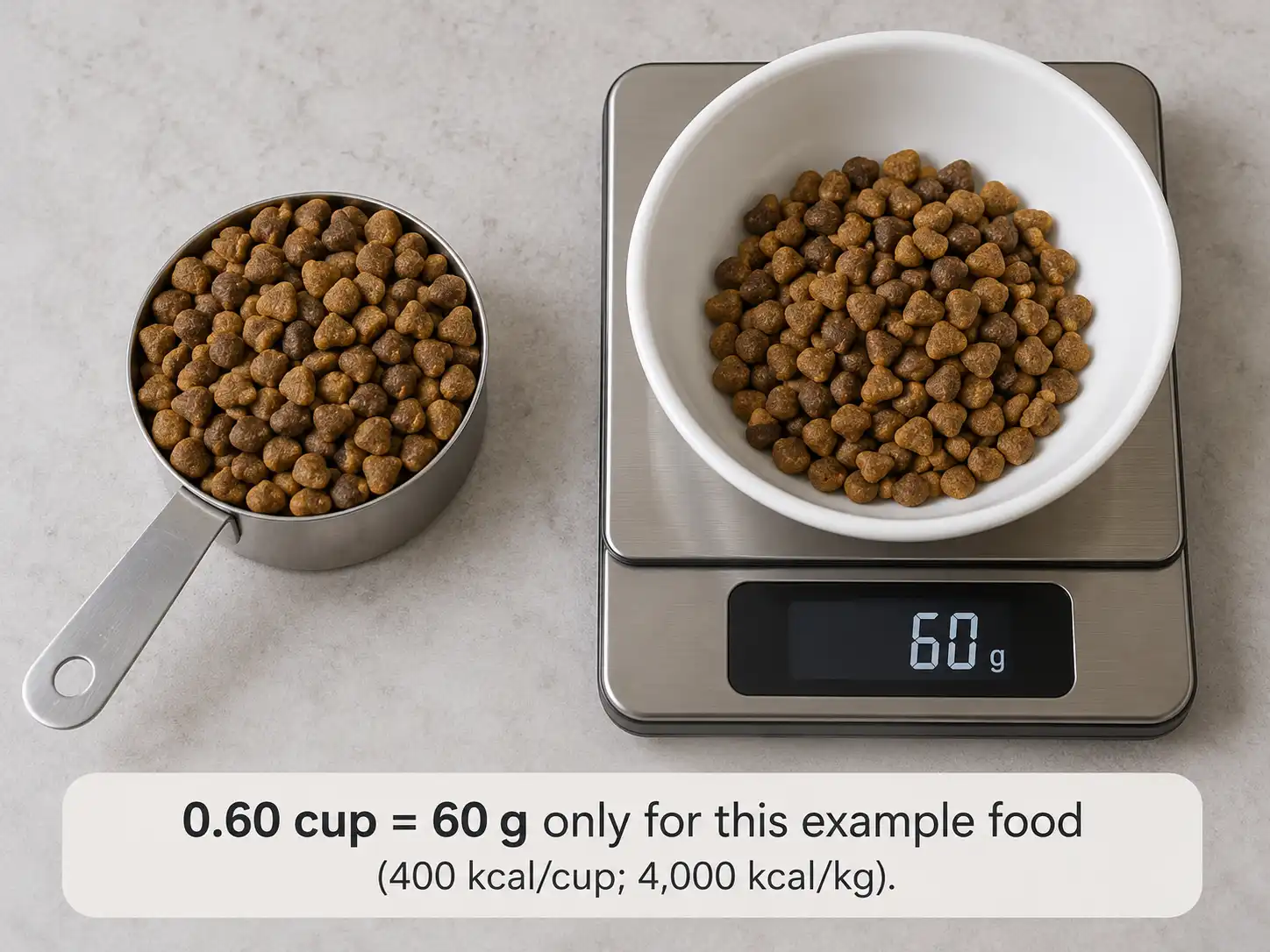
Choose 240 kcal/day as an illustrative target for that same adult cat. If its food provides 400 kcal/cup and 4,000 kcal/kg, the result is 240 ÷ 400 = 0.60 cup/day, or 240 ÷ 4 = 60 g/day.
For that adult cat eating only this dry food, a 5 lb bag would last about 38 days: (5 ÷ 2.2046) × 4,000 ÷ 240 = 37.8 days. You can also enter your food’s label values in the daily food calculator.
Is a measuring cup or kitchen scale more accurate?
A kitchen scale is usually more consistent, especially for small dry-food portions. Tufts’ guidance on weighing food explains that heaped scoops and differing kibble shapes can make cup measurements unreliable.
If using cups, choose a standard 8-fluid-oz US measuring cup and level the kibble. Fluid ounces measure volume; they do not mean that one cup of dry cat food weighs 8 oz.
For the adult cat in the worked example, 60 g/day becomes two meals of 30 g each. Tare the empty bowl on the scale first. If you use an automatic feeder, weigh what it actually dispenses instead of trusting a generic portion setting.
Do kittens, seniors, and active cats need different portions?
Yes. The adult weight chart does not apply unchanged to every life stage or activity level.
Kittens, pregnant cats, and nursing cats
Growing kittens need different calories and nutrient concentrations from adult cats. AAHA’s kitten guidance shows that energy requirements change quickly during growth. Use kitten feeding information and complete food labeled for growth or all life stages, not the adult table. Pregnant or nursing cats also need individualized feeding guidance.
Senior, active, and outdoor adult cats
A healthy senior cat does not automatically need less food. AAHA’s senior-cat guidance notes that some older cats need more calories because body condition or digestibility changes. Active adult cats, including those with substantial outdoor activity, may need more than the low-activity chart suggests.
Adult cats above or below their ideal weight
A feeding chart based on present weight can overestimate the appropriate amount for an overweight adult cat. Check healthy body condition and weight with your veterinarian before choosing a target. Do not use skipped meals, fasting, or sharp food cuts for weight loss. Cornell describes the serious liver risks associated with inadequate food intake.
How many cups if your cat also eats wet food or treats?
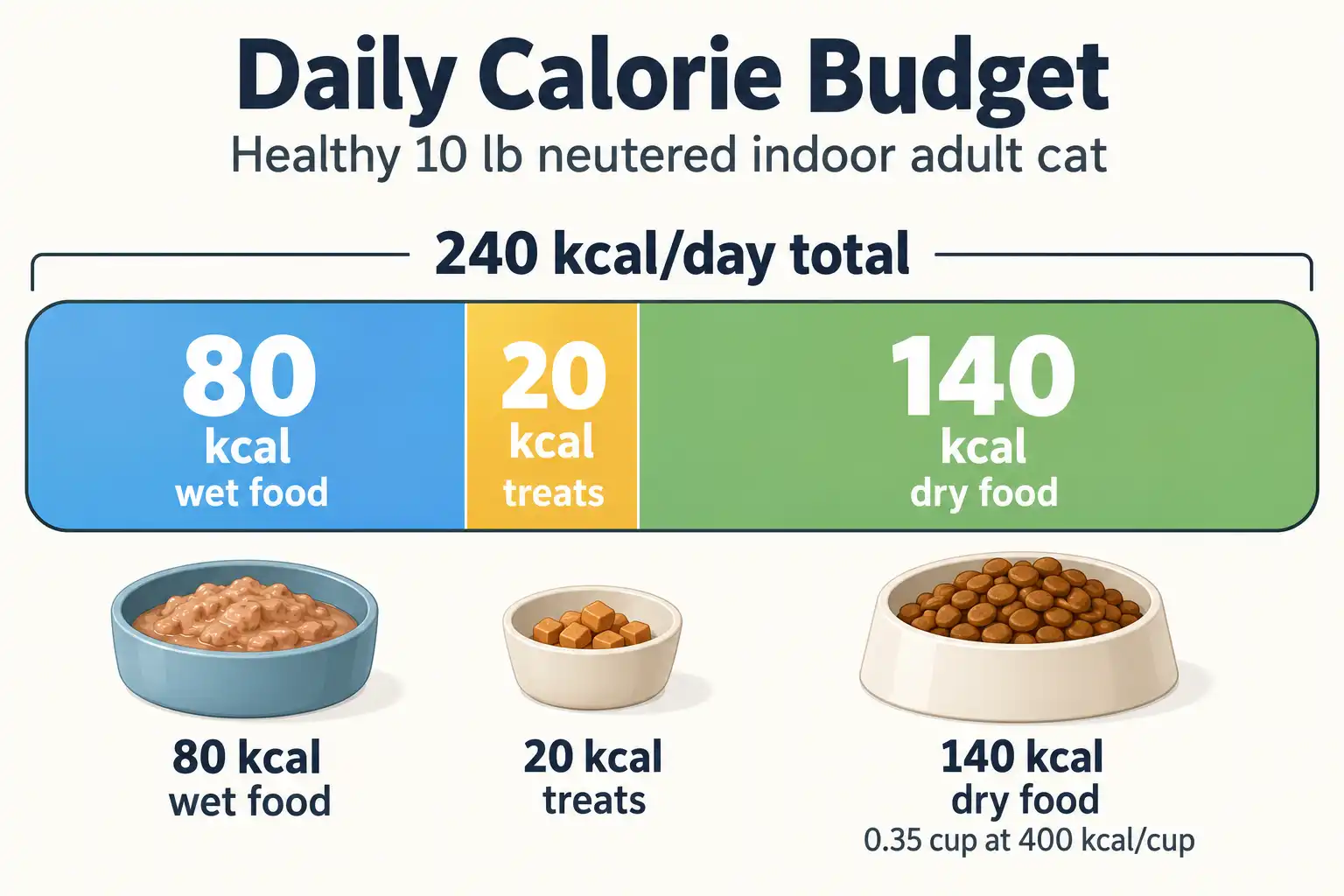
Subtract wet food and treat calories before measuring dry food. When you combine wet and dry meals, a full portion of each can exceed the daily target.
For a healthy, low-activity, neutered indoor adult cat at an ideal 10 lb, consider a 240 kcal/day target. One wet serving provides 80 kcal, and treats provide 20 kcal for that adult cat. This leaves 140 kcal for dry food. At 400 kcal/cup, the adult cat receives 0.35 cup of dry food daily.
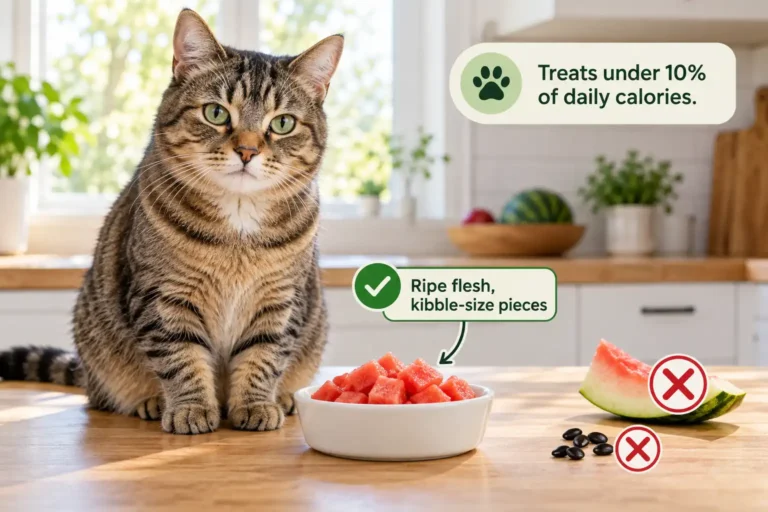
Count treats, toppers, and shared food. AAHA flags nutritionally incomplete extras above 10% of an adult cat’s calories as a risk. Keep those extras limited.
How can you tell whether the daily portion is right?
Check weight trends and body condition, not just an empty bowl. The WSAVA body-condition resources explain how to assess fat coverage and waist shape. For healthy adult cats, a body-condition score near 4 to 5 out of 9 is generally the target.
Weigh your adult cat regularly under similar conditions. If weight rises, check scoops, treats, other cats’ bowls, and automatic feeder output before making changes. If weight falls without an intended feeding change, arrange a veterinary assessment. Unexplained weight changes are not a reason to guess at calories.
What if the bag’s feeding guide disagrees with the chart?
Use both as starting information, then check the actual calorie intake. Package charts must cover many adult cats, so they cannot account fully for individual activity or body condition. Tufts’ feeding-direction discussion explains why label directions may differ from calculated needs.
If the amount seems wrong, verify kcal/cup, scoop size, treats, and whether another cat shares the food. When changing kibble, gradually introduce the new product instead of switching suddenly. Tufts’ transition example shows a one-week changeover while adjusting amounts for different calorie densities.
If your cat refuses food, do not wait for hunger to force acceptance. Contact your veterinarian promptly, with same-day attention if your cat is not eating.
FAQs about Cat Dry Food Cups by Weight
Is half a cup of dry food enough for a 10 lb cat?
It can be enough for a healthy, low-activity, neutered indoor adult cat at its ideal 10 lb, depending on the food. Half a cup at 500 kcal/cup supplies 250 kcal for that adult cat.
How many cups should a 12 lb cat eat?
For a healthy, low-activity, neutered indoor adult cat at an ideal 12 lb, the example chart estimates 0.62 to 0.75 cup daily at 400 kcal/cup. Adjust for actual food and body condition.
Is one cup of dry food too much for a cat?
It can be for a healthy, low-activity, neutered indoor adult cat with an ideal 10 lb weight, especially with calorie-dense kibble. Larger or more active adult cats may require different amounts.
Should I use my cat’s current weight or ideal weight?
For a healthy adult cat already at a good body condition, current weight is a reasonable starting point. If the cat is overweight or underweight, ask a veterinarian to establish a suitable target before changing portions.
Does an indoor cat need less food than an outdoor cat?
Often, but activity matters more than the indoor label alone. A healthy indoor adult cat that plays intensely may need more than a sedentary outdoor adult cat at the same ideal weight.
How many times a day should I feed the measured portion?
The calculated amount covers the entire day, not each meal. For a healthy adult cat, split it across two or more measured feedings, including any dry food dispensed by an automatic feeder.
Can I use the same cup amount when changing dry food?
Not unless both foods provide the same calories per cup. Recalculate cups for your healthy adult cat using the new label, then introduce the new food gradually rather than replacing the entire portion immediately.
A useful dry food portion starts with your cat’s ideal weight, a food-specific calorie statement, and accurate measurement. Keep checking body condition and ask your veterinarian to review meaningful changes in weight or appetite.