
Reading a Cat Food Label: A Panel-by-Panel Guide
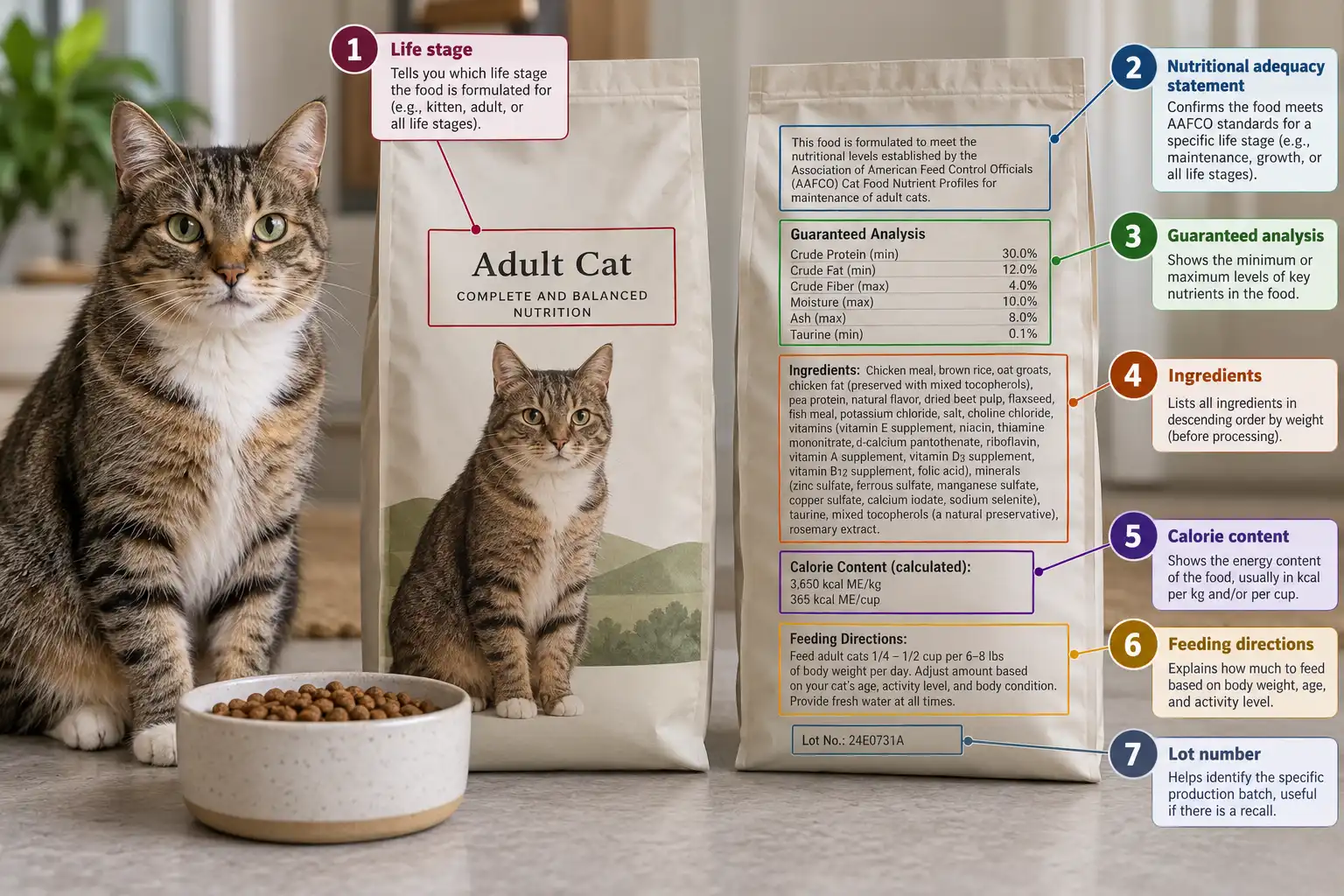
Reading a cat food label becomes easier when you know which information matters most. Each panel serves a different purpose, from identifying nutritional adequacy to explaining calories and ingredients. This guide shows you how to interpret those details and compare foods more accurately.
When reading a cat food label, check the AAFCO nutritional adequacy statement and life stage first. Next, compare calories per cup, guaranteed analysis, ingredient list, and feeding directions. Treat front-of-bag claims as secondary.
If your cat has a medical condition, suspected food allergy, or unexplained appetite changes, consult your veterinarian before selecting a diet.
Panel 1: What Does the Front of a Cat Food Bag Tell You?
The front panel identifies the food, its intended species, and the quantity inside. It also contains marketing claims that require careful interpretation.
According to the FDA’s animal food labeling requirements, labels must identify the product and state its net quantity.
Start with three details:
- Species: The package must identify the food as intended for cats. Dog food is not a suitable substitute because cats have different nutritional requirements.
- Product description: Terms such as kitten, adult, indoor, and senior describe the intended buyer or use. Confirm the actual nutritional life stage elsewhere on the package.
- Net weight: The bag’s weight tells you how much food it contains, not how much your cat should eat.
Does “Chicken Cat Food” Mean the Same Thing as “With Chicken”?
No. Under AAFCO’s product-naming rules, different phrases indicate different ingredient proportions.
| Example product wording | Meaning |
|---|---|
| Chicken Cat Food | Chicken makes up at least 95% by weight, excluding added processing water, and at least 70% including it |
| Chicken Dinner for Cats | Chicken makes up at least 25% excluding processing water, and at least 10% including it |
| Cat Food With Chicken | Chicken makes up at least 3% of the food |
| Chicken Flavor Cat Food | The flavor must be detectable, but no fixed chicken percentage is required |
These rules describe naming, not overall nutritional quality. A food containing more chicken is not automatically better balanced.
Panel 2: Where Is the Nutritional Adequacy Statement?
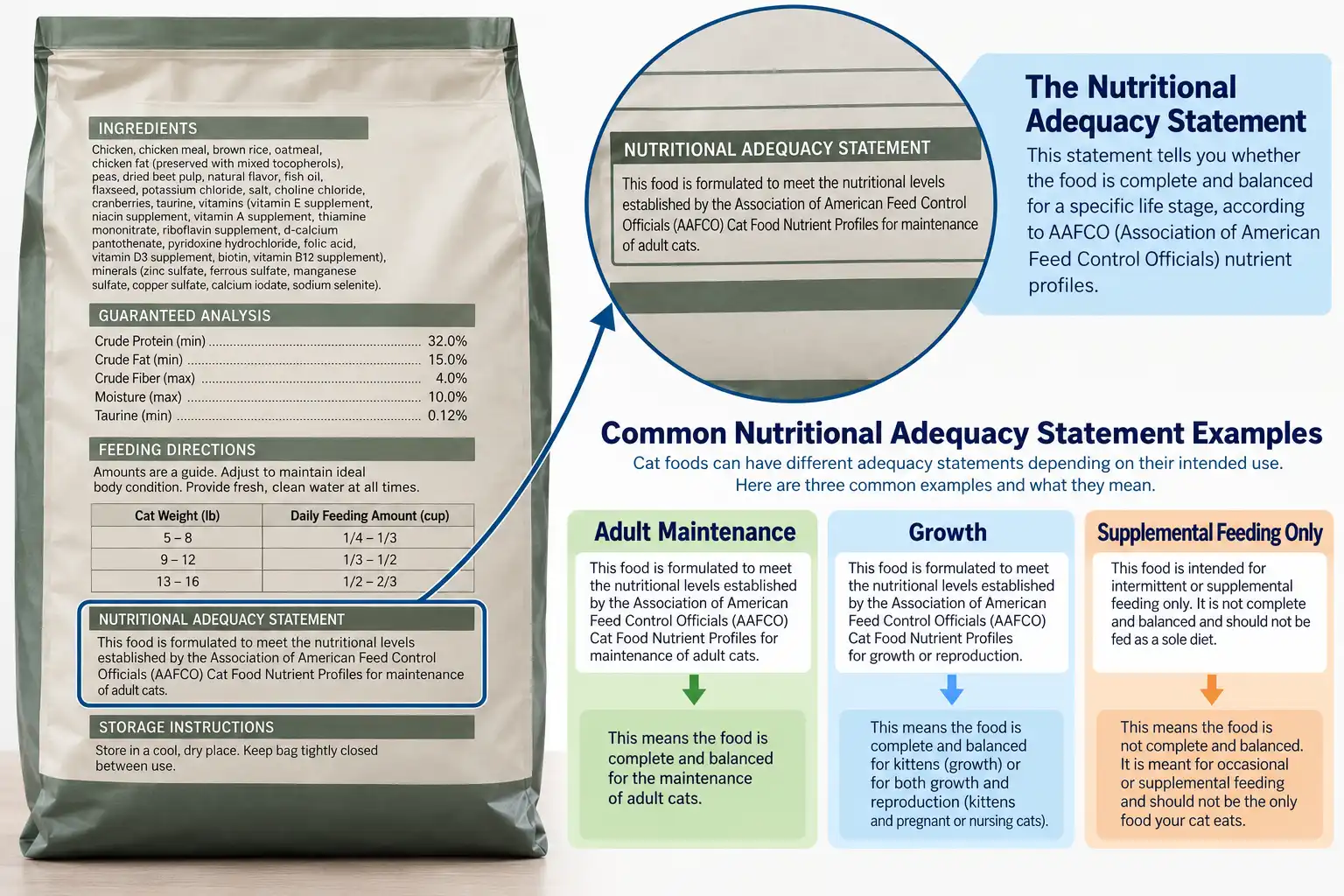
The nutritional adequacy statement is one of the most useful parts of a cat food label. It tells you whether the food is intended to provide complete nutrition and for which life stage.
On traditional packaging, this statement often appears in small print near the ingredients or guaranteed analysis. Newer labels may place it inside a Pet Nutrition Facts box.
A typical statement might read:
“Example Adult Dry Cat Food is formulated to meet the nutritional levels established by the AAFCO Cat Food Nutrient Profiles for adult maintenance.”
This is an illustrative statement. The actual product name and nutritional adequacy wording vary by food.
Look for these terms:
| Statement | What it means |
|---|---|
| Adult maintenance | Complete nutrition for healthy adult cats |
| Growth | Complete nutrition for growing kittens |
| Gestation/lactation | Nutrition intended for pregnant or nursing cats |
| All life stages | Meets requirements for growth and reproduction as well as adult maintenance |
| Intermittent or supplemental feeding only | Not intended as the sole complete diet |
AAFCO does not establish a separate senior-cat nutrient profile. Therefore, a “senior” product still needs an appropriate nutritional adequacy statement.
Formulated to Meet vs. Animal Feeding Tests
Both are recognized ways to substantiate nutritional adequacy, but they are different.
Formulated to meet indicates that the diet meets applicable nutrient-profile requirements through formulation and nutrient assessment.
Animal feeding tests using AAFCO procedures indicates that a standardized feeding trial supports the nutritional adequacy claim.
Neither statement means AAFCO personally tested, certified, or endorsed the product. Feeding trials also cannot guarantee performance for every individual cat.
Panel 3: What Does the Guaranteed Analysis Actually Mean?
The guaranteed analysis provides minimum or maximum amounts of selected nutrients. It does not show the exact nutrient composition of the finished food.
Traditional cat food labels commonly include:
| Nutrient | Type of guarantee | What to understand |
|---|---|---|
| Crude protein | Minimum | Actual protein may be higher |
| Crude fat | Minimum | Actual fat may be higher |
| Crude fiber | Maximum | Actual crude fiber may be lower |
| Moisture | Maximum | Actual moisture may be lower |
The term crude refers to the laboratory measurement method. It does not describe poor-quality protein, fat, or fiber.
For an illustrative adult-maintenance dry cat food, a 32% minimum protein guarantee means the actual protein content must not fall below that declared minimum.
AAFCO’s traditional Cat Food Nutrient Profiles specify a minimum of 26% protein on a dry-matter basis for adult maintenance cats and 30% for kitten growth and reproduction diets. These are minimum nutrient-profile requirements, not ideal targets for every individual cat.
Protein percentages alone cannot reveal amino acid availability, digestibility, or overall diet quality.
Likewise, a fat guarantee does not directly reveal how many calories a serving provides.
You may also see taurine, calcium, phosphorus, or fatty acids listed. Their presence depends partly on the label format and any additional nutrient claims.
For more meaningful comparisons, ask manufacturers for typical nutrient analyses rather than relying only on guaranteed limits.
How Can You Compare Protein in Dry and Wet Cat Food?
Compare protein on a dry-matter basis when foods have different moisture levels.
Guaranteed analysis percentages generally describe food as sold, including its water content. This is called the as-fed basis.
Dry-matter calculations remove water from the comparison.
Formula:
Dry-matter nutrient % = (As-fed nutrient % ÷ [100 – moisture %]) × 100
Consider these hypothetical adult-maintenance cat foods using typical measured nutrient values, not guaranteed minimums.
| Adult cat food | Protein as fed | Moisture | Protein on dry-matter basis |
|---|---|---|---|
| Dry food | 32% | 10% | 35.6% |
| Wet food | 10% | 78% | 45.5% |
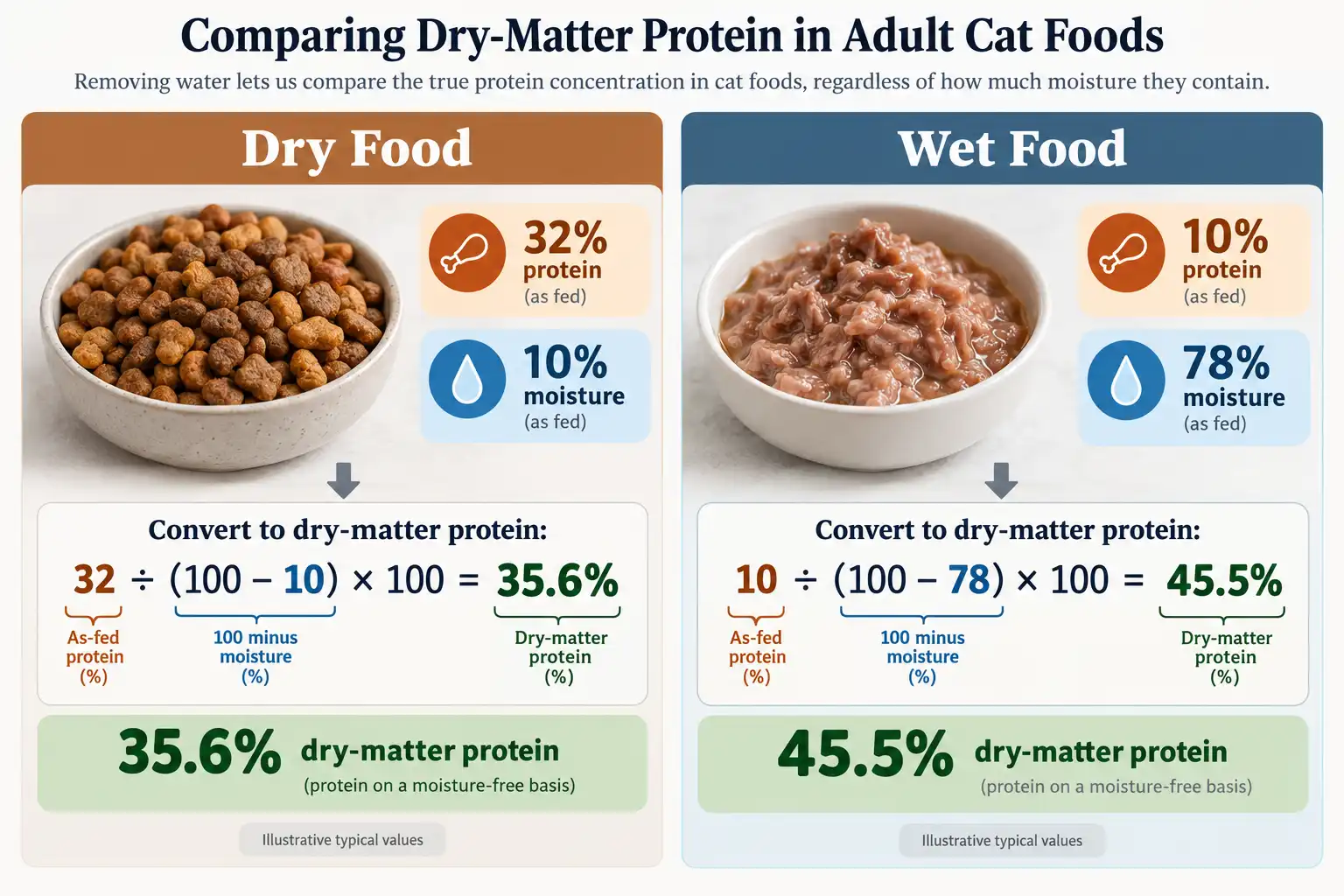
For the illustrated adult dry food, the calculation is 32 ÷ 90 × 100 = 35.6% dry-matter protein.
For the illustrated adult wet food, the calculation is 10 ÷ 22 × 100 = 45.5% dry-matter protein.
Therefore, a lower as-fed protein percentage does not necessarily mean less protein after accounting for moisture.
However, guaranteed minimums and maximums are not exact typical values. Calculations using those limits only provide estimates. Nutrients per calorie can also be useful when comparing different foods.
Panel 4: What Does the Ingredient List Reveal?
The ingredient list identifies what goes into the food, ordered by weight before processing. Under FDA labeling rules, the ingredient with the greatest weight appears first.
However, that order does not indicate how much nutrition each ingredient contributes after cooking.
For example:
- Chicken: Contains naturally occurring moisture, which contributes to its original weight.
- Chicken meal: Has already undergone processing that removes much of its water and fat, making it more concentrated by weight.
- Poultry by-product meal: Can supply valuable nutrients, depending on its composition and processing.
- Corn, rice, peas, and potatoes: May provide starch, energy, or other nutrients used in dry food formulations.
An ingredient appearing first does not establish that it supplies most of the finished food’s protein.
Similarly, splitting ingredients into components such as pea protein, pea starch, and pea fiber can affect their positions in the list.
The Tufts Cummings School of Veterinary Medicine explains that ingredient lists do not establish ingredient quality or whether the finished diet contains nutrients in appropriate amounts.
Read the list to identify ingredient sources and potential dietary restrictions. Use the adequacy statement and manufacturer information to assess the complete diet.
For suspected food allergies, a veterinarian should guide dietary assessment. Ingredient lists alone cannot confirm an allergy or establish a suitable elimination diet.
Panel 5: What Do the Calorie Figures Mean?
The calorie statement tells you how much energy the food supplies. On traditional labels, look for a heading such as “Calorie Content.” Dry cat food commonly displays two measurements:
kcal/cup: Calories in a standard measuring cup of food.
kcal/kg: Calories in 1 kilogram of food as sold.
A kilocalorie (kcal) is the same dietary calorie unit used in human nutrition.
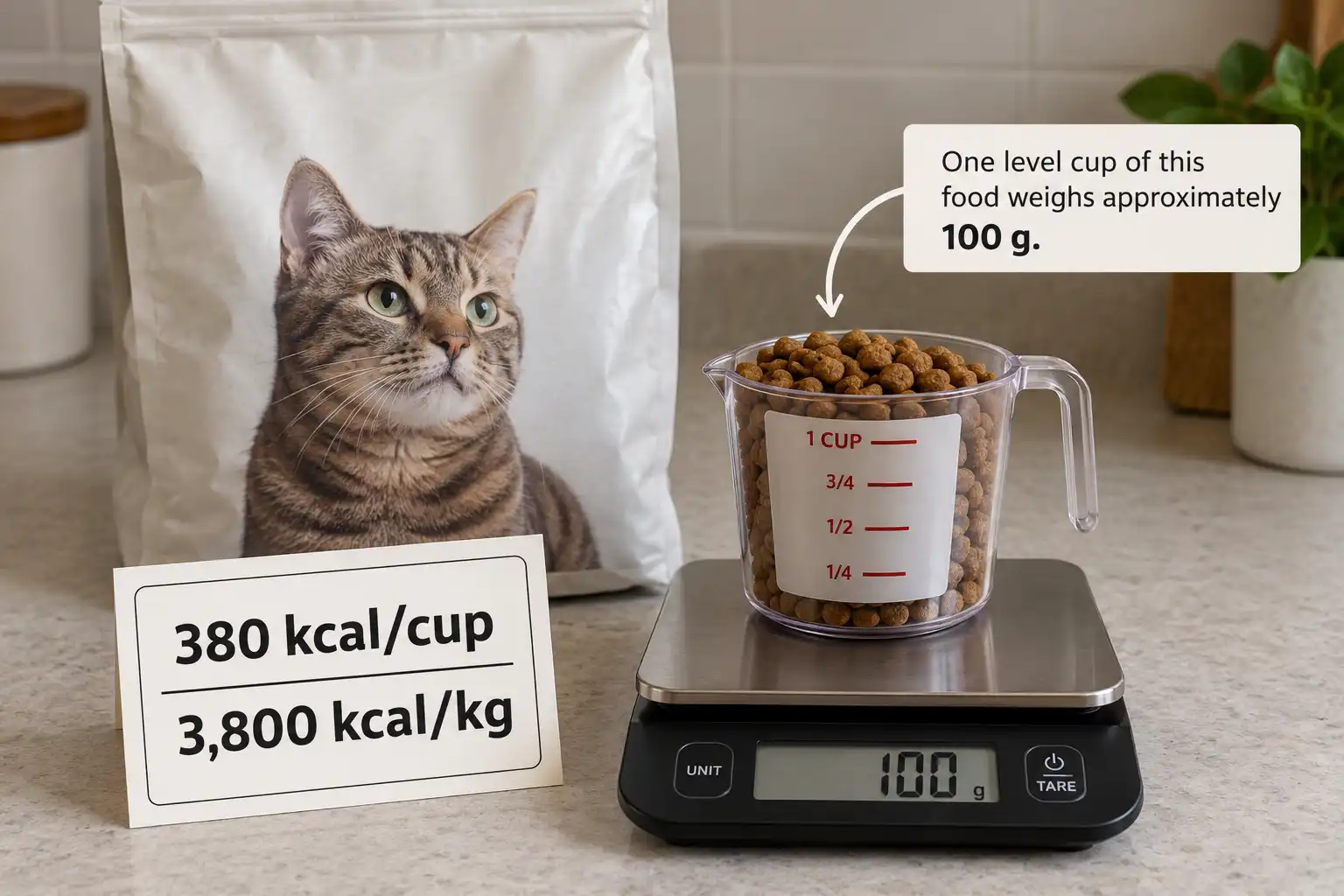
For an illustrative adult-maintenance dry cat food containing 380 kcal/cup and 3,800 kcal/kg, the figures indicate that a standard cup holds approximately 100 g of that particular kibble.
The two measurements serve different purposes.
Use kcal/cup for converting calorie targets into household portions. Use kcal/kg for weight-based portions and estimating how long a bag lasts.
AAFCO allows calorie content to be substantiated through calculation or recognized feeding procedures. Labels identify the method.
Neither method guarantees that the food is best for a particular cat.
How Do You Calculate Daily Portions From the Label?
Use the food’s calorie density with an appropriate daily calorie starting point. Then adjust portions according to your cat’s body condition and veterinary guidance.
The 2021 AAHA Nutrition and Weight Management Guidelines provide this resting energy requirement formula:
RER = 70 × body weight in kg^0.75
Weight in kg = weight in lb ÷ 2.2046
Worked Example: A Healthy Indoor Adult Cat
Consider a healthy, inactive, neutered indoor adult cat weighing 10 lb, equivalent to approximately 4.54 kg.
For this inactive adult cat, the estimated resting energy requirement is:
70 × 4.54^0.75 = approximately 218 kcal/day.
Using AAHA’s 1.0 factor for an inactive adult cat gives a starting maintenance estimate of approximately 218 kcal/day. Other adult cats may require different factors.
For this adult cat, using hypothetical food containing 380 kcal/cup:
218 ÷ 380 = 0.57 cup/day.
For the same adult cat, using food containing 3,800 kcal/kg:
218 ÷ 3.8 = 57 g/day, or approximately 2 oz.
A 4 lb bag of this adult cat food contains approximately 6,900 kcal. At the example intake of 218 kcal/day, that bag would last about 32 days.
These calculations illustrate the method. They are not individual feeding prescriptions.
Monitor body weight and body condition. Your veterinarian can help determine whether the starting amount is appropriate.
Panel 6: How Should You Use Feeding Directions?
Feeding directions provide a starting amount based on the intended life stage and body weight.
A bag might show feeding quantities in cups per day, sometimes divided by weight ranges.
However, individual calorie needs vary with age, neuter status, activity, body condition, and health.
The AAHA feline life-stage guidelines support adjusting feeding plans to individual cats rather than treating package amounts as fixed requirements.
Use these directions carefully:
- Find the recommendation for your cat’s life stage and weight.
- Check the calorie content of the suggested amount.
- Include calories from wet food, dry food, treats, and supplements used as snacks.
- Measure the portion and monitor body condition.
- Review unexpected weight changes with your veterinarian.
For healthy cats, the WSAVA guidance on treats advises keeping treats below 10% of daily calories.
If you change foods, compare calories rather than replacing equal scoop volumes. The AAHA feline guidelines describe gradual transitions over 7 to 10 days.
Do not withhold food to make a reluctant cat accept a replacement.
Panel 7: Why Do Manufacturer Details and Lot Numbers Matter?
The manufacturer or distributor information identifies the business responsible for the product. U.S. labels must provide the responsible company’s name and business address.
You may see wording such as “Manufactured by,” “Manufactured for,” or “Distributed by.”
These phrases describe different business relationships. A distributor’s name does not necessarily identify the manufacturing facility.
Look for contact information so you can ask about nutrient analysis, formulation, and quality control.
What Is the Lot Number?
A lot number identifies a particular production batch. It often appears near the best-by date or on a bag’s bottom, side, or sealed edge.
The FDA explains that lot codes help identify affected batches during investigations and recalls. A lot code is not universally mandatory, although most manufacturers use one.
The best-by date relates to product quality and shelf life. It does not replace a lot number.
Follow the FDA’s lot-number guidance by retaining the original package or photographing its identifying information.
Also check handling and storage instructions. Keeping dry food in its original bag, preferably inside a clean storage container, helps preserve identification details.
Panel 8: Which Cat Food Marketing Claims Need Closer Inspection?
Marketing language can describe a feature without proving superior nutrition.
Common examples include:
| Package claim | What to check |
|---|---|
| Grain-free | Identifies the absence of grain ingredients, not necessarily a low carbohydrate content |
| High protein | Check the actual nutrient data and life-stage adequacy |
| Natural | Has specific labeling criteria but does not prove better nutrition |
| Premium or holistic | Does not establish nutritional superiority |
| Indoor formula | Check calories, nutrient adequacy, and your cat’s body condition |
| Senior formula | Confirm adequacy because AAFCO has no separate senior nutrient profile |
| Light or low-calorie | Check actual calories and applicable AAFCO claim requirements |
| Urinary support | Evaluate the precise claim and discuss urinary health concerns with a veterinarian |
Grain-free foods are not necessarily carbohydrate-free. They may contain starches from potatoes, peas, or other ingredients.
There is insufficient evidence to conclude that grain-free food is generally healthier for cats.
Similarly, a claim such as “vet recommended” should not replace an assessment of nutritional adequacy or manufacturing practices.
The FDA reviews certain disease-related and urinary-health claims.
Cats with kidney, urinary, gastrointestinal, or other conditions may need veterinary-selected therapeutic diets. Do not substitute a retail marketing claim for a veterinary nutrition plan.
Why Do Some Cat Food Labels Look Different?
AAFCO approved revised model labeling regulations in 2023 through its Pet Food Label Modernization initiative.
States adopt these changes through their own regulatory processes. Therefore, older and newer label layouts can appear during the transition.
The changes make nutritional details easier to locate and compare.
| Traditional label | Newer AAFCO model format |
|---|---|
| Guaranteed Analysis | Pet Nutrition Facts |
| Crude fiber guarantee | Dietary fiber guarantee |
| Carbohydrate amount often absent | Calculated total carbohydrate maximum |
| Separate calorie statement | Calories integrated into the nutrition box |
| Nutritional adequacy may appear elsewhere | Adequacy statement inside the nutrition box |
| Intended life stage may require searching | Intended-use information on the front panel |
The new Pet Nutrition Facts layout also includes serving weight in grams and a breakdown of calories from protein, fat, and carbohydrate.
These details improve transparency but do not make the guaranteed nutrient figures exact measured averages.
You can review the changes through AAFCO’s Pet Food Label Modernization resources.
What Information Can a Cat Food Label Not Tell You?
A label cannot establish everything about the food’s nutritional quality.
It generally does not provide complete information about digestibility, ingredient sourcing, manufacturing controls, or the expertise behind formulation.
The WSAVA Global Nutrition Committee recommends evaluating the manufacturer as well as the label.
Useful questions to ask include:
- Who formulates the food, and what are their nutrition qualifications?
- Does the manufacturer employ qualified nutrition specialists?
- What finished-product testing and quality-control procedures are used?
- Can the company provide a typical nutrient analysis, preferably including nutrient amounts per calorie?
- Has the food undergone AAFCO feeding trials, or was its adequacy substantiated through nutrient profiles?
Clear, specific answers can help you compare manufacturers more meaningfully.
The ingredient list, a protein percentage, or a marketing slogan cannot replace this information.
When Is Reading the Label Not Enough?
A cat food label cannot explain why a cat is losing weight, refusing meals, vomiting, or developing urinary symptoms.
These situations call for veterinary assessment rather than repeated food changes.
Seek immediate veterinary help for breathing difficulty or straining to urinate with little or no output. Refusal to eat, repeated vomiting, or sudden weakness also requires same-day veterinary attention.
The Cornell Feline Health Center explains that appetite loss can accompany serious illness, including hepatic lipidosis.
Never use skipped meals or prolonged food refusal as a weight-management strategy. Significant weight loss requires a veterinarian-led feeding plan.
FAQs on Reading Cat Food Labels
How do I know whether a cat food is complete and balanced?
Look for an AAFCO nutritional adequacy statement identifying the intended life stage and the method used to substantiate adequacy. A front-panel claim such as “complete nutrition” should not replace that specific information.
Does AAFCO approve or certify individual cat food brands?
No, AAFCO establishes model standards and nutritional profiles but does not personally approve or certify individual cat foods. Manufacturers and relevant regulatory authorities are responsible for ensuring that products comply with applicable requirements.
Can I judge cat food quality by the first ingredient?
No, the first ingredient only represents the ingredient with the greatest weight before processing. It does not establish digestibility, protein quality, nutritional balance, or the finished food’s complete nutrient composition.
Why does my cat food’s guaranteed protein differ from its website analysis?
The guaranteed protein percentage usually states a minimum, while a manufacturer’s typical analysis may report an average. Those figures serve different purposes, so they do not necessarily indicate conflicting or inaccurate nutritional information.
Can I calculate carbohydrates from an older cat food label?
Not reliably from the standard guaranteed analysis alone, because ash is often missing and other figures are minimums or maximums. A meaningful carbohydrate-by-difference estimate needs representative protein, fat, fiber, moisture, and ash values.
Is an all-life-stages cat food always better than adult maintenance food?
No, an all-life-stages food meets nutritional requirements that include kitten growth and reproduction, but it is not automatically preferable for adults. Calorie density and individual nutritional needs still matter when selecting a diet.
What if my cat refuses a food that has a better-looking label?
Do not force a change or allow prolonged food refusal. Use a gradual transition when appropriate, and contact your veterinarian promptly if your cat stops eating, especially when other symptoms are present.
What Matters Most When Reading a Cat Food Label?
A cat food label is most useful when you read its nutritional information before its marketing.
Start with life-stage adequacy. Then examine calorie density, nutrient guarantees, ingredients, and feeding directions. Finally, consider manufacturer transparency and how the food fits your cat’s individual needs.
A well-chosen food is nutritionally appropriate, safely manufactured, accepted by your cat, and fed in an amount that supports a healthy body condition.