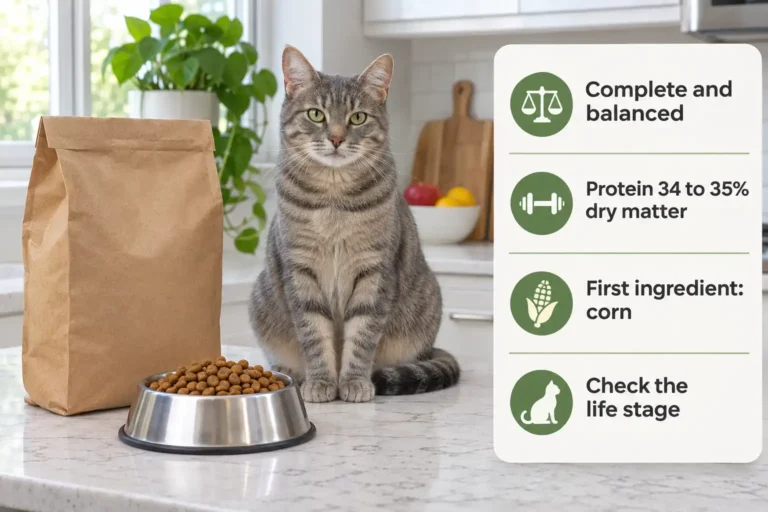
Special Kitty Dry Food: What 6 Label Checks Show
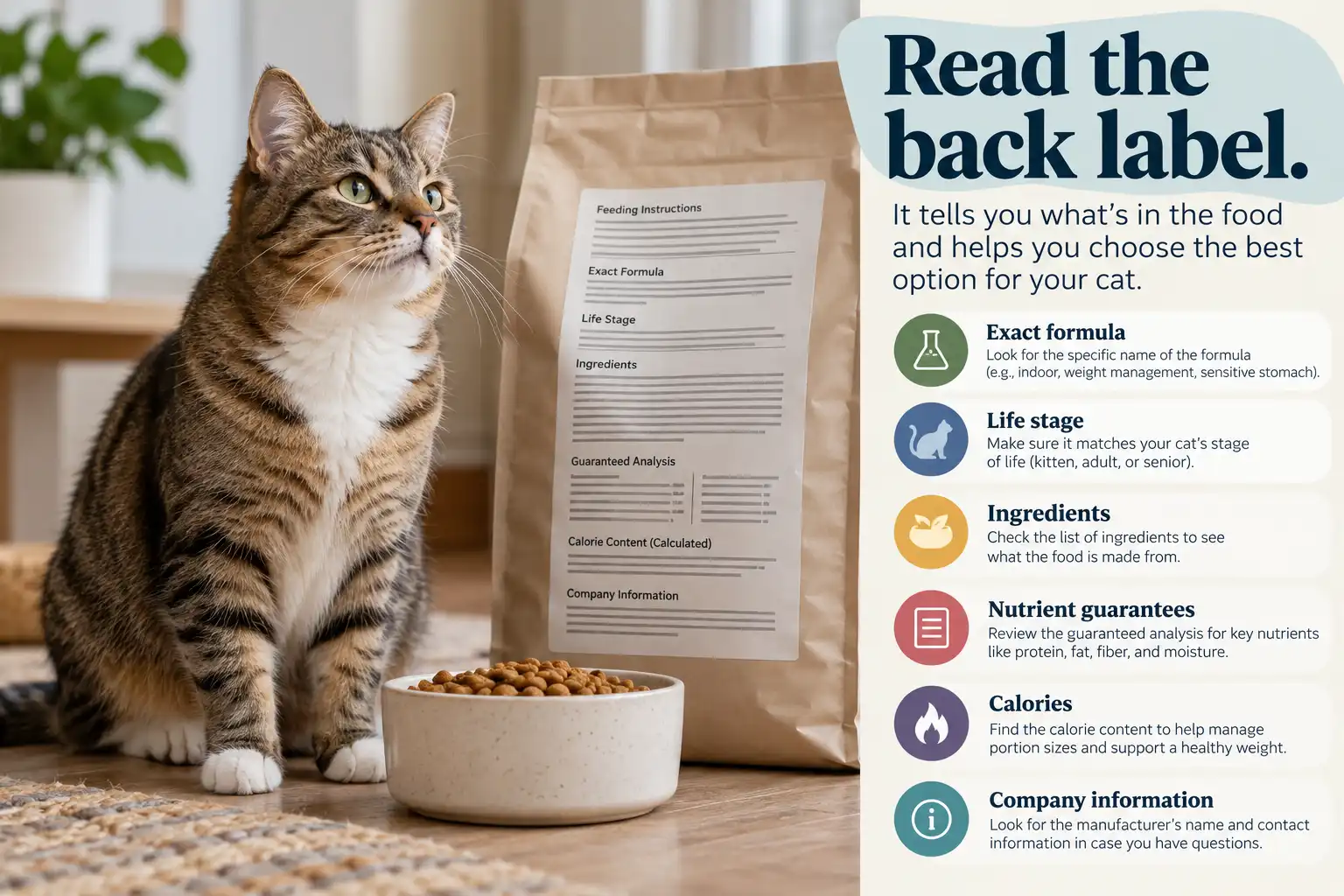
Special Kitty dry food labels reveal more than the flavor name. The useful questions concern life stage, nutritional adequacy, calorie content, and information the package cannot establish. Start with your exact bag, not a brand-wide rating.
Special Kitty dry food varies by recipe and label version. The reviewed adult Indoor label lists corn first, 30% minimum protein, and 338 kcal/cup. Check your bag’s adequacy statement rather than judging the brand alone.
Contact your veterinarian the same day if your cat stops eating or repeatedly vomits. Straining with little or no urine requires emergency care.
1. Which Special Kitty dry food label are you reading?
Read the exact formula and package because similar names can lead to different nutritional information.
Walmart lists Complete Nutrition Chicken & Turkey Flavor for adult cats. However, a separate Complete Nutrition Premium Poultry listing describes an all-life-stages product. Those records should not supply interchangeable feeding instructions.
The Indoor Chicken & Pea Flavor product also has conflicting ingredient images. One displayed panel lists added colors. Another shows a different ingredient list without those colors. These images do not establish when a change occurred or which version matches your bag.
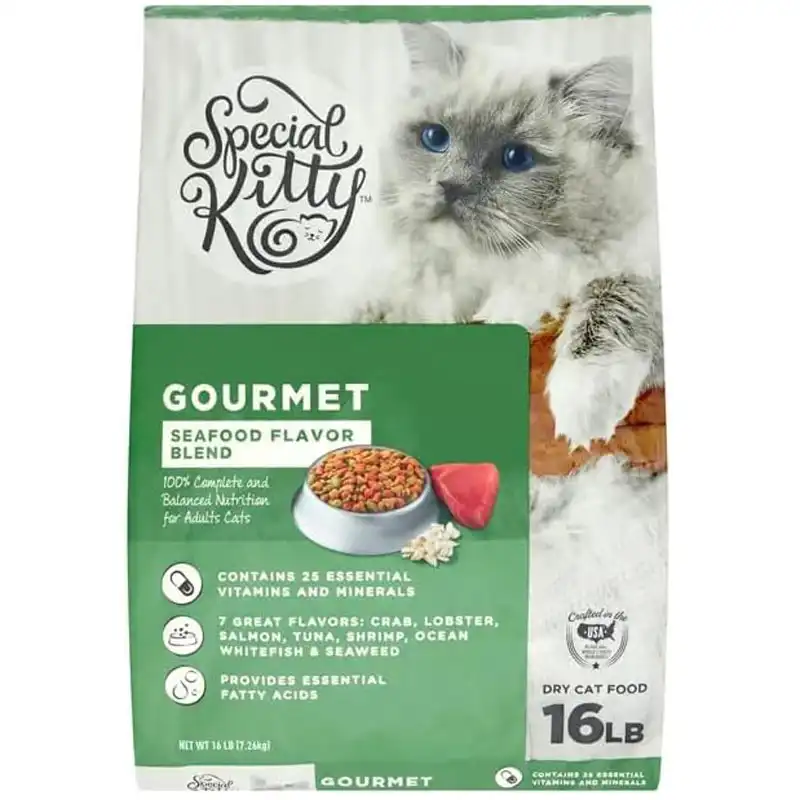
Before using an online analysis, compare the full product name, life-stage statement, ingredients, and calorie statement with your package.
The calculations below use the green Indoor adult-cat label panel displayed by Walmart. They do not describe every Special Kitty recipe.
2. Does the food match your cat’s life stage?
The nutritional adequacy statement should match the cat eating the food.
AAFCO explains that adult maintenance covers adult cats. Food intended for kittens needs a growth or all-life-stages statement. An adult-maintenance food alone is not appropriate for growing kittens or pregnant and nursing cats.
The reviewed Indoor package describes complete and balanced nutrition for adult cats. By contrast, Walmart separately lists a Chicken and Turkey Flavor with Oatmeal food for kittens. Do not transfer nutrient figures between those recipes.
Also, read how the food supports its adequacy claim. A statement based on formulation against nutrient profiles differs from one based on AAFCO feeding-test procedures. The wording identifies the supporting method.
Neither wording means “AAFCO approved.” AAFCO does not approve, certify, or endorse individual foods.
3. What do the ingredients and flavor name tell you?
The ingredient list identifies ingredients, but it does not establish their exact proportions or the food’s digestibility.
The reviewed green Indoor ingredient panel begins with corn, chicken meal, wheat bran, wheat, meat and bone meal, and poultry by-product meal. Peas appear later. Therefore, this adult-cat recipe contains grains and does not list chicken or peas first.
The FDA requires ingredients in descending order by weight. Meanwhile, AAFCO’s flavor rules do not require the named flavor ingredient to make up most of the food. “Chicken & Pea Flavor” is not a meat-percentage statement.
However, by-products do not automatically indicate unsafe or inadequate food. AAFCO recognizes that they can provide useful nutrients. Ingredient names alone cannot establish overall nutritional quality.
The reviewed green panel also lists chicken fat preserved with BHA and BHT. Thus, a “no artificial colors or flavors” claim should not be read as “no preservatives.” Those are different ingredient functions, not interchangeable claims.
4. What does the guaranteed analysis actually guarantee?
It provides nutrient limits, not an exact laboratory profile of every bag.
AAFCO explains that crude protein and crude fat appear as minimums. Crude fiber and moisture appear as maximums. These values describe the food as sold, including its moisture.
The reviewed Special Kitty Indoor adult-cat label displays these figures:
| Item on the adult-cat Indoor label | Printed value | How to read it |
|---|---|---|
| Crude protein | 30.0% minimum | Protein can exceed this amount |
| Crude fat | 9.0% minimum | Fat can exceed this amount |
| Crude fiber | 4.0% maximum | An upper limit, not an exact result |
| Moisture | 8.0% maximum | An upper limit used in label comparisons |
| Calculated energy | 338 kcal/cup; 3,250 kcal/kg | The figures used for portion calculations |
The panel does not reveal digestibility, the share of protein from each ingredient, or batch-testing results. WSAVA therefore advises looking beyond ingredient lists and requesting information about formulation and quality control.
5. How much should you feed using those calories?
Use the calorie statement to calculate a starting portion, then adjust through body-condition assessment. A bag chart cannot account for every cat’s activity and metabolism.
For a healthy, low-activity, neutered indoor adult cat weighing 10 lb, AAHA’s resting-energy formula gives approximately 218 kcal/day:
For this neutered indoor adult cat: 70 × (10 ÷ 2.2046)^0.75 ≈ 218 kcal/day.
AAHA lists an inactive adult-cat factor of 1.0, leaving that estimate unchanged for this example. This factor is not appropriate for every adult cat.
For this neutered indoor adult cat, round the illustrative allowance to 220 kcal/day.
Using the reviewed adult Indoor formula, that neutered indoor adult cat’s dry-only allowance becomes:
220 ÷ 338 ≈ 0.65 cup/day, or 220 ÷ (3,250 ÷ 1,000) ≈ 68 g/day.
Weighing that daily amount makes the example reproducible without relying on a heaped scoop. However, the calculation remains a starting estimate.
Monitor weight and body condition with your veterinarian. Use a veterinarian-led plan for weight loss rather than treating this maintenance example as a weight-loss prescription.
6. Who makes Special Kitty, and what remains unknown?
The reviewed Indoor package identifies Walmart as the distributor. That identifies the company on the label, not necessarily the manufacturing plant.
AAFCO explains that a retailer or brand company may appear as the responsible distributor while another company manufactures the food. Consequently, “distributed by” and “manufactured by” should not be treated as equivalent.
The reviewed label material does not establish the current factory or provide a complete quality-control assessment.
Following WSAVA’s guidance, ask the company who formulates the recipe and what qualifications they hold. Also request manufacturing information, a typical nutrient analysis, and details about nutritional and safety testing. Product-specific research can help answer questions that packaging cannot.
An unanswered question is an information gap, not proof that the food is unsafe. Equally, a complete-and-balanced claim does not answer every question about manufacturing consistency.
Past recall notices naming another company also do not establish who manufactures a current dry-food bag.
How do you compare protein on a dry-matter basis?
Remove moisture mathematically, but keep the limits of guaranteed values visible.
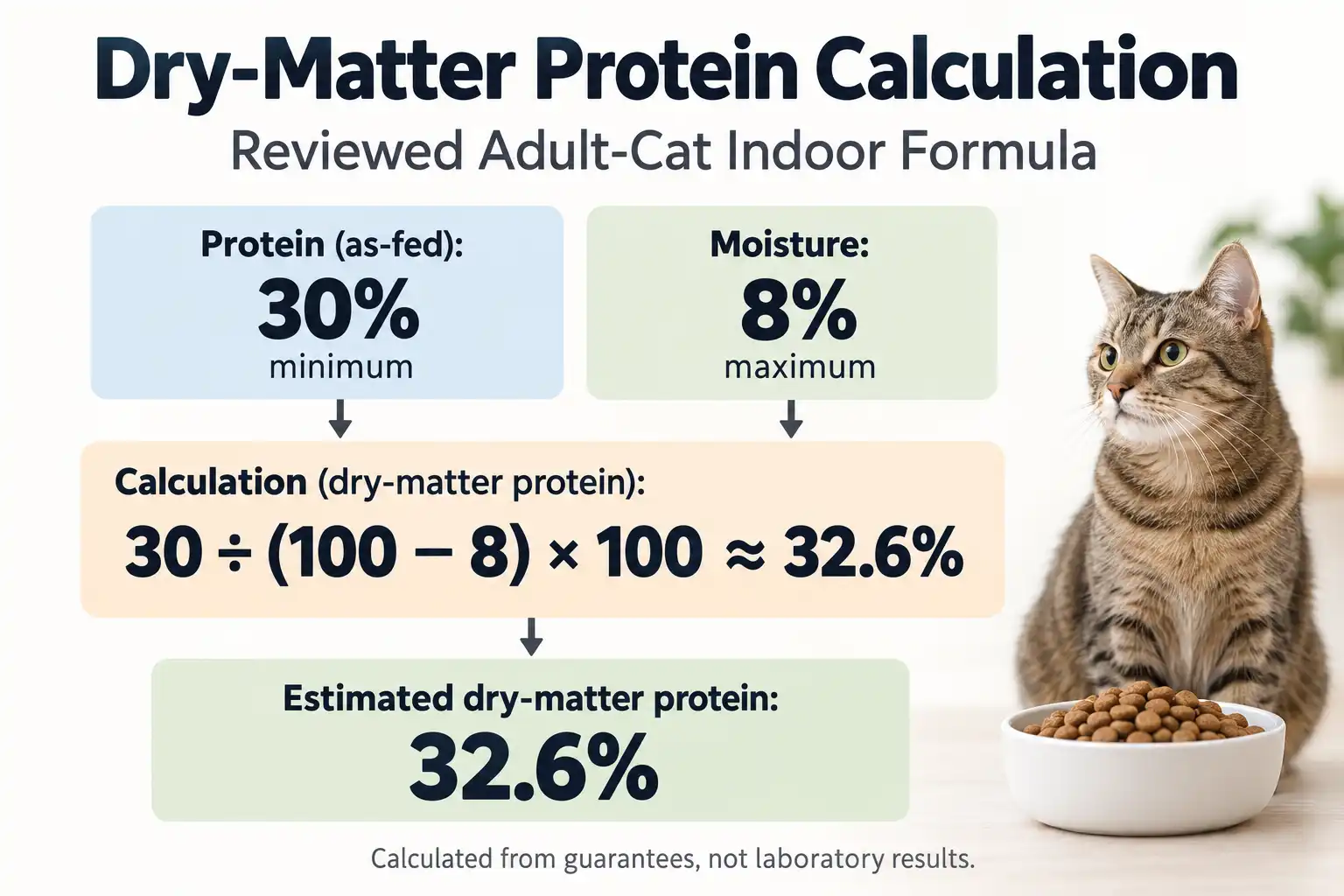
For the reviewed adult-cat Indoor formula, the protein calculation is:
30 ÷ (100 − 8) × 100 ≈ 32.6% protein on a dry-matter basis.
For that adult-cat formula, the equivalent fat calculation is 9 ÷ 92 × 100 ≈ 9.8% dry matter. These are label-based estimates, not measured values or guaranteed dry-matter minimums.
AAFCO’s dry-matter protein minimum is 26% for adult cats and 30% for growing kittens. However, protein alone cannot establish kitten suitability; the complete growth profile must be met.
The displayed label omits ash, so it does not support a reliable carbohydrate-by-difference calculation. Request a typical analysis instead of inserting an assumed ash value.
How do wet food and treats change the dry portion?
Subtract their calories from the daily allowance before calculating the remaining dry food. AAHA includes treats and other foods when assessing total intake.
Suppose a neutered indoor adult cat has an illustrative 220 kcal/day allowance and eats wet food supplying 100 kcal.
That neutered indoor adult cat has 120 kcal remaining, equivalent to approximately 37 g of the reviewed adult Indoor dry food. These are hypothetical mixed-feeding amounts, not a universal ration.
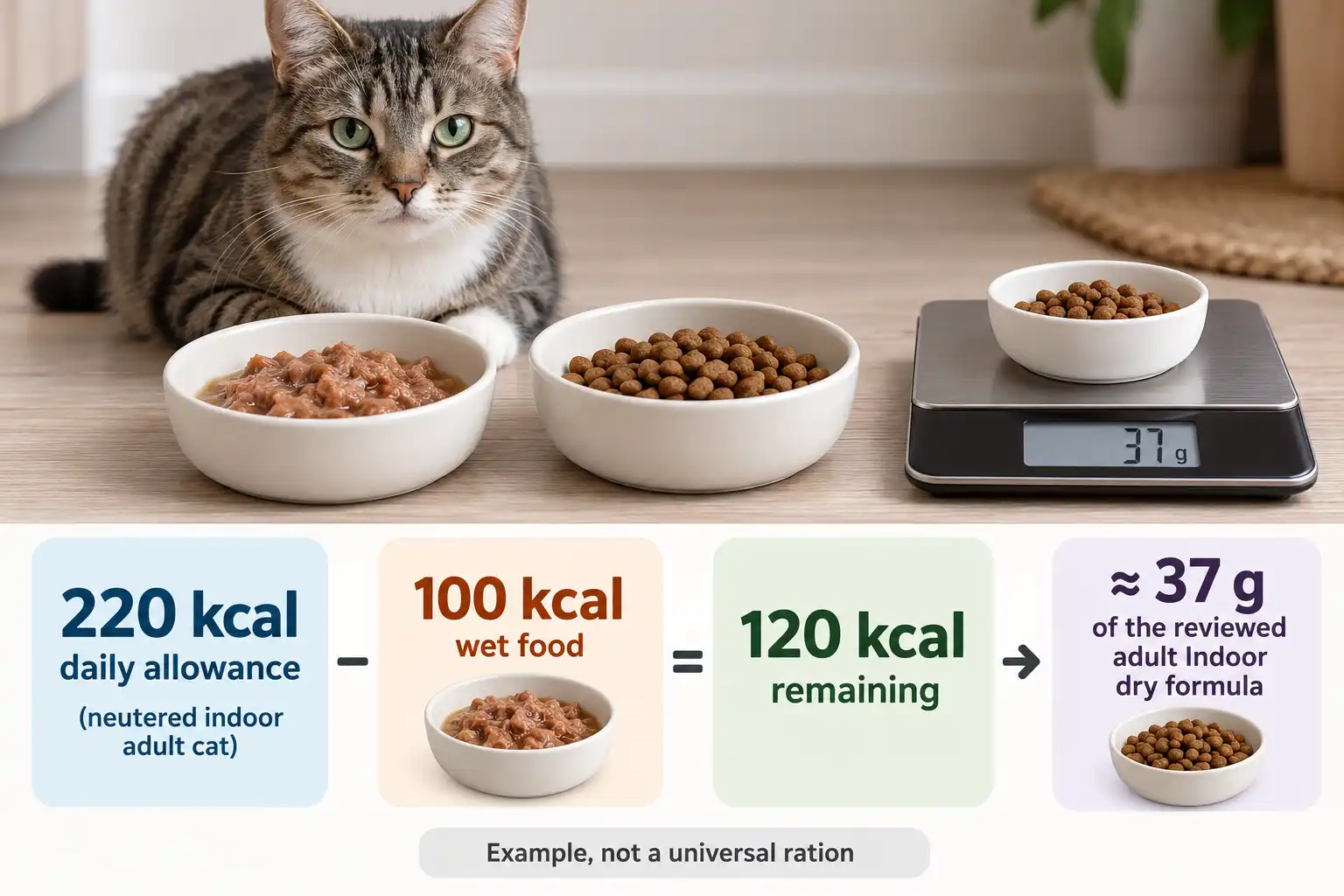
Count calories from treats and supplements too. Do not add a full wet-food allowance to an unchanged dry-food allowance. Also, provide fresh water even when meals include wet food.
How long would a bag last?
Calculate bag duration from its weight, energy density, and the household’s dry-food intake.
For one neutered indoor adult cat eating 220 kcal/day entirely from the reviewed adult Indoor formula, a 16 lb bag lasts approximately 107 days:
For this neutered indoor adult cat: (16 ÷ 2.2046) × 3,250 ÷ 220 ≈ 107 days.
That assumes the entire bag is used, with no waste. Mixed feeding would extend its use because the cat would eat less dry food.
However, bag duration is an inventory estimate, not an opened-bag freshness guarantee. Compare expected use with the package’s storage instructions.
The FDA advises keeping dry food in its original bag, stored somewhere cool and dry below 80°F. You can place the bag inside a storage container. Clean and dry the container before adding a new bag.
Keeping the packaging also preserves the lot code and best-by date.
Has Special Kitty dry food been recalled?
Yes. Historical recalls have included dry products, but dry and canned notices must be separated.
An archived FDA-posted company notice lists Special Kitty dry products in a 2008 recall involving potential Salmonella contamination. That establishes a dry-food recall history, not the status of a bag sold today.
Later notices often cited in brand discussions concern canned food. The FDA’s 2017 notice involves certain canned products with low thiamine. Its 2019 notice concerns specific Special Kitty Mixed Grill Dinner Pate canned-food lots and certain variety packs.
Those canned-food notices are not evidence that an unrelated dry-food lot is recalled.
For a recall check, match the product name, package size, UPC, lot code, and best-by date against the notice. The FDA emphasizes saving lot information because it helps identify the affected production batch. A brand name alone is insufficient.
How should you switch foods or handle refusal?
Change gradually while keeping your cat eating.
For healthy adult cats, AAHA describes a transition over 4 to 7 days. The reviewed Special Kitty adult-food listing gives 7 to 10 days. These are different published guides, not deadlines that override appetite or veterinary advice.
Introduce a small amount of the new food. Then increase its share while reducing the previous food, provided your cat continues eating comfortably.
If mixing causes refusal, offer the familiar complete food separately rather than withholding food until the new recipe is accepted. Contact your veterinarian the same day if your cat stops eating; do not wait through the transition schedule. Cornell warns that sustained appetite loss can seriously affect a cat’s health.
Repeated vomiting also needs veterinary attention. Changing flavors repeatedly should not replace an assessment of persistent symptoms.
FAQs about Special Kitty dry food
Can I feed Special Kitty dry food to my senior cat?
A healthy senior cat may eat an appropriate adult-maintenance food, but health needs and body condition guide the choice. AAFCO has no separate senior-cat nutrient profile, so an age-related claim alone does not establish suitability.
Does my cat need extra taurine with this food?
Extra taurine is generally unnecessary when your cat eats an appropriate complete and balanced food. Cornell advises against adding supplements without veterinary approval, because unnecessary additions can upset the diet’s nutritional balance rather than improve it.
Will the Indoor formula treat my cat’s urinary problems?
No, an Indoor label does not establish that a food treats urinary disease or prevents stones. Urinary conditions require veterinary assessment and sometimes a prescribed diet; straining with little or no urine requires emergency care.
Can I keep using the same scoop after switching formulas?
Yes, but recalculate the portion when the new formula has a different calorie density, even with the same scoop. For a healthy adult cat, match food amounts to the calorie plan and monitor body condition.
Final Words
Keep clear photos of the adequacy statement, ingredient panel, guaranteed analysis, calories, and lot code. Compare them when you replace the bag. A recipe-specific decision is more useful than assuming every Special Kitty dry food has the same composition or feeding instructions.