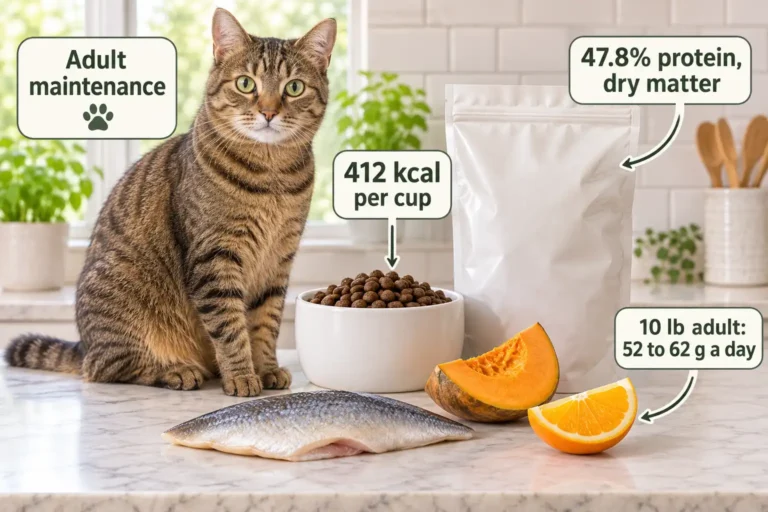
Best Dry Cat Food: 10 Picks by Life Stage, Calories, and Label
The best dry cat food depends on the cat eating it: its age, whether it lives indoors, and its weight. Every pick here is read against the label and its AAFCO statement. We did not feed-test any of them.
Purina ONE +Plus Indoor Advantage is the best dry cat food for spayed or neutered indoor adults, backed by AAFCO feeding tests for adult maintenance at 373 kcal per cup. Kittens: Kitten Chow. Seniors: Pro Plan 7+ Indoor.
The 10 Picks Side by Side Comparison
Every figure below comes from the maker’s label or product page. Use the table to sort the best dry food for cats at each life stage, then read the reviews for the details.
| Food | AAFCO statement | kcal per cup | Crude protein (as fed / dry matter) | First ingredient | Best for |
|---|---|---|---|---|---|
| Purina ONE +Plus Indoor Advantage | Adult maintenance (feeding tests) | 373 | 37% / 42.0% | Turkey | Spayed or neutered indoor adults |
| Hill’s Science Diet Adult Indoor Chicken Recipe | Adult maintenance (feeding tests) | 327 | 31% / 33.7% | Chicken | Indoor adults 1 to 6 years |
| IAMS ProActive Health Healthy Adult | Adult maintenance | 363 | 32% / 35.6% | Chicken | Budget-minded adult homes |
| Purina Kitten Chow Nurture | All life stages | 414 (503 on new panel) | 40% / 45.5% | By-product meal | Kittens on a budget |
| Tiki Cat Born Carnivore Baby Kitten Health | All life stages | 560 | 42% / 46.7% | Deboned chicken | Kittens needing dense food |
| Blue Buffalo Tastefuls Sensitive Stomach | Adult maintenance | 422 | 32% / 35.2% | Deboned chicken | Adults with sensitive stomachs |
| Royal Canin Indoor Adult | Adult maintenance | 325 | 27% / 29.3% | Chicken meal | Hairball-prone indoor adults |
| Blue Buffalo Wilderness Adult Chicken | Adult maintenance | 435 to 443 | 40% / 44.4% | Deboned chicken | Grain-free, high protein |
| Dr. Elsey’s cleanprotein Chicken | All life stages | 523 | 59% / 67.0% | Chicken | Highest protein, lowest carbs |
| Purina Pro Plan Adult 7+ Indoor | Adult maintenance (7+ is Purina’s term) | 403 | 38% / 43.2% | Chicken | Indoor cats 7 and older |
Dry matter figures use the guaranteed minimum protein and maximum moisture, so real values usually run a little higher.
How to Choose the Best Dry Cat Food for Your Cat
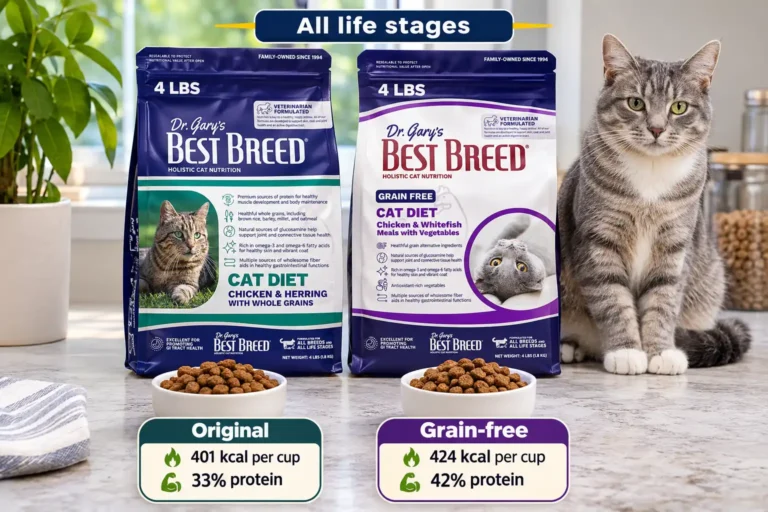
Each pick below is read against the same six label points, in this order. Use them on any bag, including foods not reviewed here, such as Dr. Gary’s Best Breed Cat Diet dry cat food. Cats are obligate carnivores, so the life stage statement and protein come first. That is how to choose dry cat food from the back of the bag. The healthiest dry cat food for your cat is one that is complete and balanced for its life stage and fits its calories.
Match the AAFCO Statement to Your Cat’s Life Stage
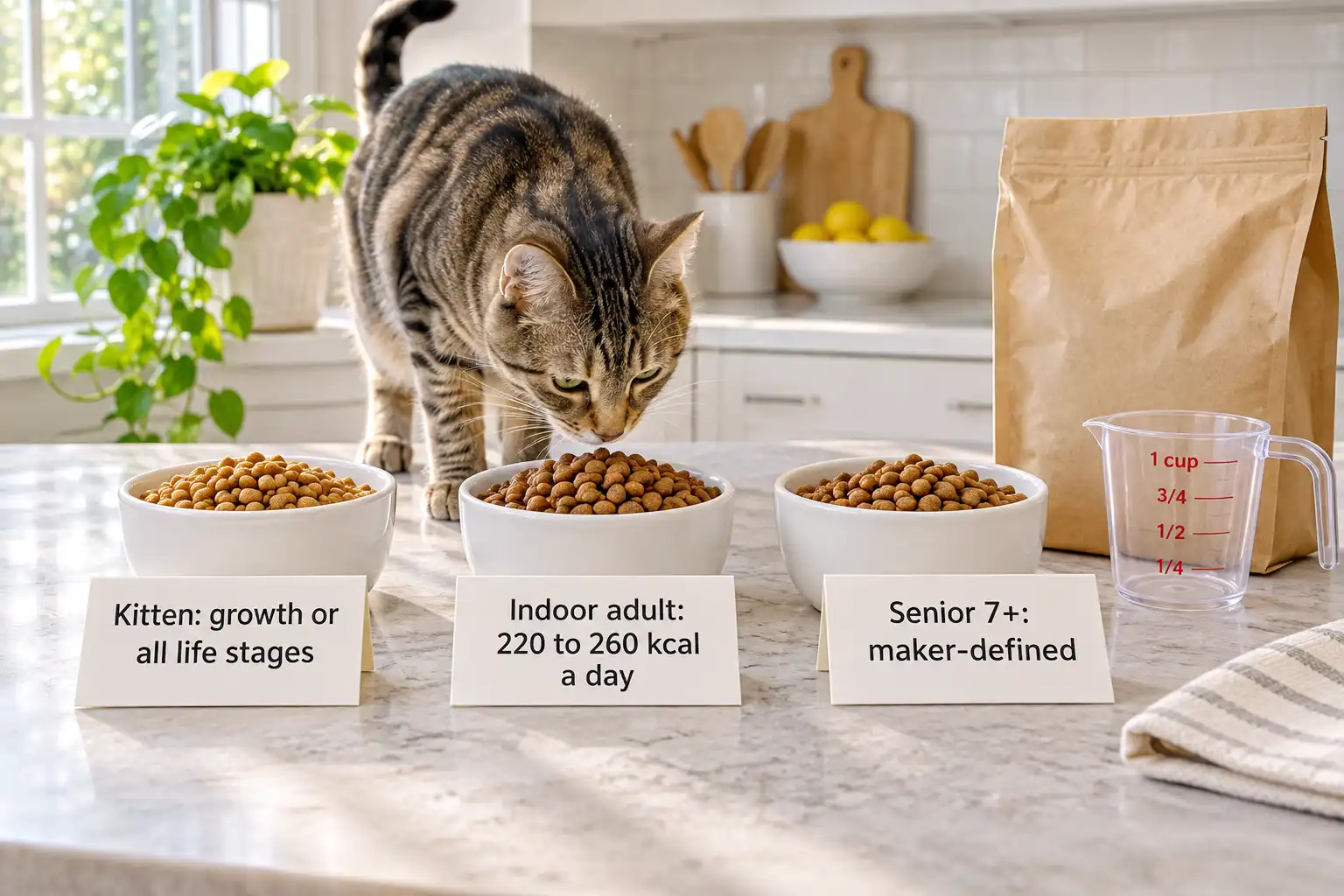
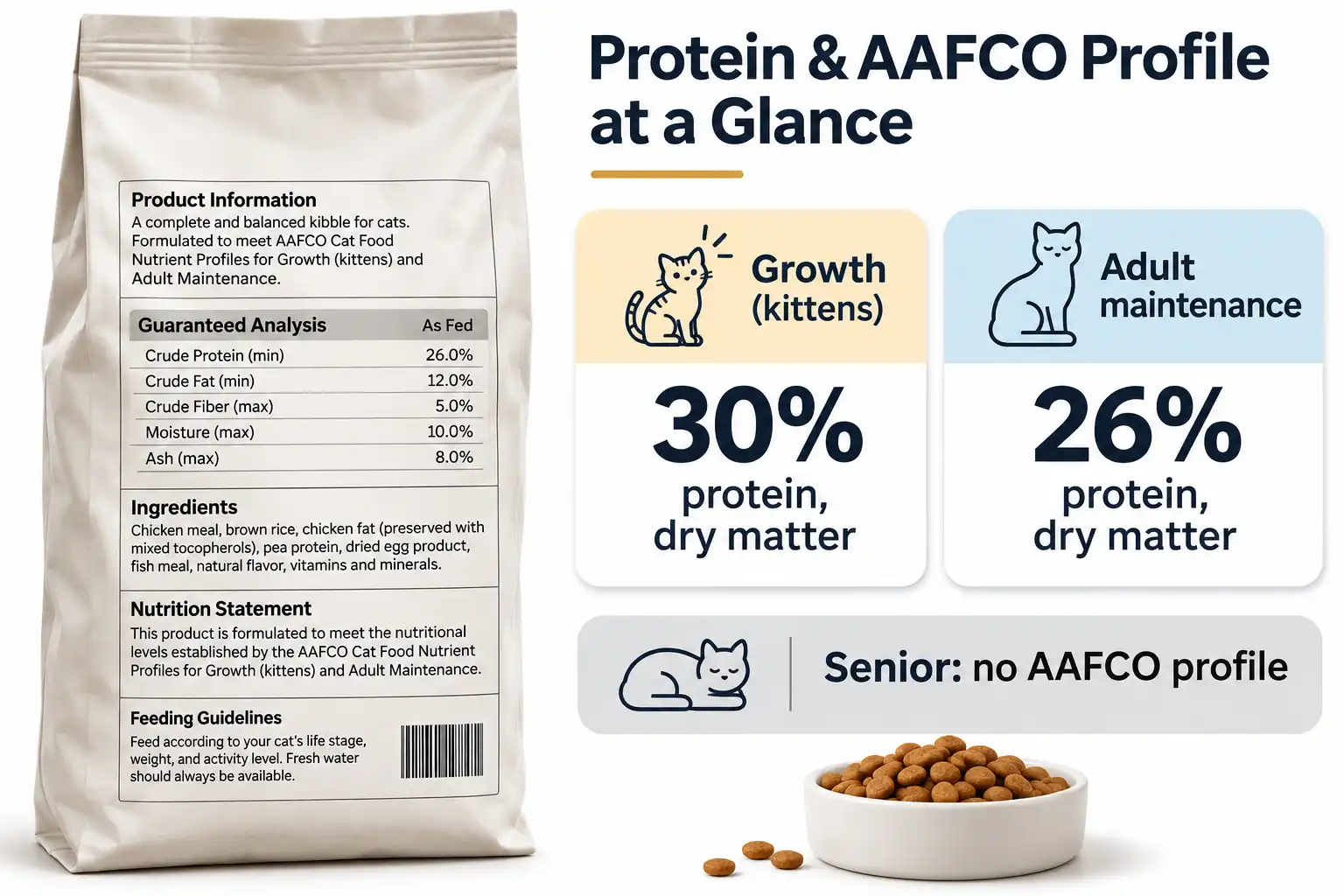
Start with the nutritional adequacy statement, the line that says which life stage a food is complete and balanced for. AAFCO publishes two cat profiles: growth, for kittens and pregnant or nursing cats, and adult maintenance. A food labeled all life stages must meet the growth profile. AAFCO sets crude protein at 30 percent of dry matter for growth and 26 percent for adult maintenance, so an adult food can leave a kitten short. AAFCO has no senior profile at all. “Senior” and “7+” mean what the maker decides. Our page on how kitten and adult dry food differ covers when to switch.
Compare Calories per Cup, Not Bag Size
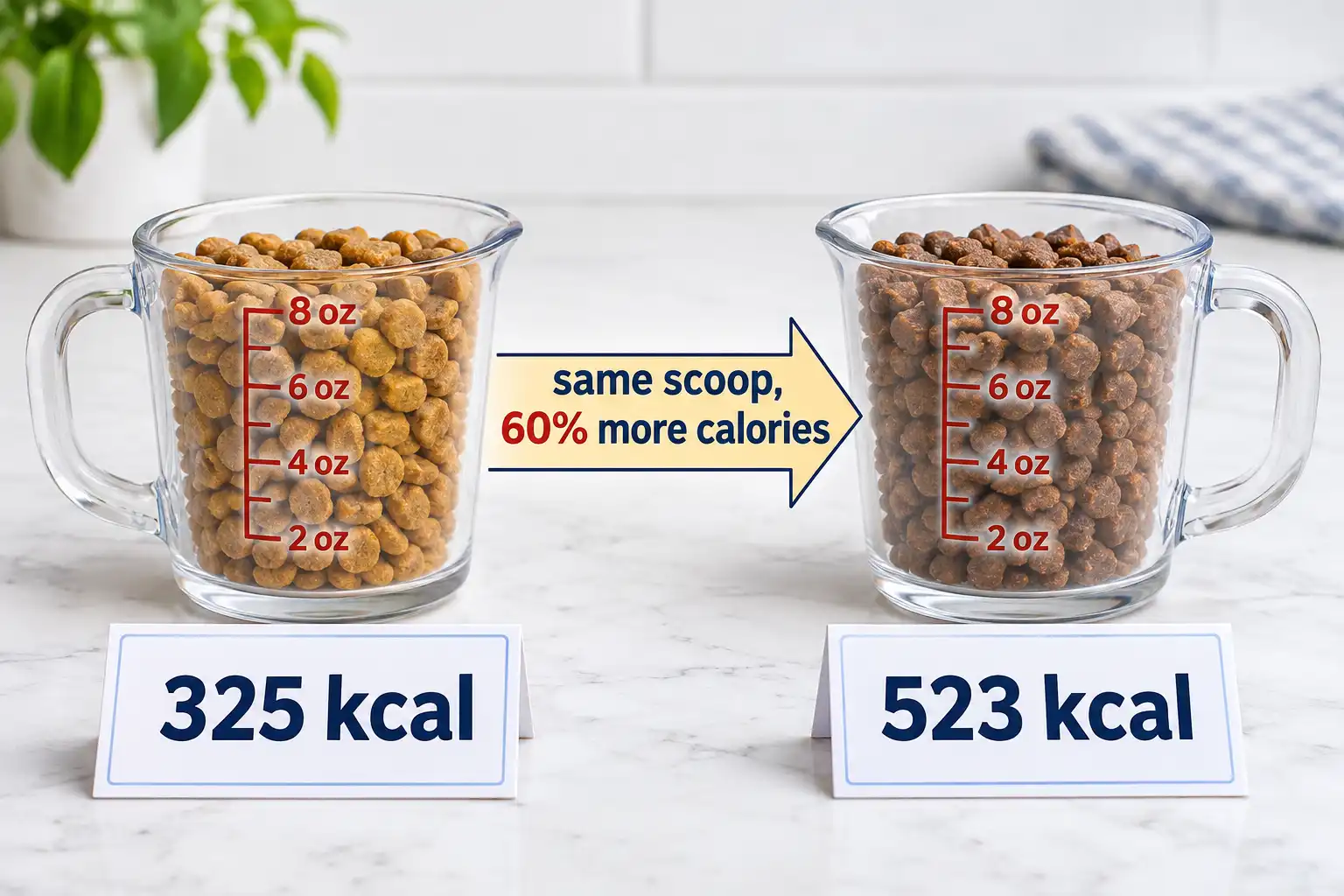
Find the calorie statement next. AAFCO requires it in kcal/kg, and most makers add kcal per cup. This figure sets the portion. A level cup of Royal Canin Indoor Adult holds 325 kcal, while a cup of Dr. Elsey’s cleanprotein holds 523 kcal, per each maker. Use one scoop for both, and an adult cat gets about 60 percent more calories from the second. If you’re comparing the best cat dry food for indoor cats, this number matters more than the word “indoor”, which has no AAFCO definition. Read it from your bag, since recipes change.
Convert Protein and Fat to a Dry Matter Basis
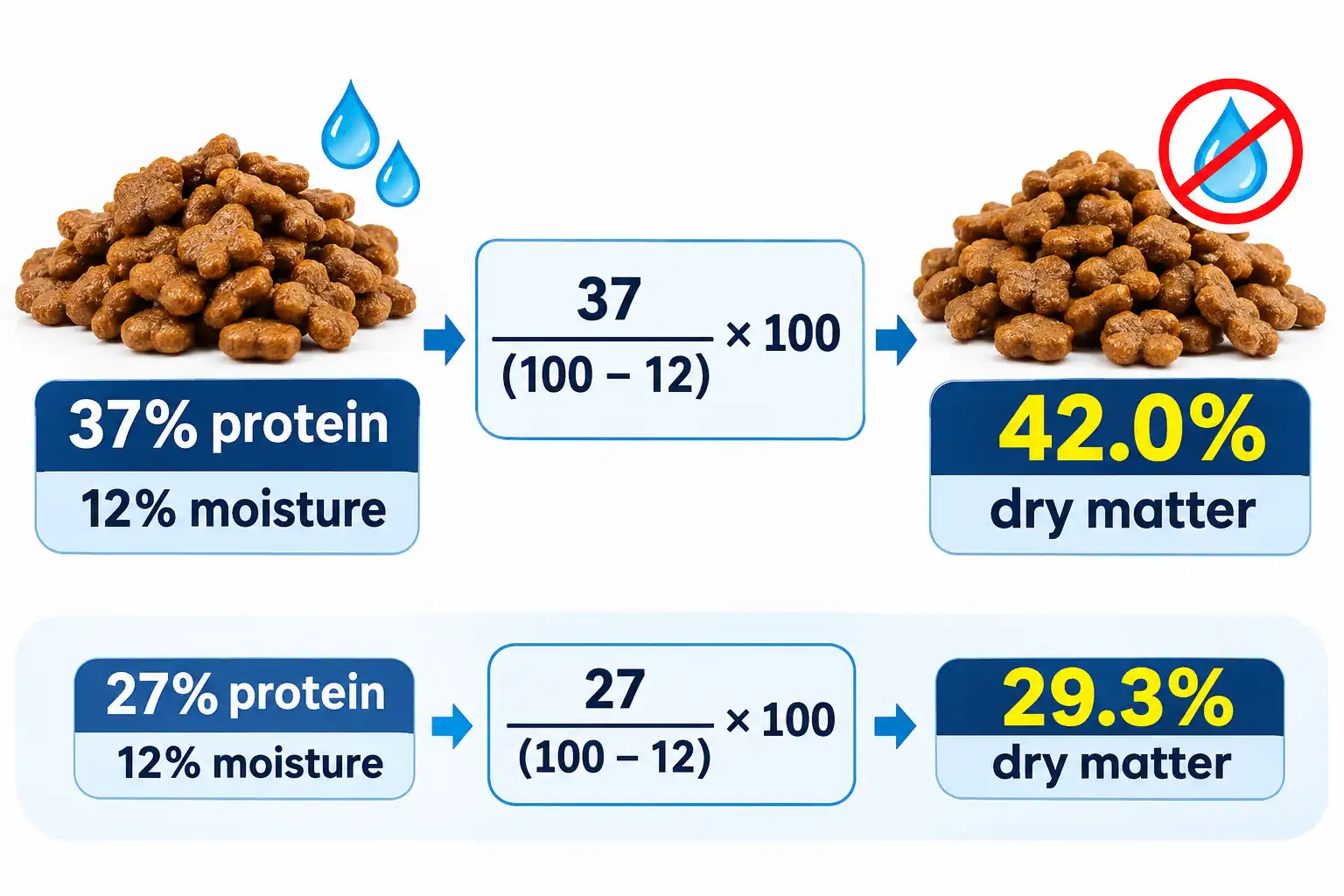
The guaranteed analysis lists crude protein and crude fat as fed, with water still in. Convert to a dry matter basis: divide the nutrient percent by (100 minus the moisture percent), then multiply by 100. Purina ONE Indoor Advantage lists 37 percent protein and 12 percent moisture, which works out to 42.0 percent. Royal Canin Indoor Adult lists 27 percent and 8 percent, or 29.3 percent. As fed, the gap looks like 10 points. On dry matter, it is nearly 13. You can work out carbohydrates by difference only when ash is listed, and none of these ten labels lists it. Our guide to comparing protein on a dry matter basis walks through more examples.
Read the First Ingredients With the FDA Naming Rules
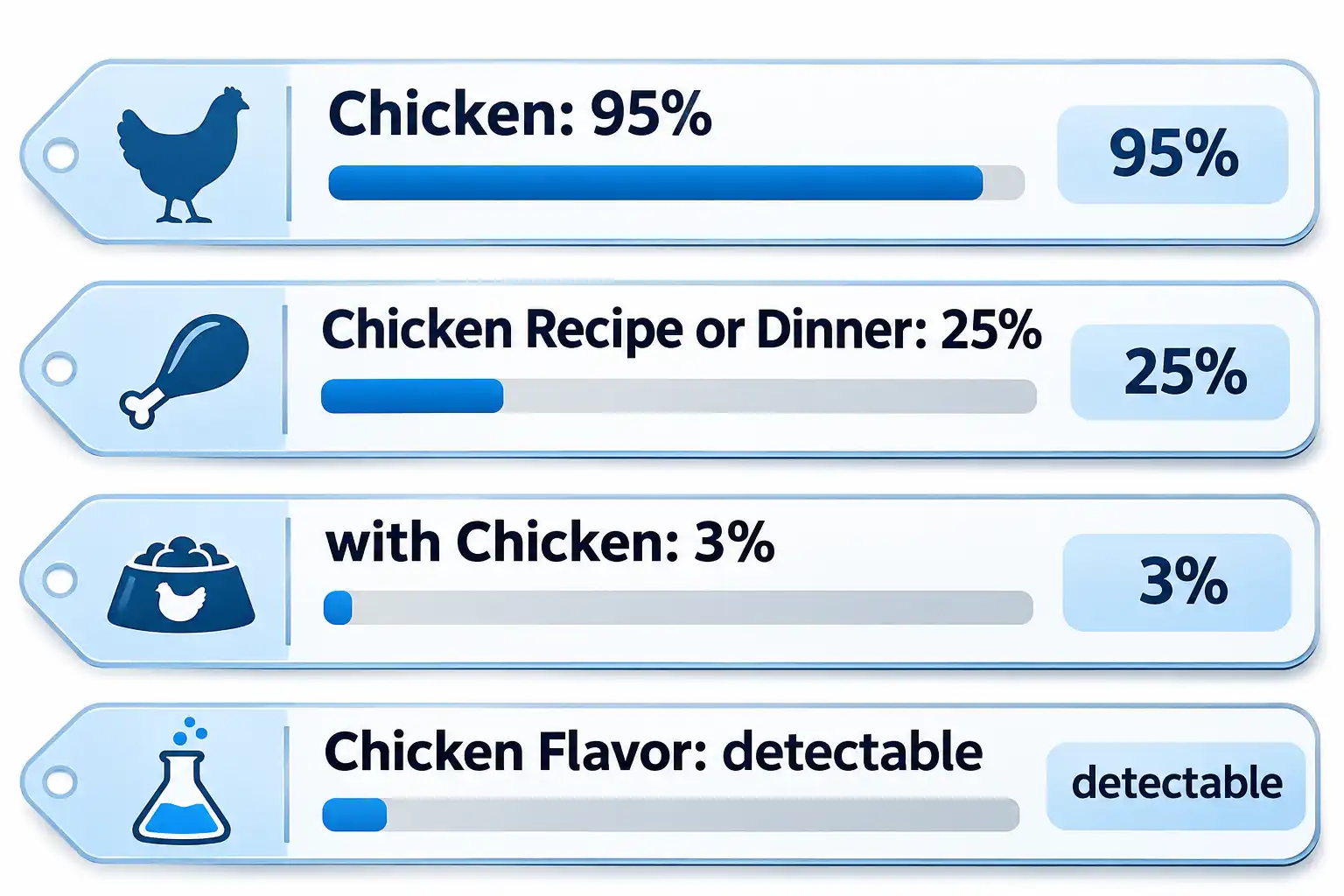
Ingredients are listed by weight before cooking, water included. Fresh chicken is mostly water, so it can lead the list yet add less protein than a dry chicken meal further down. A by-product meal uses parts AAFCO defines, such as organs, and excludes feathers. Product names follow rules from the FDA Center for Veterinary Medicine: “Chicken” alone means at least 95 percent chicken, a “Chicken Recipe” or “Dinner” at least 25 percent, “with Chicken” at least 3 percent, and “Chicken Flavor” only a detectable amount. “Premium”, “natural”, and “human-grade” are maker claims. The FDA notes premium foods meet no higher nutritional standard. Our guide to reading a cat food label line by line goes deeper.
Ask the Maker the WSAVA Questions
The WSAVA Global Nutrition Committee suggests asking every maker a short set of questions and judging the answers, not the brand:
- Do you employ a full-time qualified nutritionist, such as a board-certified veterinary nutritionist (ACVN) or a PhD in animal nutrition?
- Who formulates your foods, and what are their credentials?
- What quality control checks cover ingredients and finished food?
- Do you run AAFCO feeding trials, and do you publish research?
The label answers part of the last one. Purina ONE and Hill’s state AAFCO feeding tests; the other eight picks say “formulated to meet”.
Treat Kibble Size and Taste as Owner Reports
Palatability, kibble size, odor, and crumbling don’t appear on any label. For these, the reviews below draw on patterns across verified buyer reviews, labeled as owner reports every time. They show trends, not guarantees. Since picky eaters are common, a small bag first is the cheaper way to find out.
How Much of Each Food a 10 lb Adult Cat Eats
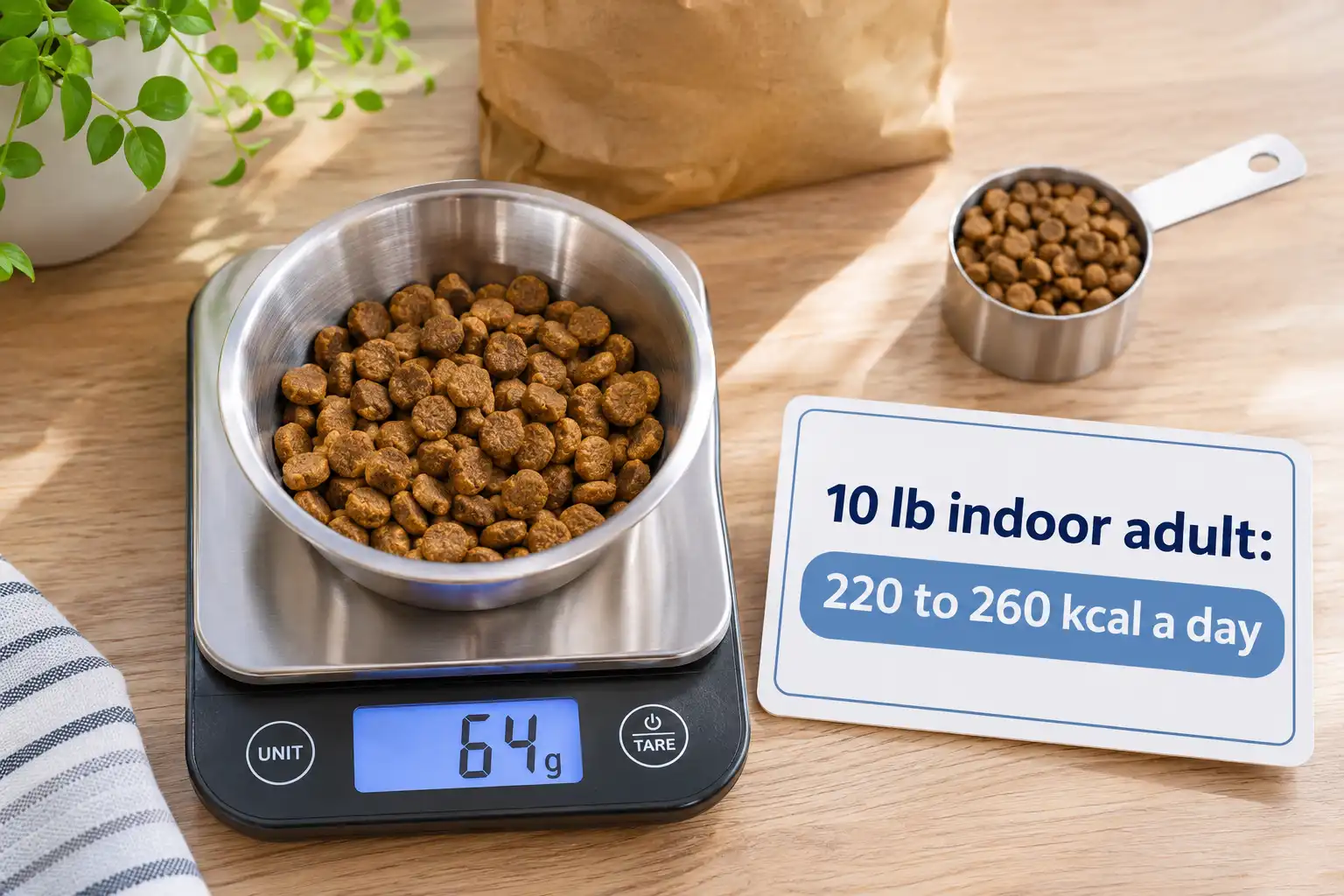
A 10 lb spayed or neutered indoor adult needs about 220 to 260 kcal a day as a starting point. This is how much dry food to feed a cat that size on each pick.
Here is the math. Ten pounds is 4.54 kg. AAHA‘s 2021 guidelines start with resting energy (RER), using the same formula as the NRC: 70 x (weight in kg) to the 0.75 power, or about 218 kcal for this cat. Daily need (MER) is RER times a life stage factor. AAHA lists 1.2 to 1.4 for neutered adults and 1.0 for inactive or obesity-prone cats, and it notes that indoor cats may need less than its table shows. So for an indoor adult, 1.0 to 1.2 times RER, or 220 to 260 kcal, is a sensible start.
Next, divide by each food’s kcal per cup. On Purina ONE, the same calories weigh 58 to 69 g on a kitchen scale. Bag charts often run higher because they cover a weight band; Purina ONE’s starts a 10 to 14 lb adult at 2/3 to 1 cup. Check your cat’s body condition score with your vet, then adjust. Treats come out of the same total, so check what cats can eat before adding extras. Our daily food calculator runs this for your cat’s weight.
| Food | kcal per cup | Cups a day (220 to 260 kcal) | Bag size | Days per bag |
|---|---|---|---|---|
| Purina ONE +Plus Indoor Advantage | 373 | 0.6 to 0.7 | 16 lb | 105 to 124 |
| Hill’s Science Diet Adult Indoor | 327 | 0.7 to 0.8 | 15.5 lb | 94 to 112 |
| IAMS ProActive Health Healthy Adult | 363 | 0.6 to 0.7 | 7 lb | 45 to 53 |
| Blue Buffalo Tastefuls Sensitive Stomach | 422 | 0.5 to 0.6 | 3 lb | 20 to 23 |
| Royal Canin Indoor Adult | 325 | 0.7 to 0.8 | 3 lb | 18 to 22 |
| Blue Buffalo Wilderness Adult Chicken | 435 to 443 | 0.5 to 0.6 | 6 lb | 40 to 47 |
| Dr. Elsey’s cleanprotein Chicken | 523 | 0.4 to 0.5 | 2 lb | 14 to 16 |
| Purina Pro Plan Adult 7+ Indoor | 403 | 0.55 to 0.65 | 3.5 lb | 21 to 25 |
Kitten foods are left out, because kittens are fed for growth at AAHA’s factor of 2.5 times RER. To compare value, divide your own bag price by its days per bag. That gives cost per day, which is fairer than price per pound.
The 10 Best Dry Cat Foods, by Life Stage and Need
Each pick is read against the six points above. Together they cover the best dry cat food choices for indoor adults, kittens, seniors, and three specific needs.
1. Purina ONE +Plus Indoor Advantage: Best Overall for Indoor Adults
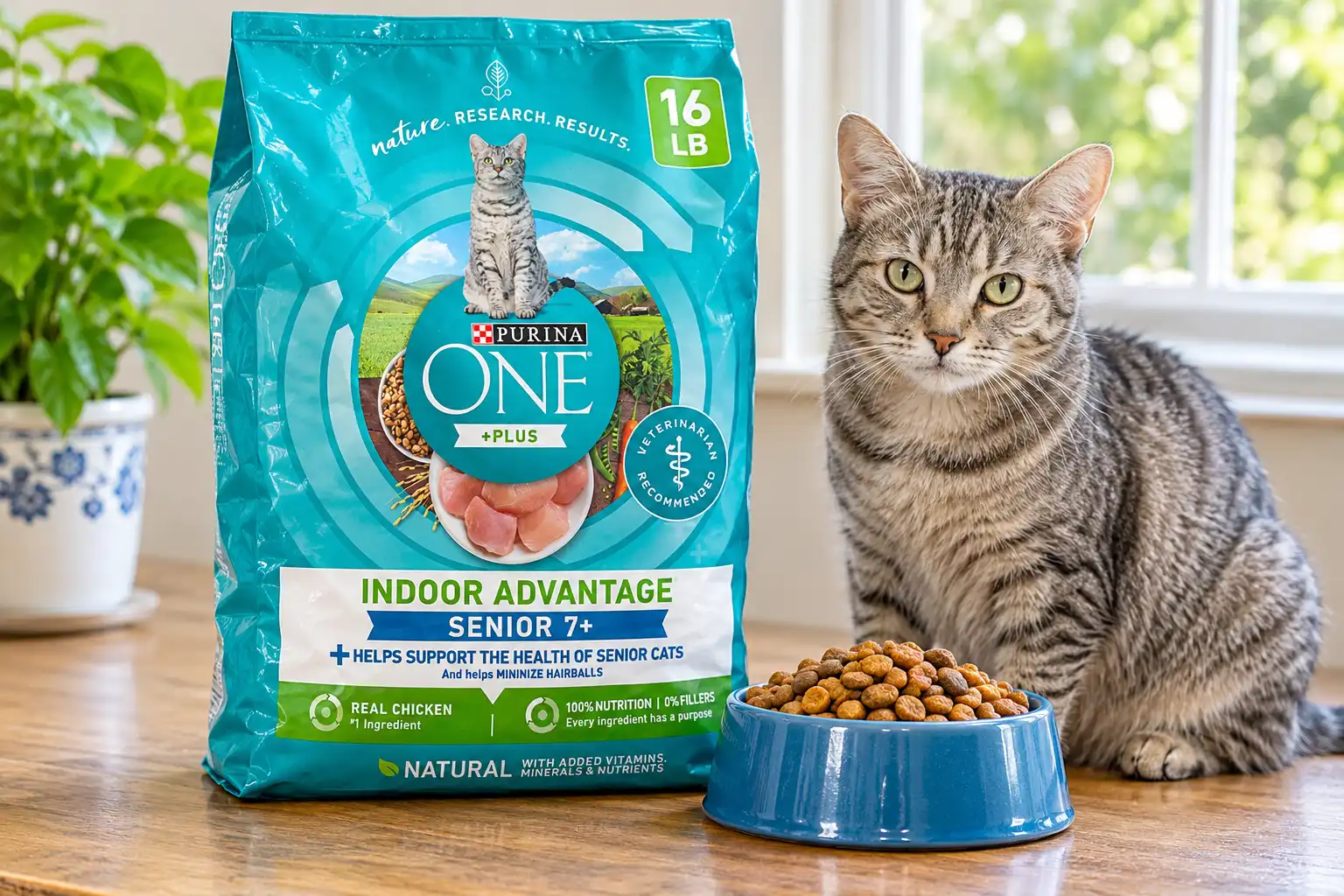
Purina ONE +Plus Indoor Advantage is Nestlé Purina’s indoor formula, complete and balanced for adult maintenance by AAFCO feeding tests. A 10 lb indoor adult eats about 0.6 to 0.7 cup a day. Purina says its fiber blend helps with hairballs and weight. Owner reports note cats eat it readily and it suits automatic feeders. On label facts, it is our pick for the best dry cat food for indoor cats.
PROS
- Feeding-tested maintenance statement
- Turkey is listed first
- Moderate 373 kcal per cup
- Sold in three bag sizes
CONS
- Turkey recipe still contains chicken
Specifications:
- AAFCO: adult maintenance (feeding tests)
- Calories: 373 kcal per cup
- Crude protein: 37% as fed, 42.0% dry matter
- First ingredient: turkey
2. Hill’s Science Diet Adult Indoor Chicken Recipe: Best Chicken-First Indoor Formula
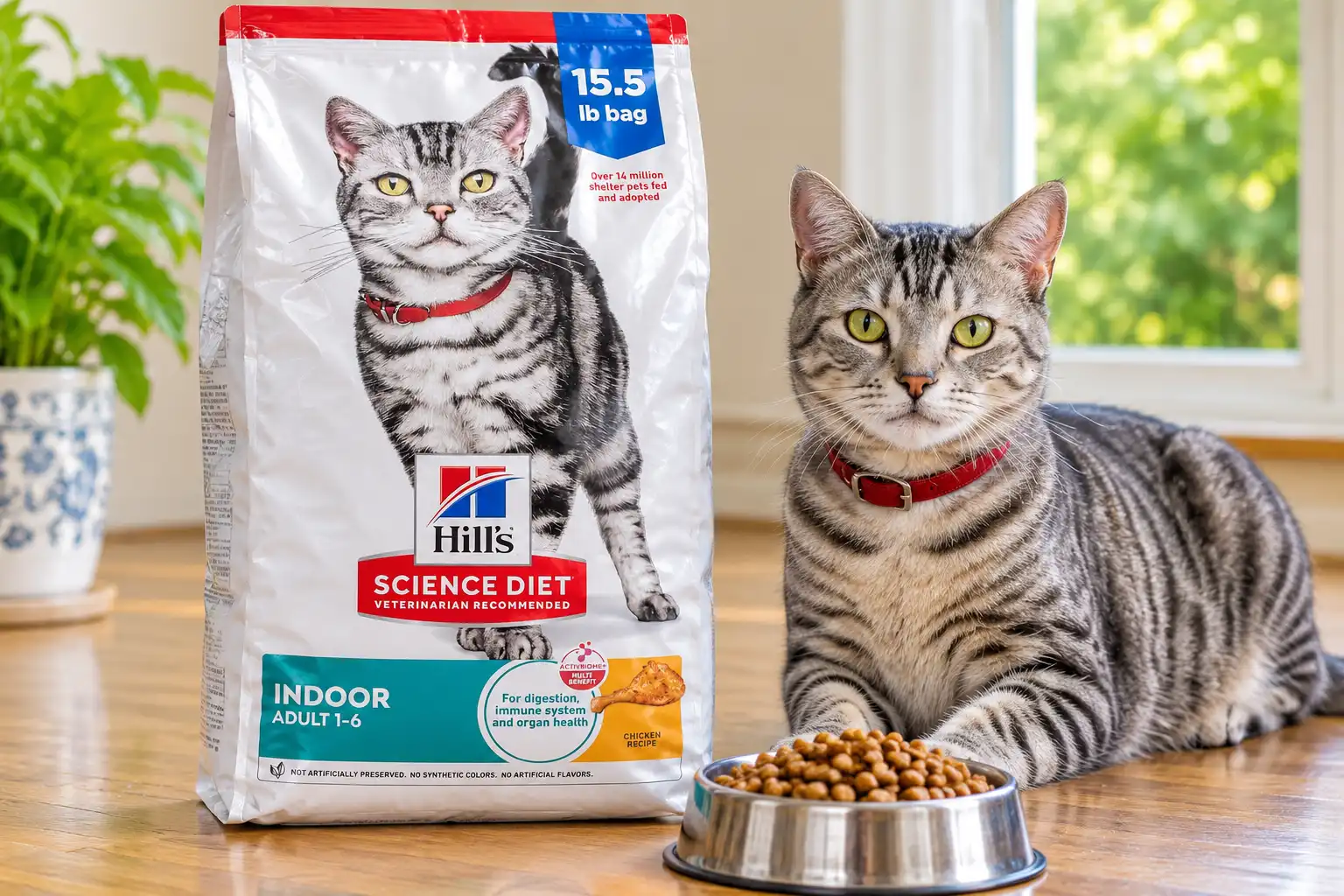
The Hill’s Science Diet Adult Indoor Chicken Recipe is complete and balanced for adult maintenance, backed by AAFCO feeding tests. Hill’s Pet Nutrition calls itself U.S. veterinarians’ #1 recommended brand; that is Hill’s own claim. Its current page lists 327 kcal per cup, while older bags show 319, so check yours. A 10 lb indoor adult eats about 0.7 to 0.8 cup. Owner reports note most cats eat it, though some refuse it. Hill’s also makes an Adult 7+ Indoor recipe.
PROS
- Chicken is listed first
- Feeding-tested maintenance statement
- Low 327 kcal per cup
- Small triangular kibble
CONS
- Recipe changed; recheck portions
Specifications:
- AAFCO: adult maintenance (feeding tests)
- Calories: 327 kcal per cup
- Crude protein: 31% as fed, 33.7% dry matter
- First ingredient: chicken
3. IAMS ProActive Health Healthy Adult: Best Value for Adult Cats
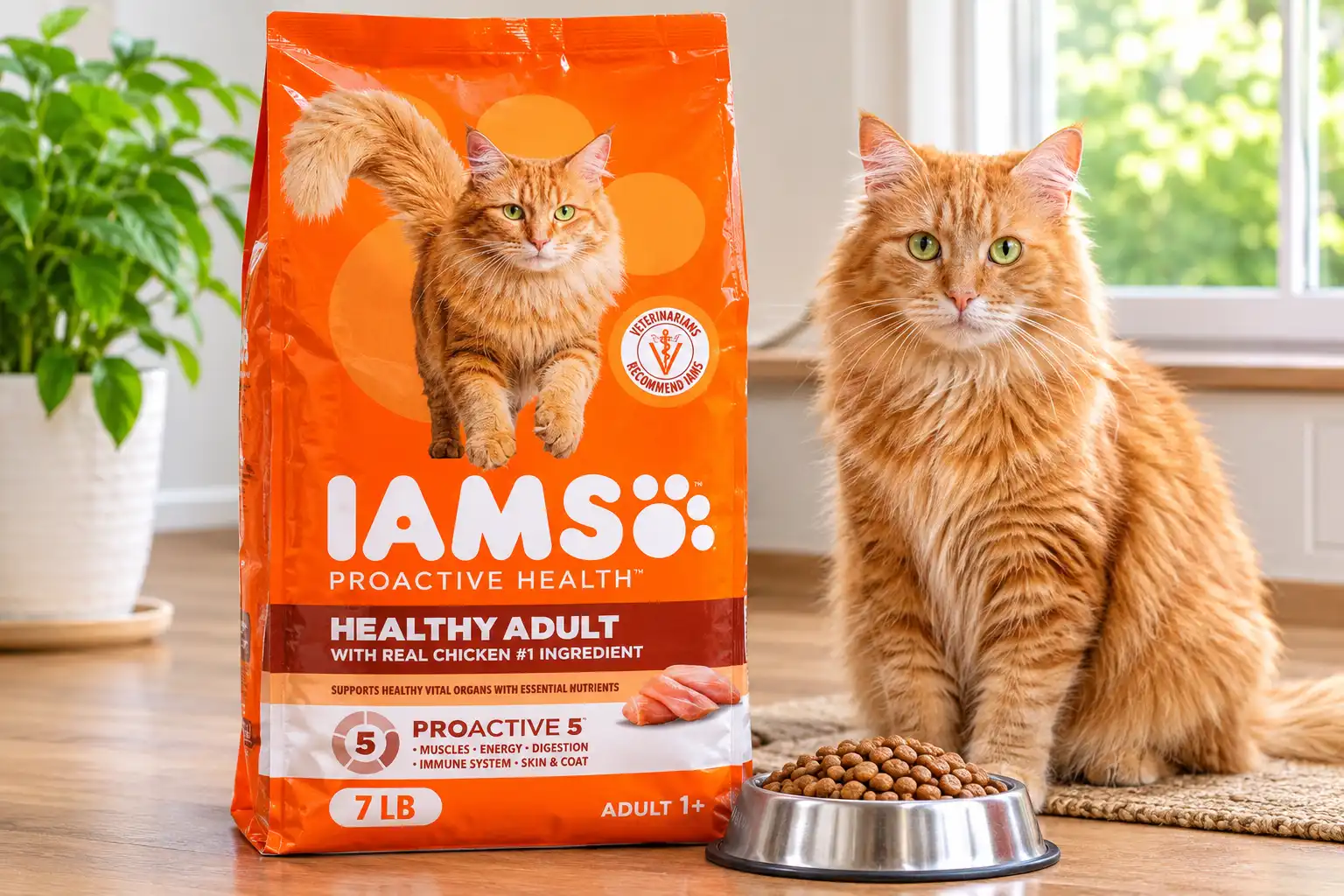
IAMS ProActive Health Healthy Adult with Chicken is complete and balanced for adult maintenance, from a brand dating to 1946. Chicken leads, then by-product meal, corn, and beet pulp. The salmon recipe runs 384 kcal per cup against 363, with chicken by-product meal still second. For the best cheap dry cat food, judge cost per day: a 7 lb bag feeds a 10 lb indoor adult 45 to 53 days. Owner reports note picky eaters often accept it.
PROS
- Chicken is listed first
- Bags up to 22 lb
- Small, feeder-friendly kibble
- Beet pulp and prebiotics
CONS
- Bag is not resealable
Specifications:
- AAFCO: adult maintenance
- Calories: 363 kcal per cup
- Crude protein: 32% as fed, 35.6% dry matter
- First ingredient: chicken
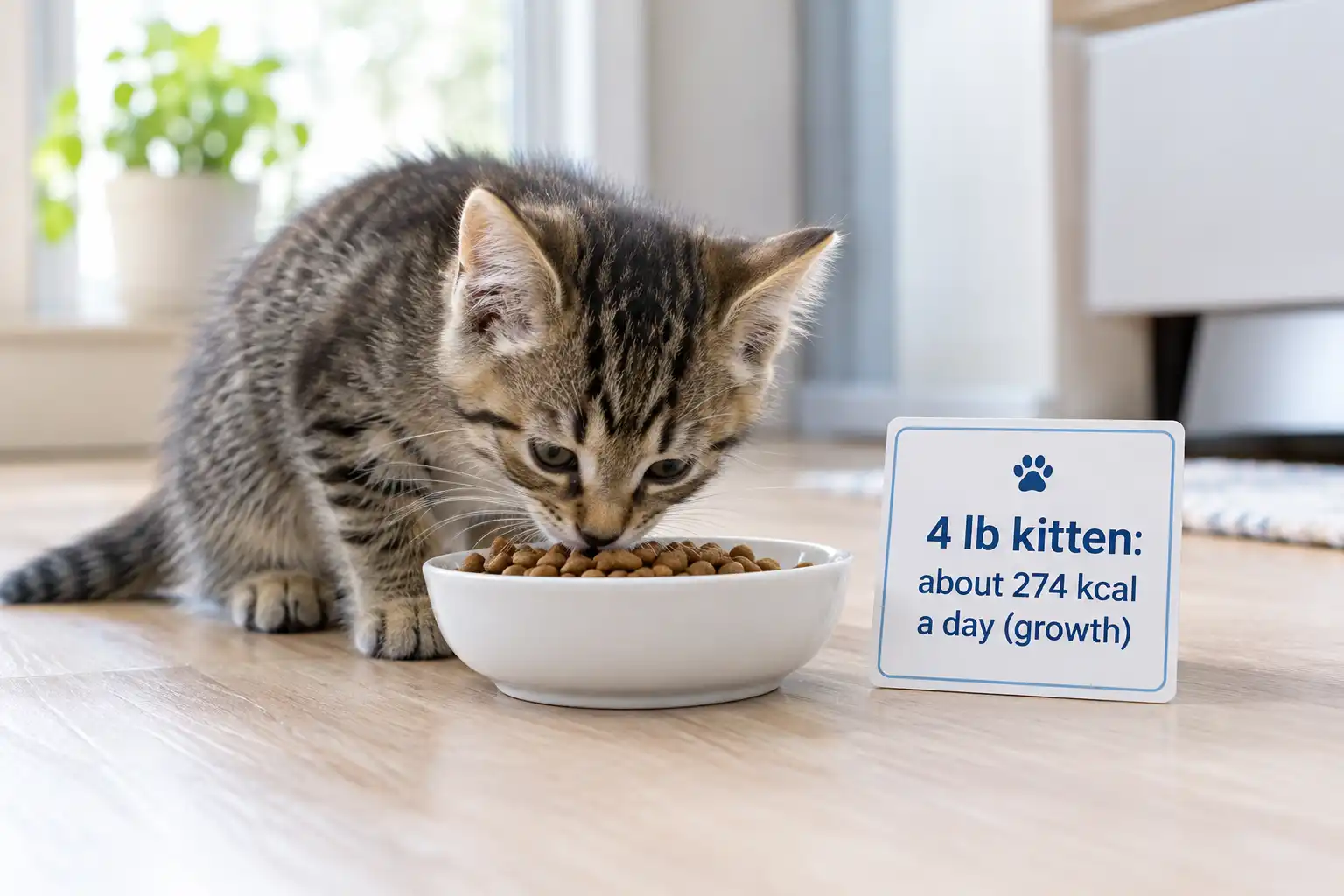
4. Purina Kitten Chow Nurture: Best Budget Kitten Food
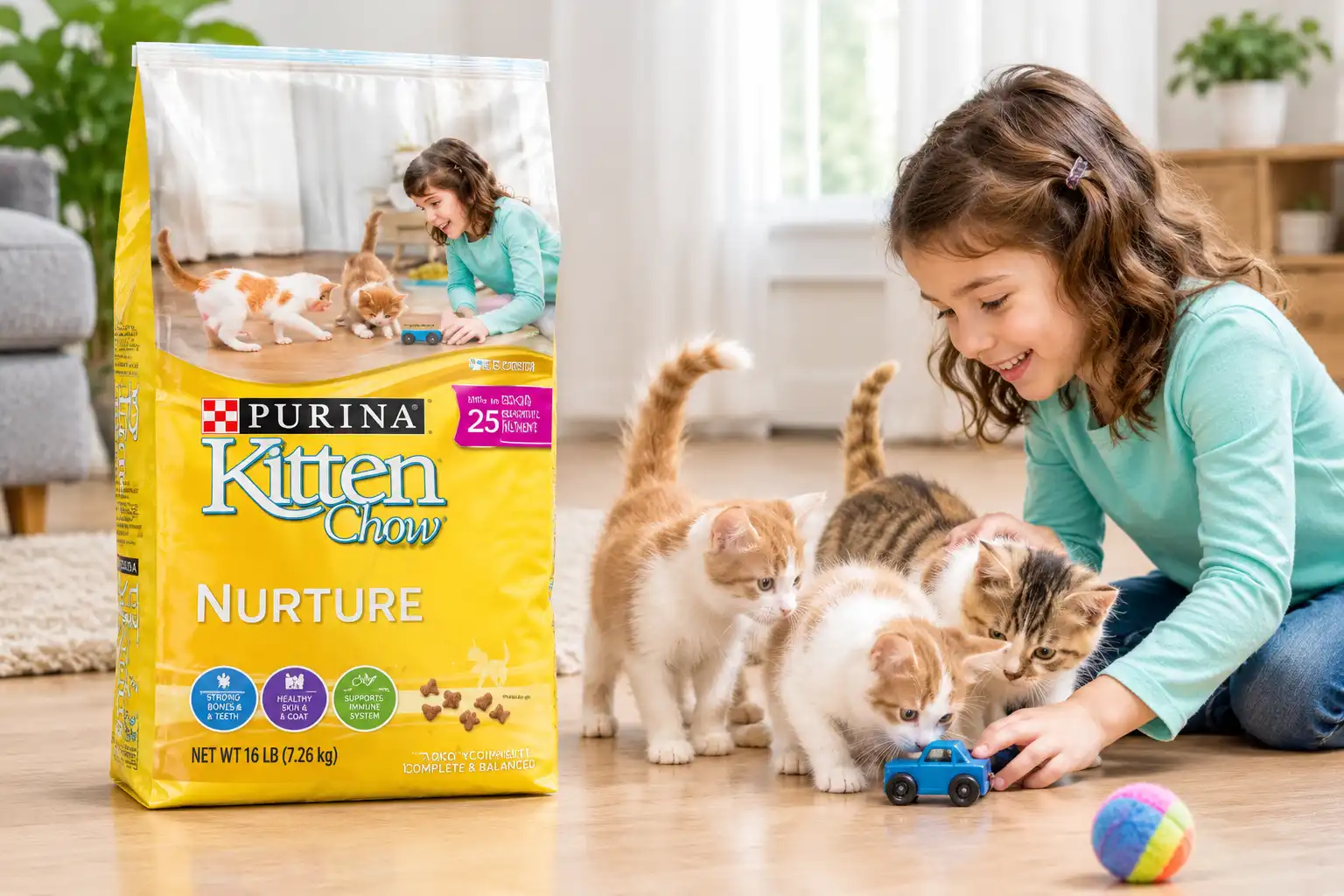
Purina Kitten Chow Nurture, now sold as Kitten Chow Year One Essentials, is complete and balanced for all life stages, which covers growth. It’s our budget pick for the best cat food for kittens. Calories need care: Purina’s product page lists 414 kcal per cup, while its 2026 label shows 503. A 4 lb kitten needs about 274 kcal a day, roughly 0.55 to 0.65 cup. Owner reports note kittens eat it readily.
PROS
- All life stages statement
- 45.5% dry matter protein
- Added DHA for kittens
- Bags up to 14 lb
CONS
- Calorie figure differs by label
Specifications:
- AAFCO: all life stages
- Calories: 414 or 503 kcal per cup, by label
- Crude protein: 40% as fed, 45.5% dry matter
- First ingredient: by-product meal
5. Tiki Cat Born Carnivore Chicken & Egg Kitten: Best High-Protein Kitten Food
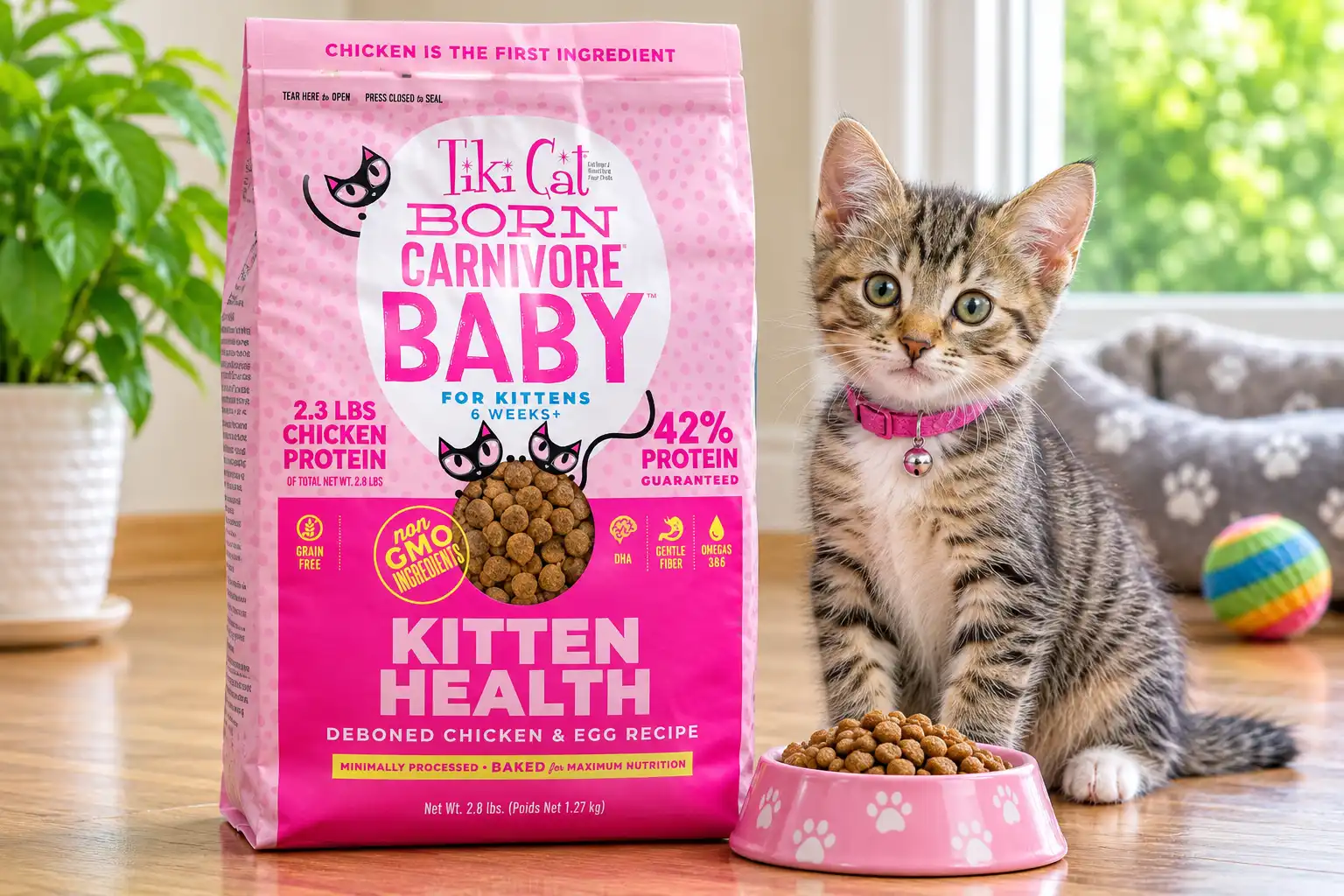
Tiki Cat Born Carnivore Baby Kitten Health is a baked, grain-free kitten food, complete and balanced for all life stages. Deboned chicken, chicken meal, and egg lead. Its 46.7 percent dry matter protein clears the AAFCO growth profile minimum of 30 percent, making it our high-protein kitten food pick. At 560 kcal per cup, a 4 lb kitten eats half a cup, so a 2.8 lb bag lasts about 18 days. Owner reports note picky kittens sometimes refuse it.
PROS
- Three animal proteins first
- 46.7% dry matter protein
- DHA at 0.1% minimum
- Small baked kibble
CONS
- Costs more per day
Specifications:
- AAFCO: all life stages
- Calories: 560 kcal per cup
- Crude protein: 42% as fed, 46.7% dry matter
- First ingredient: deboned chicken
6. Blue Buffalo Tastefuls Sensitive Stomach: Best for Sensitive Stomachs
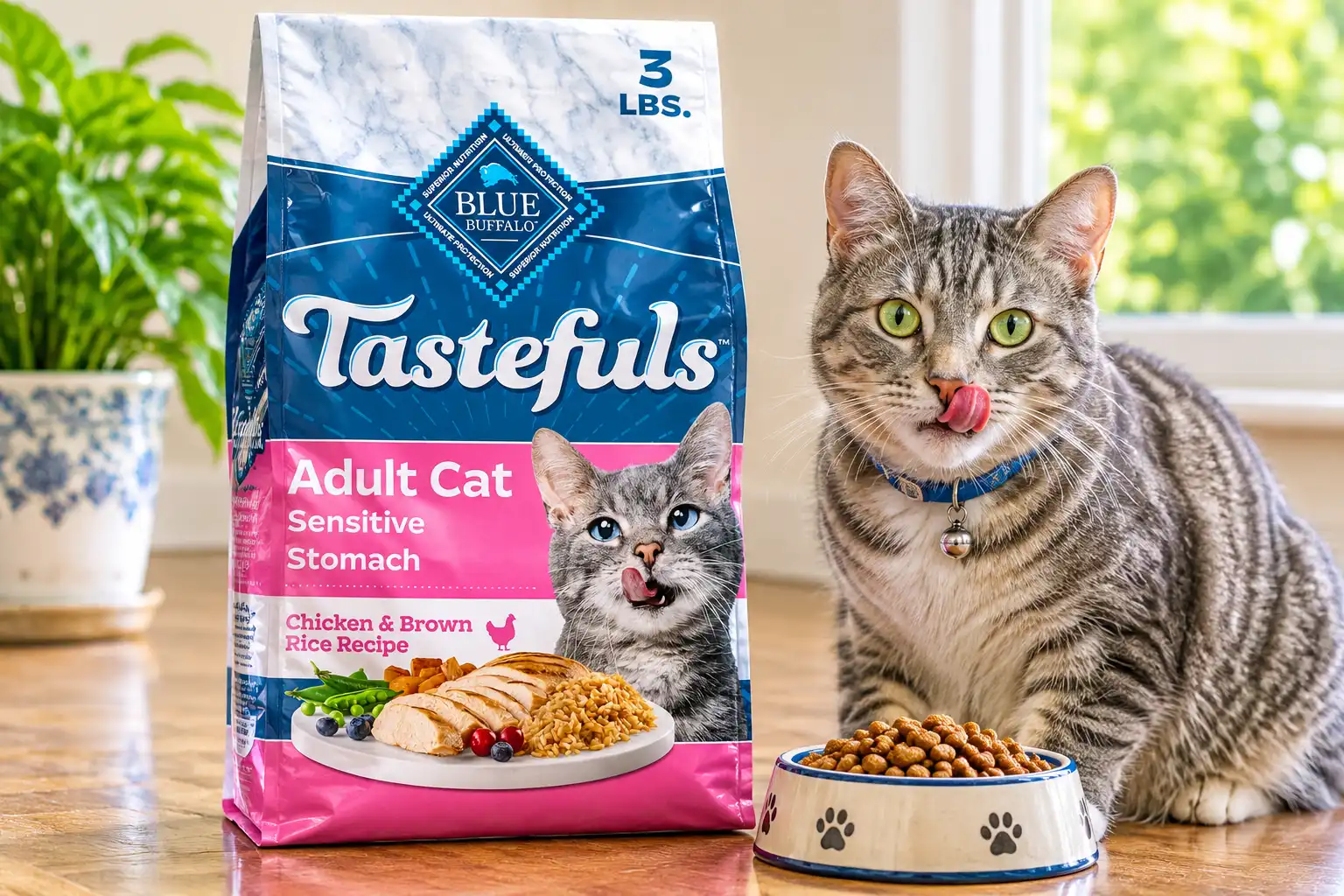
Repeated vomiting needs a vet visit before any food change; see when vomiting needs a vet. Blue Buffalo Tastefuls Sensitive Stomach is complete and balanced for adult maintenance on Blue Buffalo’s page, though some listings say indoor adult. Deboned chicken leads, with brown rice, oatmeal, and FOS prebiotic fiber. It is our best dry cat food for sensitive stomachs once illness is ruled out. Owner reports note most picky cats accept it.
PROS
- Deboned chicken listed first
- Added FOS prebiotic fiber
- No corn, wheat, or soy
- Rice, oatmeal, barley grains
CONS
- No standard behind "sensitive stomach"
Specifications:
- AAFCO: adult maintenance
- Calories: 422 kcal per cup
- Crude protein: 32% as fed, 35.2% dry matter
- First ingredient: deboned chicken
7. Royal Canin Indoor Adult: Best for Hairball-Prone Indoor Adults
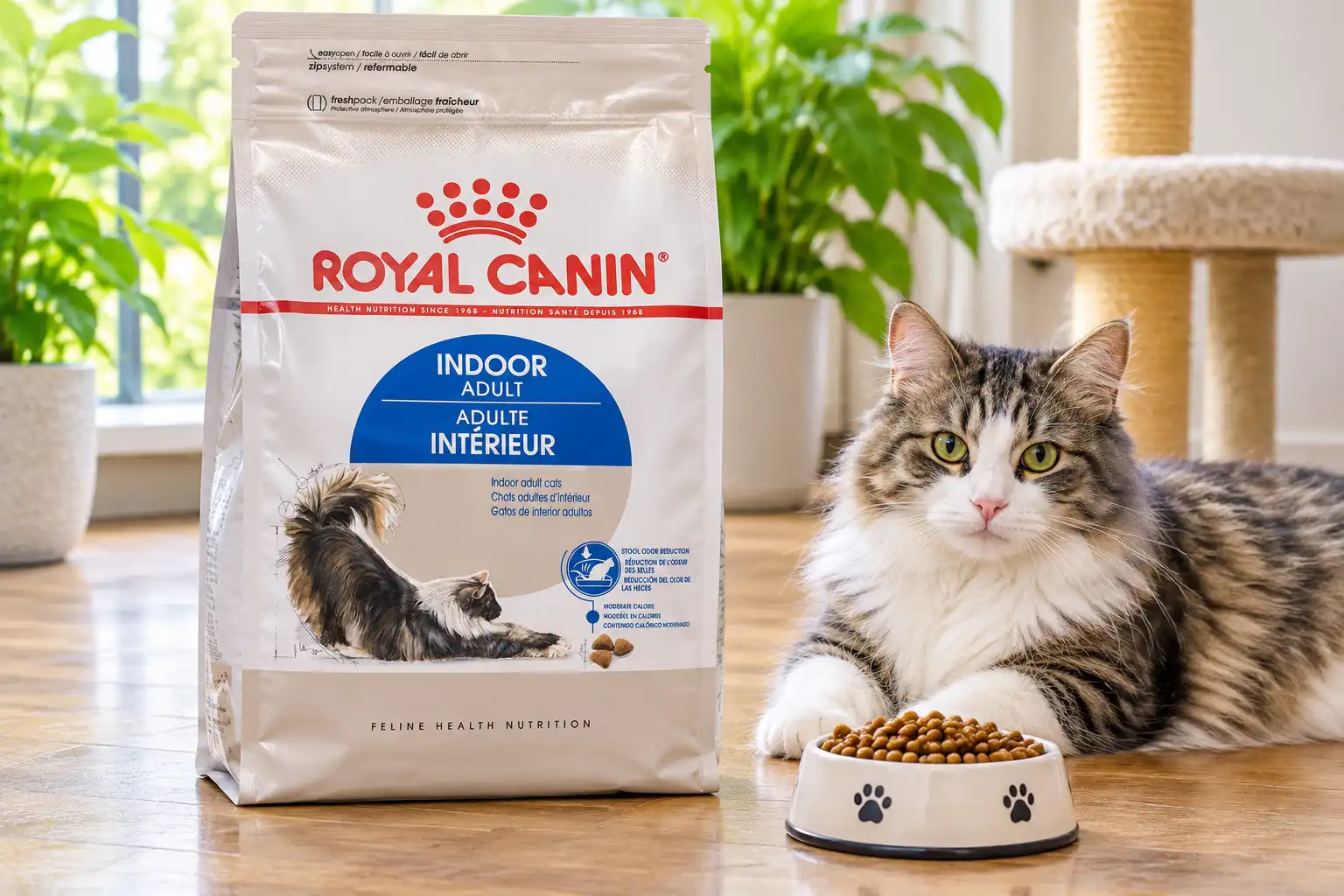
The Royal Canin Indoor Adult is complete and balanced for adult maintenance and sold as an indoor cat food for ages 1 to 7. Royal Canin says its fiber blend helps move swallowed hair through the gut, but hairball control has no AAFCO standard. At 325 kcal per cup, a 10 lb indoor adult eats about three quarters of a cup, so the bowl looks fuller. Owner reports note cats eat it readily. An Indoor 7+ version exists.
PROS
- Lowest calories per cup
- Chicken meal listed first
- Built for indoor adults
- Fiber blend for hairballs
CONS
- Lowest protein of the ten
Specifications:
- AAFCO: adult maintenance
- Calories: 325 kcal per cup
- Crude protein: 27% as fed, 29.3% dry matter
- First ingredient: chicken meal
8. Blue Buffalo Wilderness Adult Chicken: Best Grain-Free Dry Cat Food
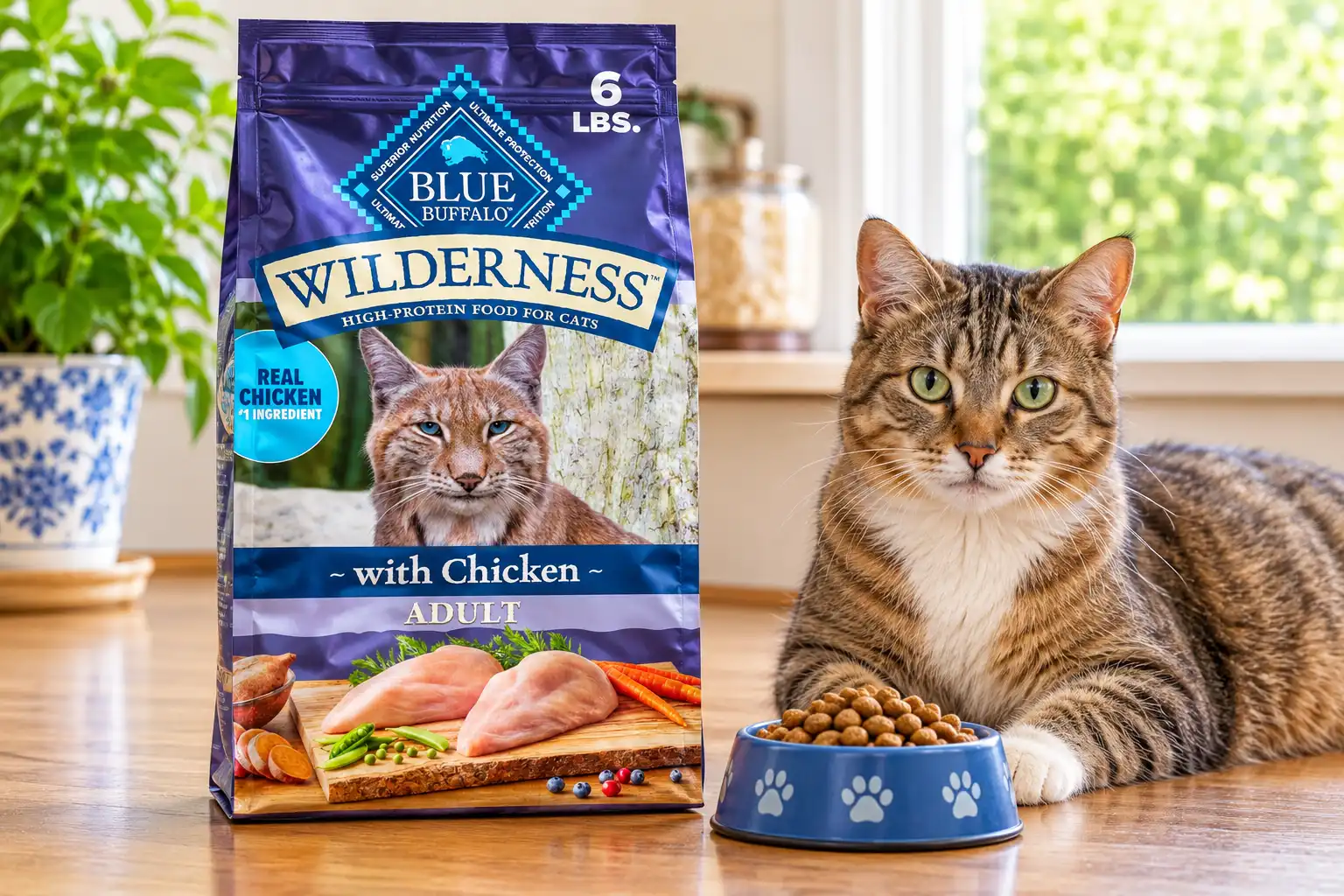
Blue Buffalo Wilderness Adult Chicken is the best grain-free dry cat food here on protein, complete and balanced for adult maintenance. Deboned chicken, chicken meal, and turkey meal lead, then tapioca starch, peas, and potatoes replace grain. LifeSource Bits are Blue Buffalo’s vitamin and antioxidant blend; any benefit is the maker’s claim. With no ash listed, carbohydrates can’t be worked out. Owner reports note most cats take to it, though some refuse it.
PROS
- Three animal proteins first
- 44.4% dry matter protein
- No corn, wheat, or soy
- Duck and salmon versions
CONS
- Grain-free benefit unproven for cats
Specifications:
- AAFCO: adult maintenance
- Calories: 435 to 443 kcal per cup
- Crude protein: 40% as fed, 44.4% dry matter
- First ingredient: deboned chicken
9. Dr. Elsey’s cleanprotein Chicken: Best High-Protein, Low-Carb Kibble
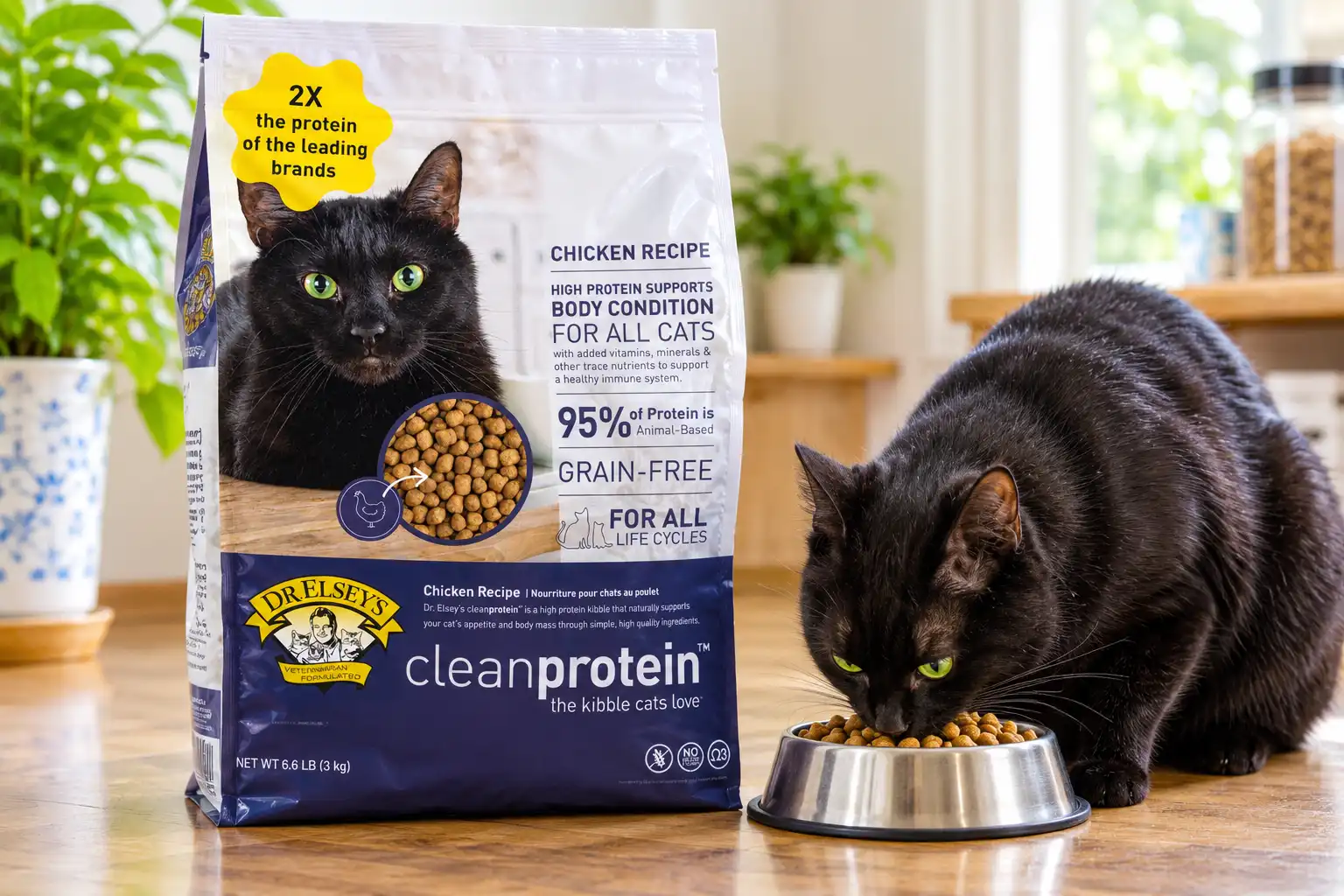
Dr. Elsey’s cleanprotein Chicken, from the maker best known for cat litter, is complete and balanced for all life stages, with the highest protein here. The label lists no ash, but the maker’s analysis of an earlier recipe put carbohydrates near 4.6 percent of dry matter, making it this list’s clearest low-carb dry cat food. The recipe recently changed (544 to 523 kcal per cup). Owner reports note eager eaters, but some cats refuse it.
PROS
- 67.0% dry matter protein
- No grain, potato, or peas
- Chicken is listed first
- All life stages statement
CONS
- Costs more per day
Specifications:
- AAFCO: all life stages
- Calories: 523 kcal per cup
- Crude protein: 59% as fed, 67.0% dry matter
- First ingredient: chicken
10. Purina Pro Plan Adult 7+ Indoor Chicken & Rice: Best Senior Dry Cat Food (Maker-Defined)
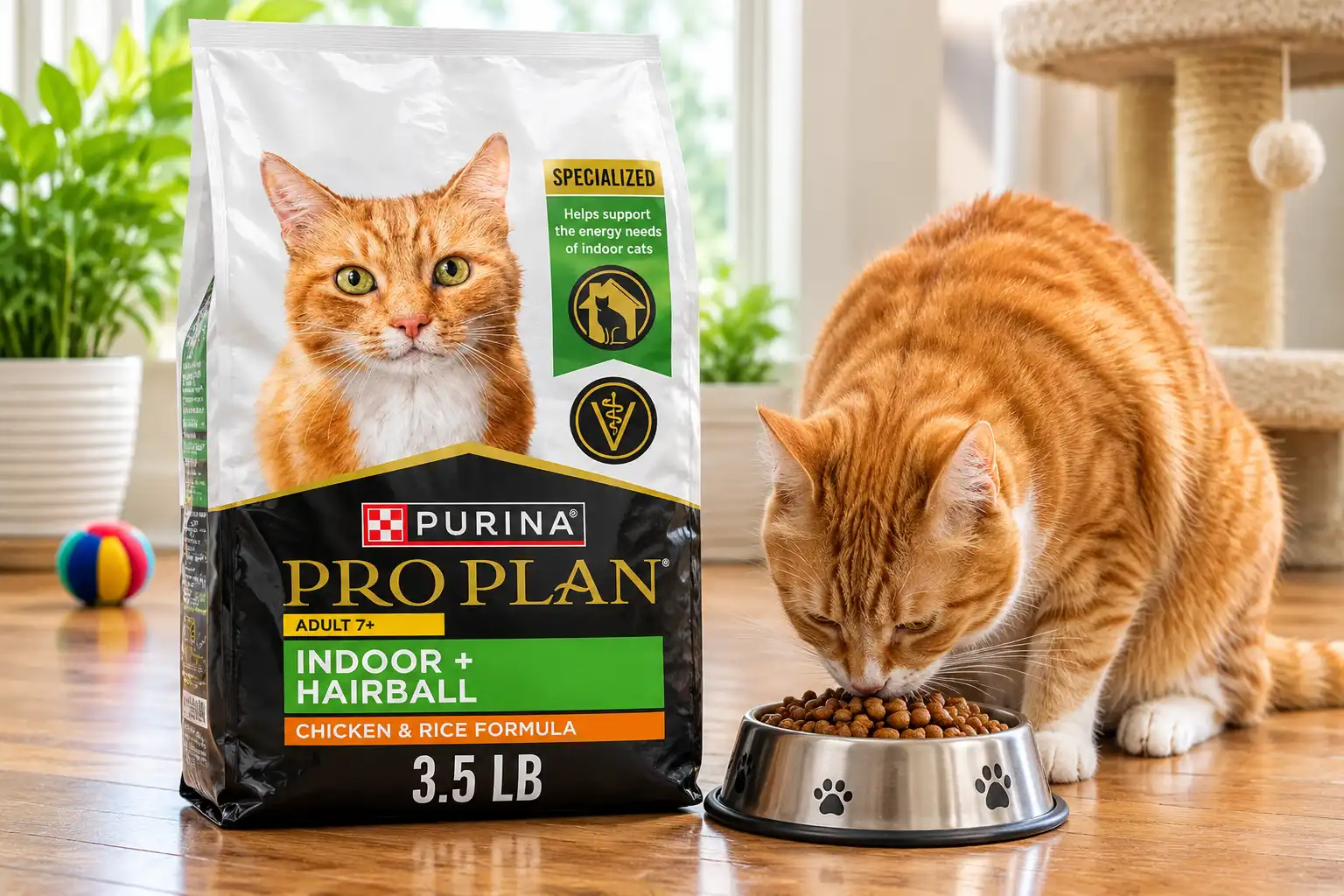
Purina Pro Plan Adult 7+ Indoor Chicken & Rice is complete and balanced for adult maintenance. AAFCO has no senior profile, so this senior cat food 7+ label is Purina’s own term. A 10 lb indoor cat eats 0.55 to 0.65 cup. Purina’s 9-year longevity study claim belongs to its former Prime Plus 7+ recipe, now AdvantEDGE Senior Support+, a denser 590 kcal per cup food. Owner reports note older cats chew the uniform kibble easily.
PROS
- Chicken is listed first
- 43.2% dry matter protein
- Moderate 403 kcal per cup
- Prebiotic fiber, per Purina
CONS
- "7+" has no AAFCO standard
Specifications:
- AAFCO: adult maintenance
- Calories: 403 kcal per cup
- Crude protein: 38% as fed, 43.2% dry matter
- First ingredient: chicken
Grain-Free, Air-Dried, and Freeze-Dried Raw: What the Research Supports
A health benefit of grain-free dry cat food for healthy cats is not established. The research is thin. Grain-free does not mean low-carb, either. Blue Buffalo Wilderness swaps grain for tapioca starch, peas, and potatoes.
The FDA Center for Veterinary Medicine investigated reports of heart disease (DCM) in dogs eating certain diets, many of them grain-free. That work concerned dogs, so it says nothing direct about cats, for or against.
Air-dried cat food, such as ZIWI Peak, is dried rather than extruded into kibble, by the maker’s description. It is not kibble, so it sits outside this list.
Freeze-dried raw food is uncooked. On January 17, 2025, the FDA required cat and dog food makers using uncooked or unpasteurized poultry or cattle ingredients to treat H5N1 bird flu as a known hazard in their food safety plans. The FDA had linked H5N1 cases in cats to contaminated food. It has also warned about Salmonella and Listeria in raw pet food, which can reach the people handling it. Talk with your veterinarian before trying raw feeding. We publish no raw or homemade recipes.
Dry Food and Water: Moisture, Urinary Health, and Adding Water
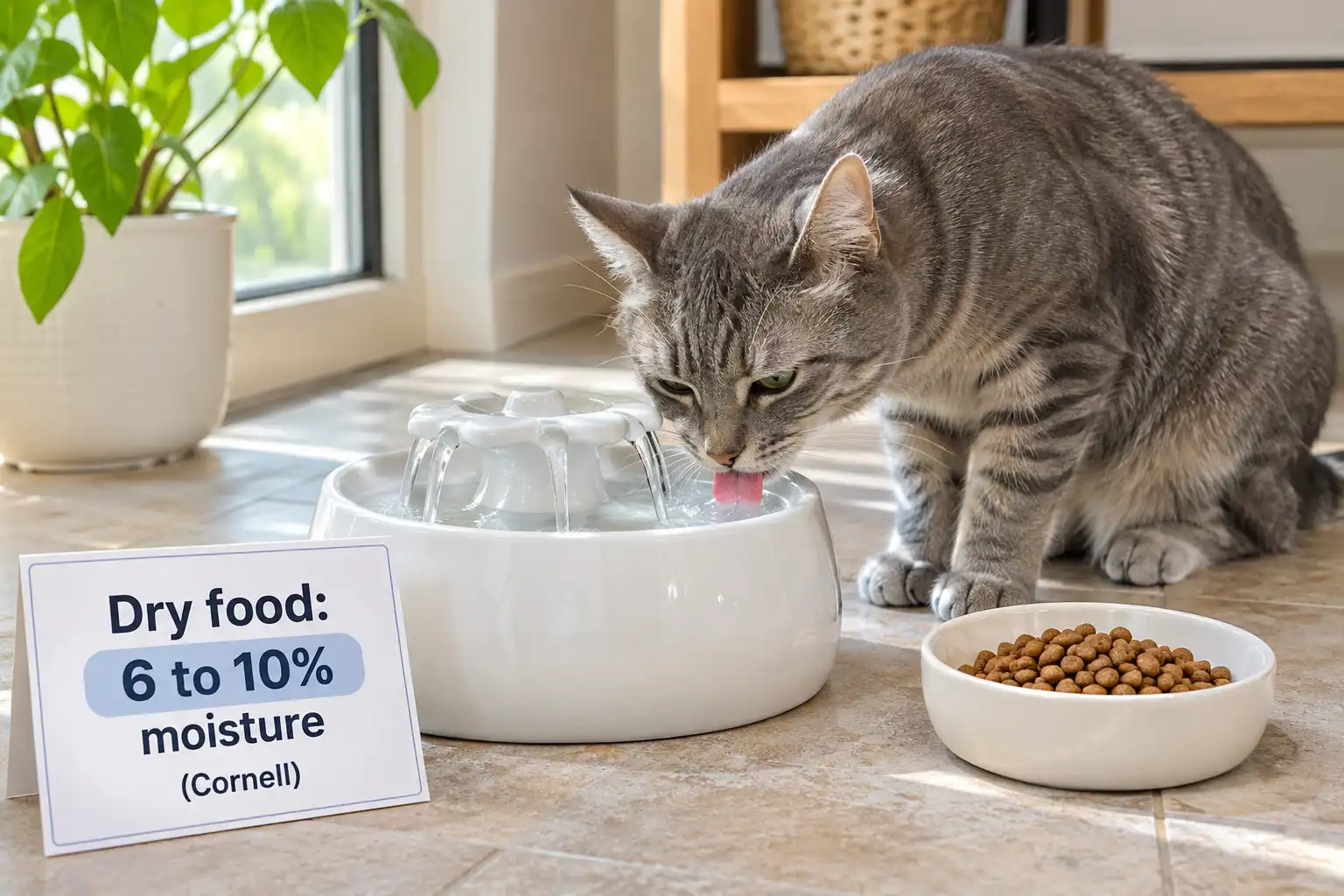
A cat that eats only kibble gets most of its water from the bowl. Published dry cat food moisture figures differ. Cornell Feline Health Center puts dry food at 6 to 10 percent moisture. The FDA says dry pet food typically runs 10 to 12 percent. Your bag’s guaranteed analysis gives its maximum, and the picks here list 8 to 12 percent.
Call your vet the same day if your cat strains in the litter box and passes little or no urine. Male cats are more prone to a urinary blockage, which is an emergency.
So is the best cat food dry or wet? Neither for every cat. Owners weighing kibble against the best wet cat food often ask about water first, and research on dry versus wet food for urinary health is split. A middle route works for many homes: add warm water to kibble (Blue Buffalo lists it as a serving option), offer a water fountain, or set bowls in more than one room. Our page on how dry and wet food compare shows how to split calories between them.
Switching to a New Dry Food Without Stomach Upset
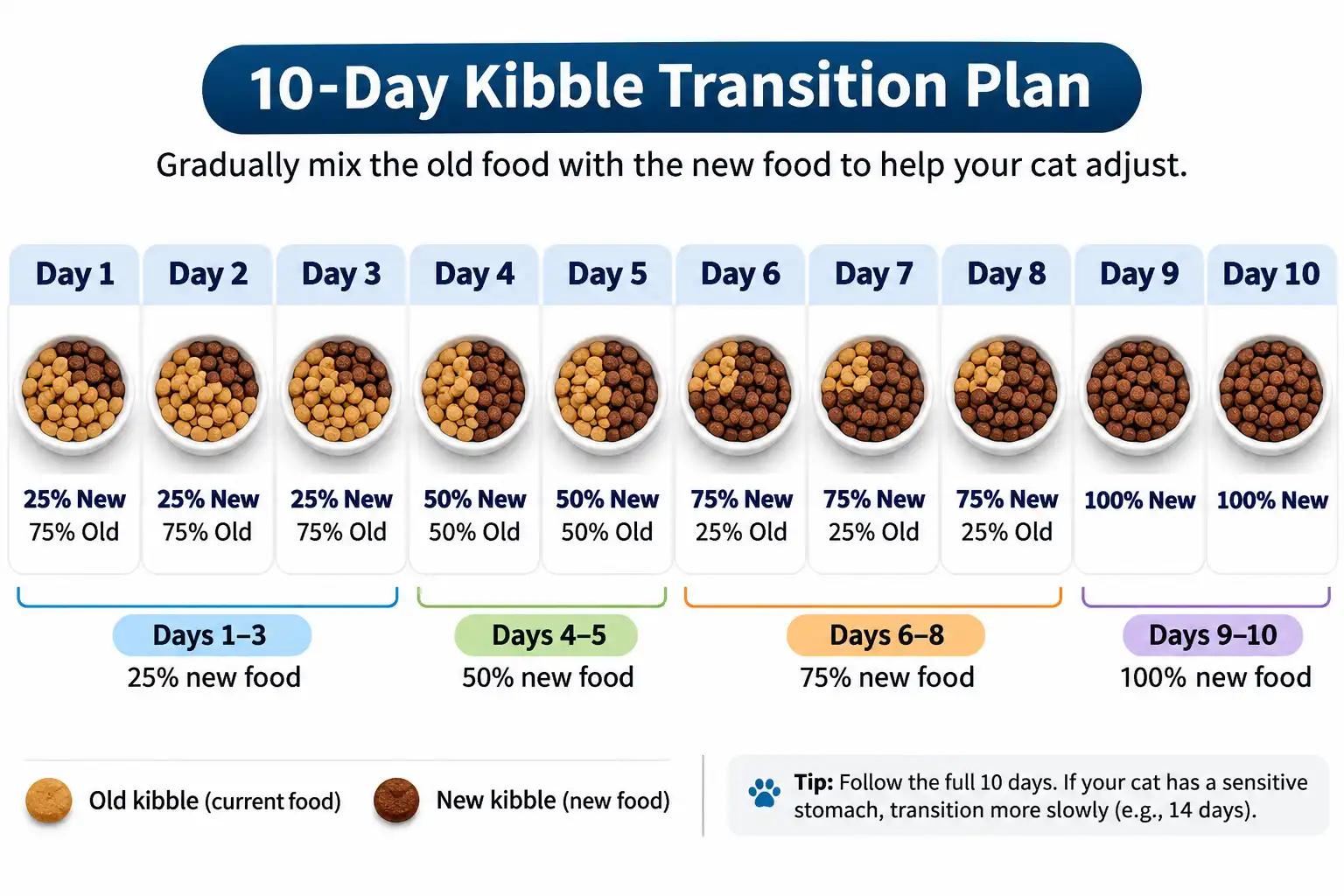
Switch over at least 7 days, and longer for a sensitive cat. Makers disagree on pace. IAMS says 4 days, Hill’s says 7, Purina and Dr. Elsey’s say 7 to 10, and Blue Buffalo says 14. Use the longer end, and step up in quarters: 25 percent new food, then 50, then 75, then all new. That is how to switch cat food with the least upset.
If your cat refuses the new food, go back a step and slow the food transition down. Never wait for hunger to win. Cornell Feline Health Center notes that a cat that stops eating, especially an overweight one, can develop hepatic lipidosis (fatty liver disease). If your cat stops eating, call your veterinarian.
FAQs About Dry Food for Cats
What is the healthiest dry cat food?
No single food is healthiest for every cat. The healthiest choice for yours is complete and balanced for its life stage, lists a named animal protein first, and has kcal per cup that fits its weight.
Is it OK to feed a cat only dry food?
Yes, if the food is complete and balanced for your cat’s life stage. Cornell Feline Health Center puts dry food at 6 to 10 percent moisture, so a kibble-fed cat gets most of its water from the bowl.
How much dry food should I feed my cat?
Start from calories, not the bag chart. AAHA’s 2021 guidelines put a 10 lb neutered indoor adult near 220 to 260 kcal a day; divide by your bag’s kcal per cup, then adjust with your vet.
Should I add water to dry cat food?
It’s optional, and it adds water to your cat’s day. Blue Buffalo, for one, lists warm water as a serving option, so serve moistened kibble fresh and lift what your cat leaves.
Is grain-free dry cat food better for cats?
No benefit is proven for cats, and the research is thin. Grain-free foods usually swap grain for peas, potatoes, or tapioca, so carbohydrates do not necessarily drop compared with grain-inclusive recipes.
Does dry food clean a cat’s teeth?
Ordinary kibble is not proven to clean teeth. The exception is a food with the VOHC seal, such as Hill’s Science Diet Oral Care for cats, which VOHC accepts for plaque and tartar control.
Should I mix wet food with dry kibble?
Yes, if both are complete and balanced for your cat’s life stage. Split the day’s calories between them, so a 10 lb indoor adult still lands near 220 to 260 kcal in total.
How long does an open bag of dry cat food stay fresh?
Use it before the best-by date, and keep it folded shut in its original bag. The FDA advises storing dry food below 80°F and keeping the lot number handy in case of a recall.
Are by-products bad in dry cat food?
No, not by definition. AAFCO’s definitions cover parts such as organs, which carry real nutrients, and exclude feathers; quality depends on the maker’s sourcing, which the label does not show.
Can kittens eat adult dry cat food?
Not as their main diet unless the bag says growth or all life stages. An adult maintenance food only meets AAFCO’s adult profile, which sits below the growth minimums kittens need.
What to Check Before You Buy
Four checks narrow the best dry cat food for your cat. First, match the AAFCO statement to its life stage: growth or all life stages for kittens, adult maintenance for adults. Next, turn kcal per cup into cups a day for its weight. Then compare protein on a dry matter basis, not as fed. Finally, keep the bag and its lot number until it’s empty, since the FDA uses lot numbers to trace recalls. A cat with a diagnosed condition eats what your veterinarian chooses, not a pick from any list.