Can Cats Eat Chocolate? Why It’s Toxic and What to Do
Chocolate sits in most kitchens, within reach of any cat that jumps on counters. Can cats eat chocolate at all, even a lick? This guide covers the risk by chocolate type, the warning signs, and the first steps when a cat gets into some.
No. Cats can’t eat chocolate because it contains theobromine and caffeine, stimulants that can cause vomiting, a racing heart, tremors, and seizures. Cocoa powder and baking chocolate are the most dangerous. If your cat ate some, call a veterinarian now.
If your cat just ate chocolate: Call your veterinarian, an emergency clinic, or a pet poison hotline now, even if your cat seems fine. Two hotlines answer 24 hours a day: the ASPCA Animal Poison Control Center (888-426-4435) and Pet Poison Helpline (855-764-7661). Both may charge a consultation fee. If your cat has tremors, seizures, labored breathing, or repeated vomiting, or collapses, go to an emergency clinic right away.
Why Chocolate Is Toxic to Cats
Chocolate is toxic to cats because it contains theobromine and caffeine. Both are methylxanthines, stimulants that come from the cacao bean. Merck Veterinary Manual notes that chocolate holds 3 to 10 times more theobromine than caffeine, but both contribute to poisoning.
These stimulants speed up the heart and overexcite the nervous system. They also act as diuretics, so an affected cat drinks and urinates more. That’s why chocolate poisoning brings restlessness and a racing heart, not just an upset stomach.
Fat is a second problem. Merck adds that rich chocolate products may trigger pancreatitis, an inflamed pancreas. Cornell Feline Health Center lists chocolate among the human foods that are off-limits for cats, alongside grapes, raisins, onions, and anything containing xylitol.
Can Cats Die From Chocolate?
Yes, chocolate can kill a cat, though cat poisonings are far less common than dog poisonings. When a case turns fatal, Merck Veterinary Manual says the cause is usually an abnormal heart rhythm, a dangerously high body temperature, or respiratory failure.
Merck explains that dogs are the most common victims because they eat almost anything. Cats also can’t taste sugar, and a 2005 study in PLoS Genetics explains why. Cats carry a nonworking version of Tas1r2, one of two genes needed to build a sweet taste receptor. As a result, a candy bar holds little pull for most cats.
Still, less common doesn’t mean safe. For any one cat, four things set the risk: chocolate type, amount, body weight, and how fast treatment starts. Merck notes that early decontamination, such as a vet making the cat vomit, can reduce how severe the signs become.
Which Chocolate Is Most Dangerous for Cats?
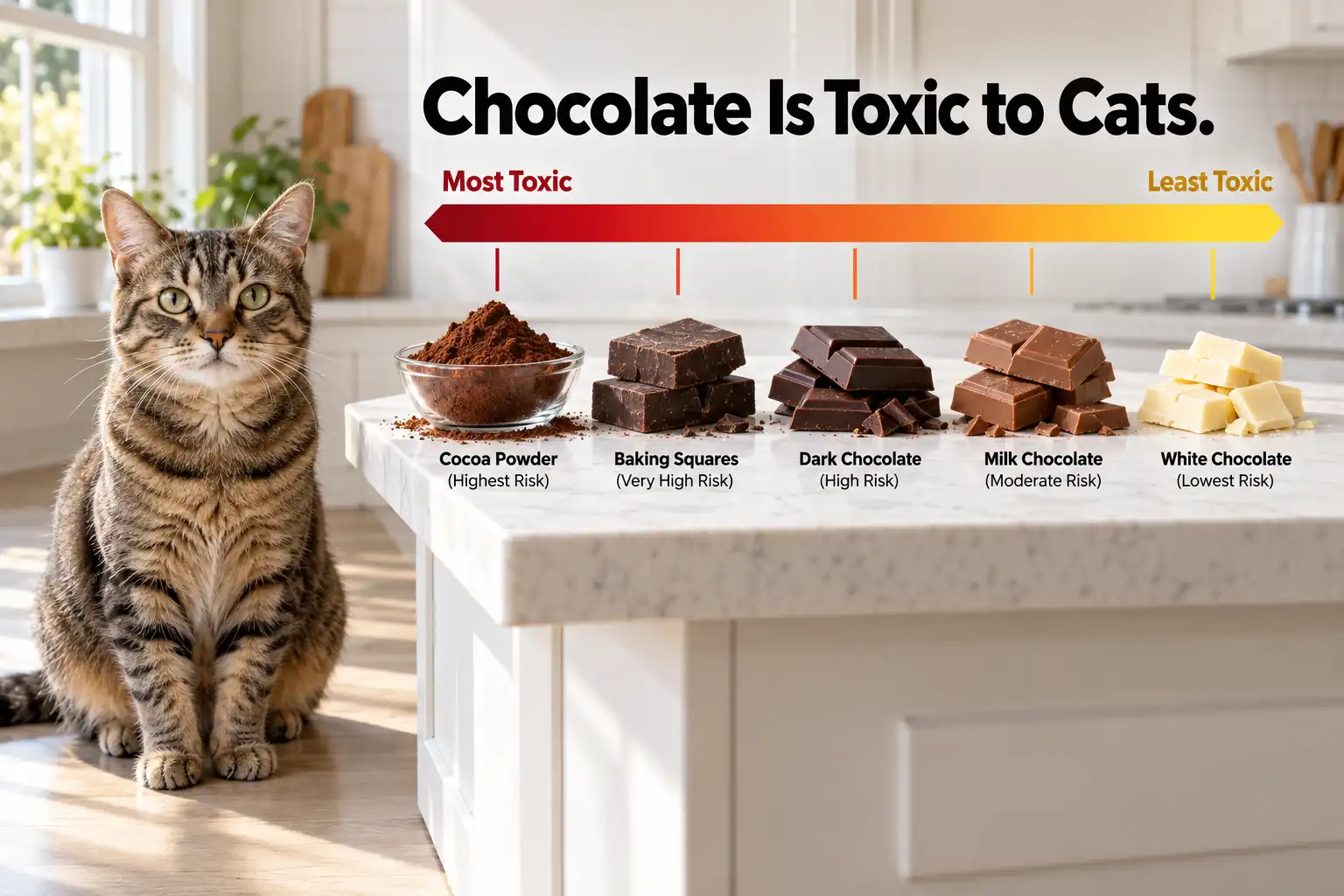
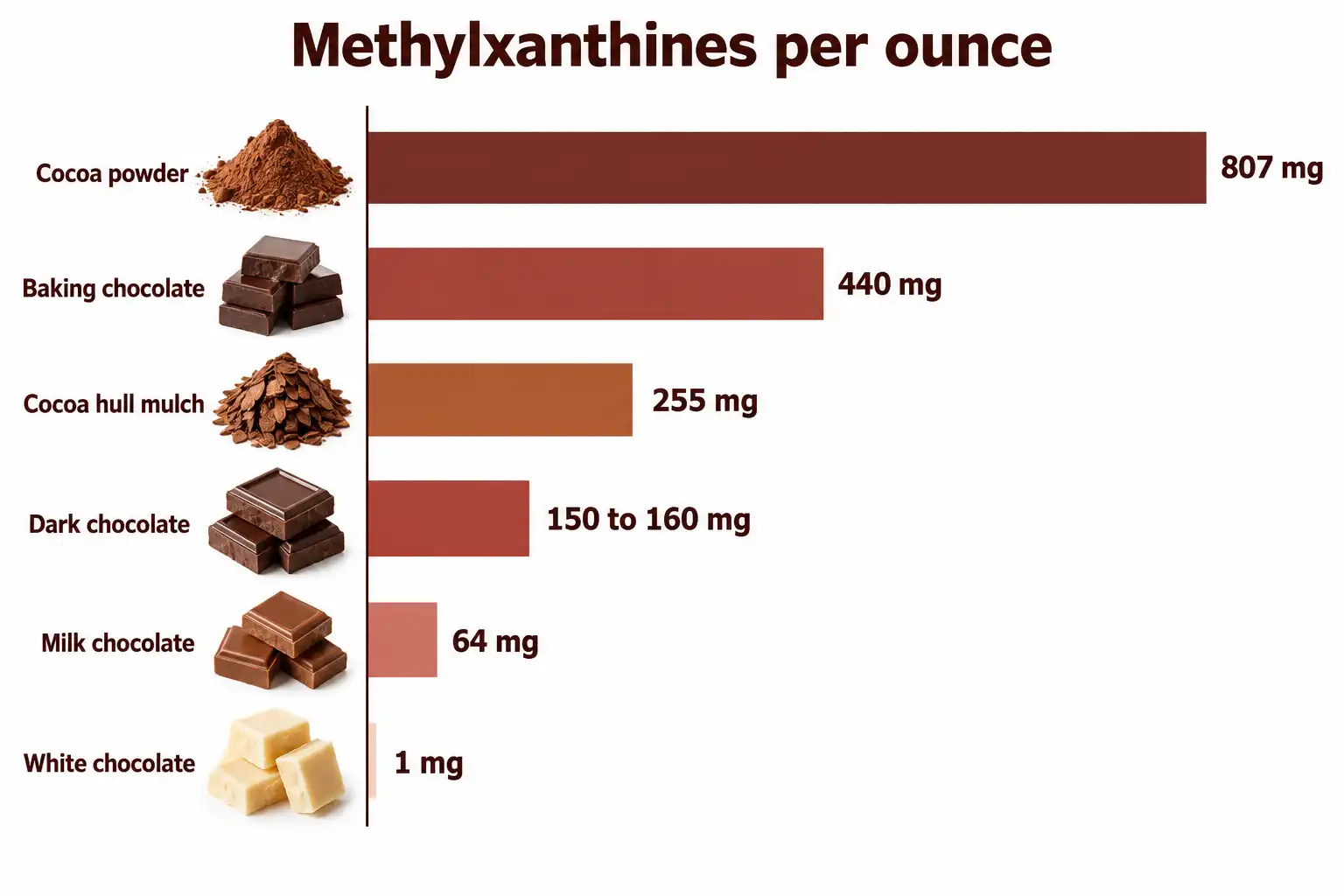
Cocoa powder and unsweetened baking chocolate are the most dangerous for cats, followed by dark chocolate. The darker and less sweet the product, the more methylxanthines it holds. Merck Veterinary Manual gives these approximate figures for theobromine and caffeine combined, and actual products vary by bean and brand.
| Chocolate type | Methylxanthines per ounce | Compared with milk chocolate |
|---|---|---|
| Cocoa powder | About 807 mg | About 13 times |
| Unsweetened baking chocolate | About 440 mg | About 7 times |
| Cocoa bean hull mulch | About 255 mg | About 4 times |
| Semisweet and sweet dark chocolate | About 150 to 160 mg | About 2.5 times |
| Milk chocolate | About 64 mg | Baseline |
| White chocolate | About 1.1 mg | Negligible |
White chocolate carries almost no theobromine. Even so, it’s a mix of fat, sugar, and dairy that cats don’t need. Baked goods vary with the recipe, so brownies, frosting, and anything made with cocoa powder or baking chocolate deserve a call.
Check the Cacao Percentage
The percentage on a dark chocolate bar shows how much unsweetened chocolate it contains, per Merck. Multiply that percentage by 440 mg, the baking chocolate figure, to estimate the bar’s content per ounce.
- 70 percent bar: 0.70 x 440 = about 308 mg per ounce, nearly 5 times milk chocolate
- 85 percent bar: 0.85 x 440 = about 374 mg per ounce, nearly 6 times milk chocolate
Merck’s dark chocolate row covers semisweet and sweet dark chocolate. A high-cacao bar can hold about twice that. So the high-cacao bars many people prefer are the riskiest bars in the house for a cat.
How Much Chocolate Is Toxic to a Cat?
No published source gives a reliable safe amount of chocolate for cats. The toxicity thresholds in Merck Veterinary Manual are dog figures, and Merck notes that sensitivity varies from one individual to the next. Converting dog numbers into a cat chart would invent a precision the research doesn’t have, so we don’t publish one.
What the math can show is scale. A 10 lb cat weighs one seventh as much as a 70 lb dog. So the same square of dark chocolate gives the cat about seven times as much theobromine per pound of body weight. A 4 lb kitten gets more than 17 times as much as that dog.
Your veterinarian or a poison hotline can run the actual calculation. Merck publishes a chocolate toxicity calculator for veterinarians that works from body weight, chocolate type, and amount eaten. Have those three facts ready, and let a professional judge the risk.
What Happens If Cats Eat Chocolate?
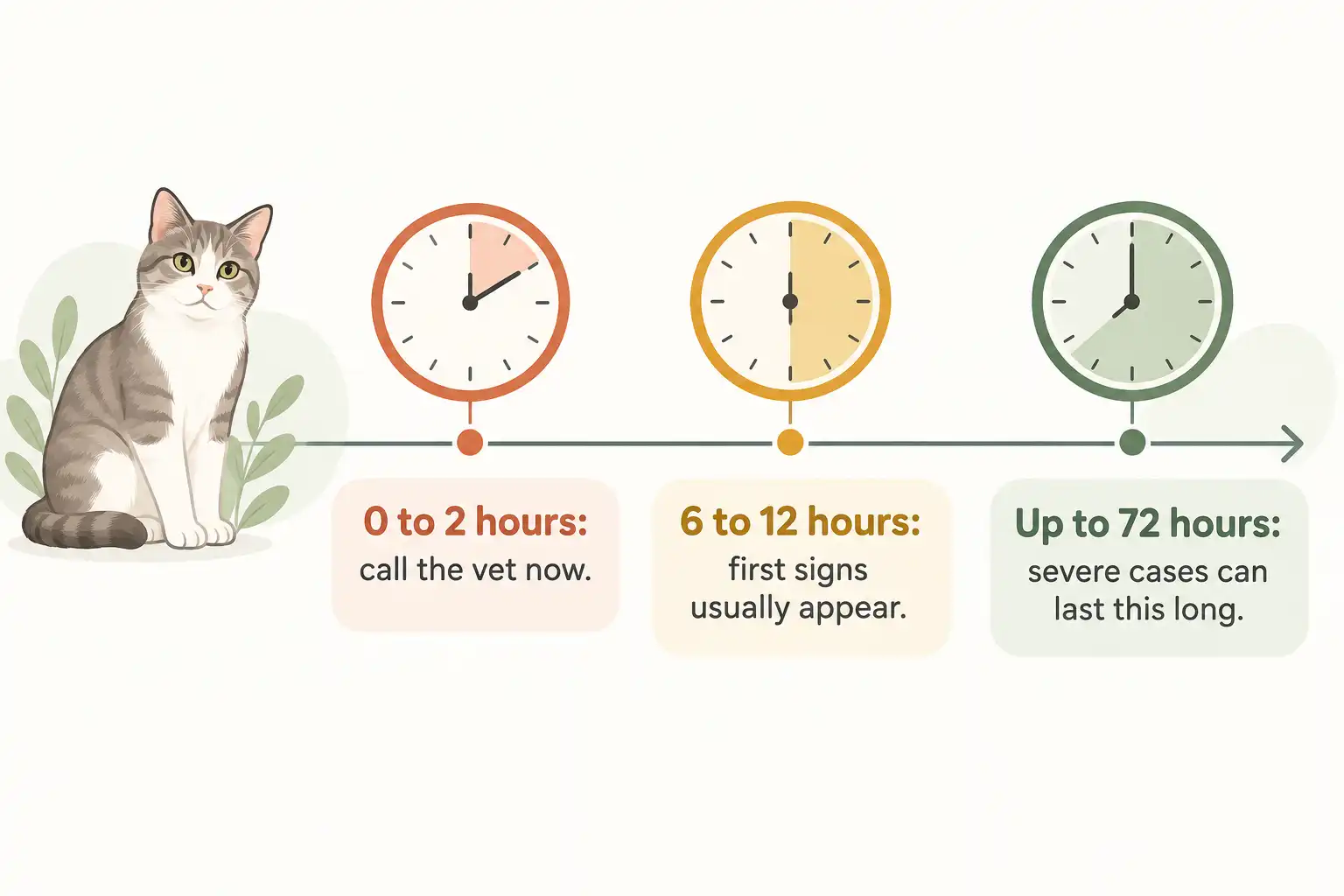
A cat that eats a toxic amount of chocolate usually shows signs within 6 to 12 hours, according to Merck Veterinary Manual. Early signs are heavy thirst, vomiting, diarrhea, a swollen belly, and restlessness. From there, signs can progress to hyperactivity, frequent urination, wobbly walking, stiffness, tremors, and seizures. The heart may race or beat irregularly. Breathing can speed up, and body temperature can climb.
| Time after eating | What to expect |
|---|---|
| First 2 hours | Signs often haven’t started. Merck notes this is when vets consider inducing vomiting in a cat that still acts normal. |
| 6 to 12 hours | First signs usually appear: thirst, vomiting, diarrhea, restlessness. |
| After that | Signs can progress to tremors, seizures, heart rhythm problems, and high body temperature. |
| Up to 72 hours | Severe cases can stay symptomatic this long. |
Merck’s timings cover every species, and dogs make up most chocolate cases. Treat them as a guide for cats, not a promise. Also, vomiting alone has many possible causes. Merck notes there’s no readily available test for chocolate poisoning, so the diagnosis rests on history and signs. That’s why the vet needs to hear about any chocolate your cat could have reached.
Cat Ate Chocolate: What to Do Right Now
Act before signs appear. Cornell Feline Health Center notes that by the time an owner spots a problem, a cat may already be at serious risk, so it advises a prompt veterinary consultation.
- Move your cat away and pick up the rest. Keep the wrapper or package.
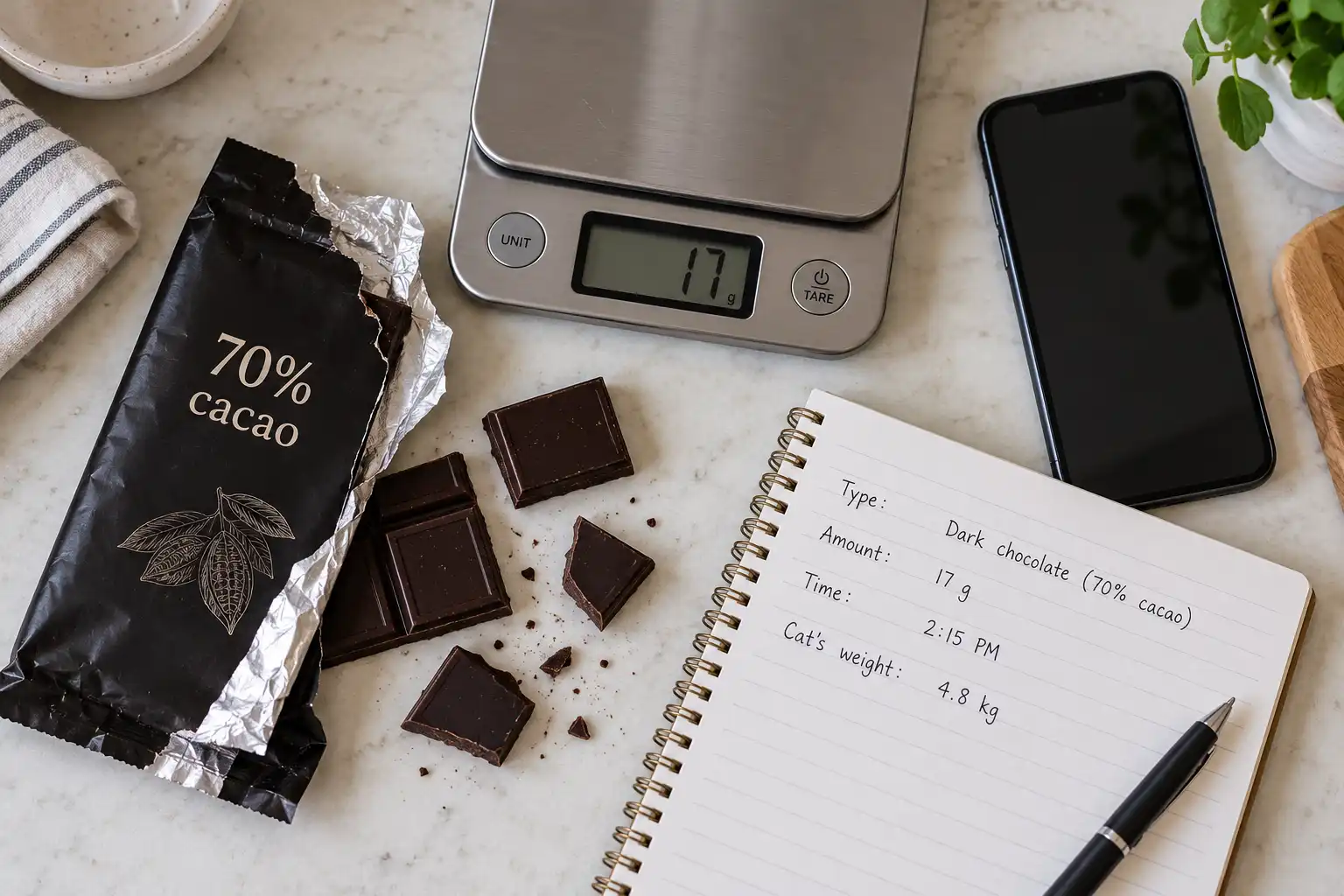
- Note what your cat ate. Write down the type, the cacao percentage, the amount missing, and the time.
- Get your cat’s weight. A recent weight from a vet visit works.
- Call now, even if your cat looks normal. Phone your vet, an emergency clinic, or a poison hotline. Merck notes that vets consider inducing vomiting only for recent exposures, roughly within 2 hours.
- Follow the instructions you get. If you’re told to come in, bring the wrapper.
Don’t Make Your Cat Vomit at Home
Never give a cat hydrogen peroxide or any other home remedy to make it vomit. Vets sometimes use hydrogen peroxide to make dogs vomit, but it can badly injure a cat. A 2017 case report in the Journal of Veterinary Emergency and Critical Care shows the danger. A cat given 3 percent hydrogen peroxide to induce vomiting developed necroulcerative hemorrhagic gastritis. That means parts of its stomach lining died, ulcerated, and bled. Instead, vets use injectable medication for cats, and only when the timing and the cat’s condition call for it.
What the Vet May Do
Treatment depends on timing and signs. Merck Veterinary Manual describes the usual options. If the chocolate went down recently and the cat is stable, the vet may induce vomiting. IV fluids then correct dehydration and help flush the stimulants out. Heart monitoring and medication manage vomiting, tremors, seizures, and abnormal rhythms. Vets also use activated charcoal cautiously, because Merck notes it can disturb sodium levels after chocolate exposure.
Afterward, follow your vet’s feeding instructions. If your cat won’t eat its usual food in the following days, call the vet back. Cornell Feline Health Center warns that a cat that refuses to eat can develop serious medical problems.
Can Cats Eat Chocolate Ice Cream?
No. Chocolate ice cream adds dairy and fat to the theobromine. The cocoa content varies by recipe, and fudge swirls, brownie pieces, and chocolate chips raise it.
Dairy is the first added problem. Cornell Feline Health Center notes that many cats are lactose intolerant and react to dairy with digestive upset. It’s the same reason milk upsets so many adult cats. Fat is the second. As with any rich chocolate product, Merck notes it may trigger pancreatitis.
Sugar-free ice cream brings another risk. Cornell lists anything containing xylitol, an artificial sweetener, among the foods that are off-limits for cats. So check the label before you assume a “light” pint is gentler.
Plain vanilla ice cream contains no theobromine. Still, the lactose and fat make it a poor treat. If your cat ate chocolate ice cream, call with the flavor, the brand, and how much is gone.
Keeping Chocolate Away From Your Cat
Cats rarely chase chocolate for its taste, so most exposures are accidents. Without a working sweet receptor, a cat licking frosting or ice cream is most likely after the fat or dairy. Kittens also chew wrappers out of curiosity. A few habits close most gaps:
- Store chocolate, cocoa powder, baking chips, and hot cocoa mix in closed cabinets. Cats jump, so a high shelf isn’t enough.
- Clean up as you bake. Spilled cocoa powder is the most concentrated chocolate product in the kitchen.
- Cover candy bowls during Halloween, Valentine’s Day, Easter, and the winter holidays.
- Use a lidded trash can for wrappers.
- Keep mugs of hot cocoa or mocha and chocolate-covered coffee beans out of reach. Coffee adds more caffeine.
Safer Treats for Cats
Skip chocolate entirely and pick treats made for cats, counted against the day’s calories. For an adult cat, AAHA recommends that treats supply no more than 10 percent of daily calories. Cornell Feline Health Center allows 10 to 15 percent of a cat’s daily calories.
Here’s what that range means in practice. A 10 lb (4.54 kg) spayed or neutered adult cat has a resting energy of about 218 kcal, using the formula in AAHA’s 2021 guidelines (70 x 4.54^0.75). AAHA starts this adult cat at 1.0 to 1.2 times that, or about 220 to 260 kcal a day. For this adult, 10 percent leaves about 22 to 26 kcal for treats, and 15 percent leaves about 33 to 39 kcal. The daily food calculator gives the figure for your own cat.
Good choices include cat treats with a calorie statement on the label or a bite of plain cooked egg. Better still, hold back a few pieces of the day’s dry food. Served from a puzzle or slow feeder, that kibble becomes a treat with no added calories.
Frequently Asked Questions
Is white chocolate safe for cats?
No, though it’s the least toxic type. Merck Veterinary Manual puts white chocolate at about 1.1 mg of methylxanthines per ounce, but it’s still fat, sugar, and dairy that cats don’t need.
My cat only licked chocolate. Do I need to call the vet?
Yes, call your vet or a poison hotline, even for a lick. The risk depends on the product and your cat’s weight, and a professional can tell you whether watching at home is enough.
How long after eating chocolate does a cat show symptoms?
Signs usually appear within 6 to 12 hours, according to Merck Veterinary Manual. Severe cases can last up to 72 hours, so call your vet before any signs start rather than waiting to see.
Can cats have hot chocolate or chocolate milk?
No, because both drinks usually start with cocoa powder, the most concentrated product in Merck Veterinary Manual’s chocolate table. Both also contain milk, and Cornell Feline Health Center notes that many cats are lactose intolerant.
Can kittens eat chocolate?
No, and the same bite carries more risk for a kitten. A 4 lb kitten weighs less than half as much as a 10 lb adult cat, so it gets more than twice the theobromine per pound.
Is cocoa mulch dangerous for cats?
Yes, it can be. Merck Veterinary Manual reports deaths in animals that ate cocoa bean hull mulch, which can hold about 255 mg of methylxanthines per ounce, though some brands remove them during manufacturing.
The Practical Takeaway
Treat any chocolate your cat eats as a reason to call, not to wait. Keep the wrapper, know your cat’s weight, and phone your vet or a poison hotline right away. Skip home remedies, especially hydrogen peroxide. Then store cocoa powder and dark chocolate as carefully as medication, and keep treats to food made for cats.