Can Cats Eat Dog Food? Risks, Safety, and What to Do
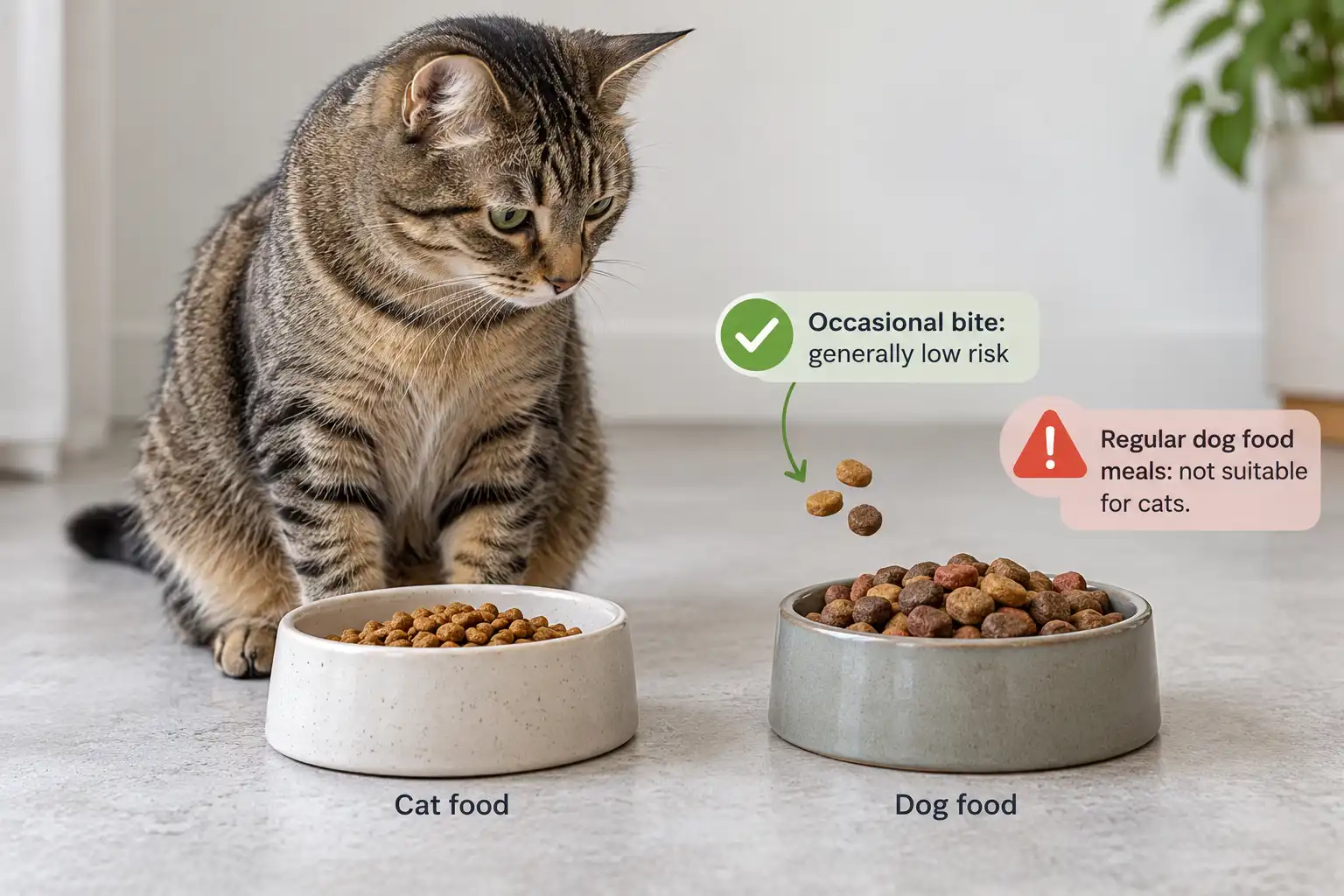
Can cats eat dog food? An occasional bite is unlikely to cause problems, but regular feeding is different. Although cat and dog foods share ingredients, they are formulated for different nutritional needs. Understanding those differences helps you decide when to monitor your cat and when to contact a veterinarian.
Cats can eat a few bites of ordinary dog food without problems in most cases. However, dog food is not suitable for regular meals. If your cat stops eating or vomits repeatedly, seek same-day veterinary care.
Is It Bad for Cats to Eat Dog Food?
Dog food is unsuitable as a regular diet for cats. However, the risk depends on how much a cat eats, how often it happens, and whether the cat has an underlying health condition.
A few stolen kibbles usually do not harm a healthy cat. The concern increases when dog food replaces normal meals.
According to VCA Animal Hospitals, occasional small amounts are generally tolerated, but commercial dog foods do not provide the complete nutritional balance cats need.
What happens if a cat eats dog food?
| Situation | Possible concern | What you should do |
|---|---|---|
| Eats a few dog kibbles | Usually low risk for a healthy cat | Return to regular cat food and observe |
| Eats wet dog food once | Possible digestive upset | Monitor appetite and stool |
| Eats a whole dog food meal | May cause digestive upset; not balanced for cats | Resume appropriate cat food and watch for symptoms |
| Regularly eats dog food | Nutrient deficiencies may develop | Contact your veterinarian for dietary guidance |
| Eats dog food while on a therapeutic diet | May interfere with prescribed nutrition | Contact your veterinarian for advice |
A cat’s normal behavior after eating dog food is reassuring, but it does not prove that regular feeding is safe. Nutritional problems can develop without obvious early warning signs.
Why Is Dog Food Not Suitable for Cats?
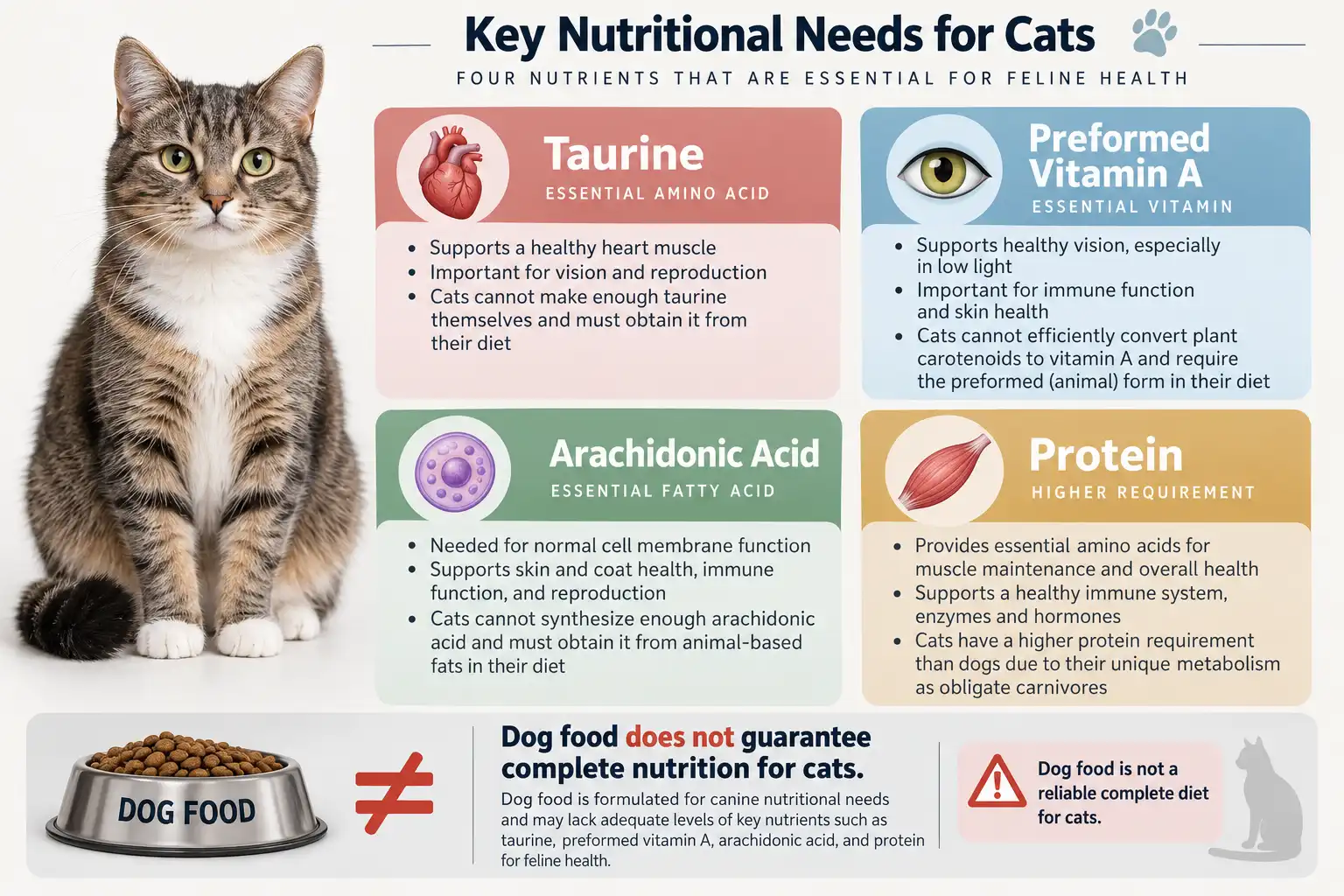
Cats are obligate carnivores. They depend on specific nutrients that must come from their diet. According to the Merck Veterinary Manual, dog food may lack adequate amounts of several nutrients essential to cats. These include taurine, preformed vitamin A, arachidonic acid, and sufficient protein.
1. Taurine supports heart and eye health
Taurine is an essential amino acid that cats must obtain through food. Insufficient taurine over time can contribute to serious problems, including dilated cardiomyopathy, a disease affecting heart muscle function, and retinal degeneration that can damage vision.
Some dog foods contain taurine. However, their formulations do not necessarily provide the amounts cats require.
2. Cats need preformed vitamin A
Cats cannot efficiently convert beta-carotene from plant ingredients into usable vitamin A. Instead, their diets must supply preformed vitamin A. This nutrient supports normal vision, immune function, and other essential processes.
Dog food is not necessarily formulated to meet that requirement.
3. Cats require arachidonic acid
Arachidonic acid is an essential fatty acid for cats. It supports normal cell function and several physiological processes. Cats have limited ability to produce enough of it from other dietary fatty acids.
Cat food must provide adequate amounts, while dog food may not supply enough for cats.
4. Cats have higher protein requirements
Cats require more dietary protein than dogs to maintain normal body functions. According to the Merck Veterinary Manual’s nutritional requirements, AAFCO specifies a minimum crude protein level of 26% on a dry matter basis for adult cats and 30% for growing kittens and reproducing cats.
These are minimum nutritional profile levels, not ideal targets for every individual cat.
A dog food with a high protein percentage is not automatically suitable for cats. It must also provide the correct balance of amino acids, fatty acids, vitamins, and minerals.
Can Cats Eat Wet Dog Food?
A small accidental amount of wet dog food is unlikely to harm most healthy cats. However, wet dog food is no more suitable for regular feeding than dry dog food. The main difference between wet and dry food is moisture content, not whether the food meets feline nutritional requirements.
Wet dog food may contain meat, organs, and other ingredients also found in wet cat food. However, similar ingredients do not guarantee the same nutrient balance. The Tufts University Cummings School of Veterinary Medicine explains that both wet and dry cat foods can provide adequate nutrition when properly formulated.
Therefore, if your cat prefers moist food, choose complete and balanced wet cat food instead of canned dog food. For a closer comparison of moisture, nutritional composition, and feeding considerations, see how wet and dry cat foods differ.
What Should You Do If Your Cat Eats Dog Food?
If your cat accidentally eats a small amount of ordinary dog food and appears healthy, you can usually monitor them at home. However, a larger amount, repeated exposure, or symptoms require more attention.
Follow these steps:
- Remove access to the dog food. Move the bowl or secure the remaining food to prevent further eating.
- Check what your cat ate. Identify the product, approximate amount, and whether it was ordinary food, a treat, or a special formulation. Contact your veterinarian if you suspect a harmful ingredient.
- Offer regular cat food. Continue your cat’s normal meals and provide fresh water. Do not withhold food to compensate for the dog food.
- Watch for changes. Pay attention to vomiting, diarrhea, reduced appetite, unusual behavior, or weakness.
- Contact your veterinarian when appropriate. Seek advice if your cat ate a substantial amount, has a medical condition, or regularly eats dog food.
If your cat has been eating mostly dog food, arrange veterinary advice on returning to balanced feline nutrition. Do not continue feeding dog food simply to avoid a dietary change.
When Can Dog Food Hurt Cats Enough to Need Veterinary Care?
Dog food can cause short-term digestive problems in some cats. Regular consumption can also contribute to nutritional deficiencies, even without immediate symptoms. Contact your veterinarian if your cat develops diarrhea, appears uncomfortable, loses weight, or regularly chooses dog food instead of cat food.
Seek same-day veterinary care if your cat stops eating or vomits repeatedly. Breathing difficulty, sudden weakness, or straining to urinate with little or no urine output also require immediate veterinary attention.
According to the Cornell Feline Health Center, loss of appetite can become dangerous quickly. Prolonged food refusal increases the risk of serious complications, including hepatic lipidosis, a liver condition.
Vomiting can have several causes beyond eating an unfamiliar food. Learn more about possible reasons cats vomit and which symptoms require prompt veterinary care.
What Should You Feed Your Cat Instead of Dog Food?
Choose complete and balanced cat food formulated for your cat’s life stage. According to the FDA, a food labeled “complete and balanced” must meet the applicable AAFCO nutrient profile or satisfy AAFCO feeding-trial requirements. However, the statement must identify the appropriate species and life stage.
Check the nutritional adequacy statement
Look for wording similar to:
Formulated to meet the nutritional levels established by the AAFCO Cat Food Nutrient Profiles for adult maintenance.
The statement identifies the intended species and nutritional life stage.
The word Cat matters. A dog food that meets AAFCO Dog Food Nutrient Profiles is not automatically suitable for cats.
The AAFCO label guidance also explains why ingredients and guaranteed analysis percentages alone cannot establish complete nutritional adequacy.
For more information, see how to read nutritional information on cat food packaging.
Choose food for your cat’s life stage
Cats have different nutritional needs during growth, adulthood, and reproduction.
- Kittens: Choose complete and balanced food labeled for growth or all life stages for cats.
- Healthy adult cats: Choose cat food appropriate for adult maintenance, or a suitable all-life-stages formula while managing calorie intake.
- Pregnant or nursing cats: Select feline nutrition intended for growth and reproduction, with veterinary guidance.
- Senior cats: AAFCO does not establish a separate senior nutrient profile. Food selection depends on the cat’s health, body condition, and individual needs.
For growing cats, the differences between kitten and adult dry food explain why matching the life stage matters.
Cats with kidney, urinary, gastrointestinal, or other diagnosed conditions may need veterinarian-selected therapeutic diets.
What If You Run Out of Cat Food?
If you run out of cat food, obtain an appropriate replacement as soon as possible rather than routinely substituting dog food. A complete and balanced wet cat food can replace dry cat food when the usual dry product is unavailable, provided the formula suits your cat’s life stage and health needs.
Likewise, suitable dry cat food can replace wet cat food for many healthy cats.
Keep these points in mind:
- Check that the product is labeled for cats.
- Confirm the nutritional adequacy statement and life stage.
- Follow the new food’s feeding directions, accounting for different calorie densities.
- Avoid using treats or supplements as a replacement for complete meals.
Gradual changes between cat foods may reduce digestive upset. However, do not prolong dog-food feeding or allow your cat to miss meals to follow a transition schedule.
If your cat refuses the available cat food, contact your veterinarian the same day. Cats on therapeutic diets need individualized replacement advice.
How Can You Stop Your Cat From Eating Dog Food?
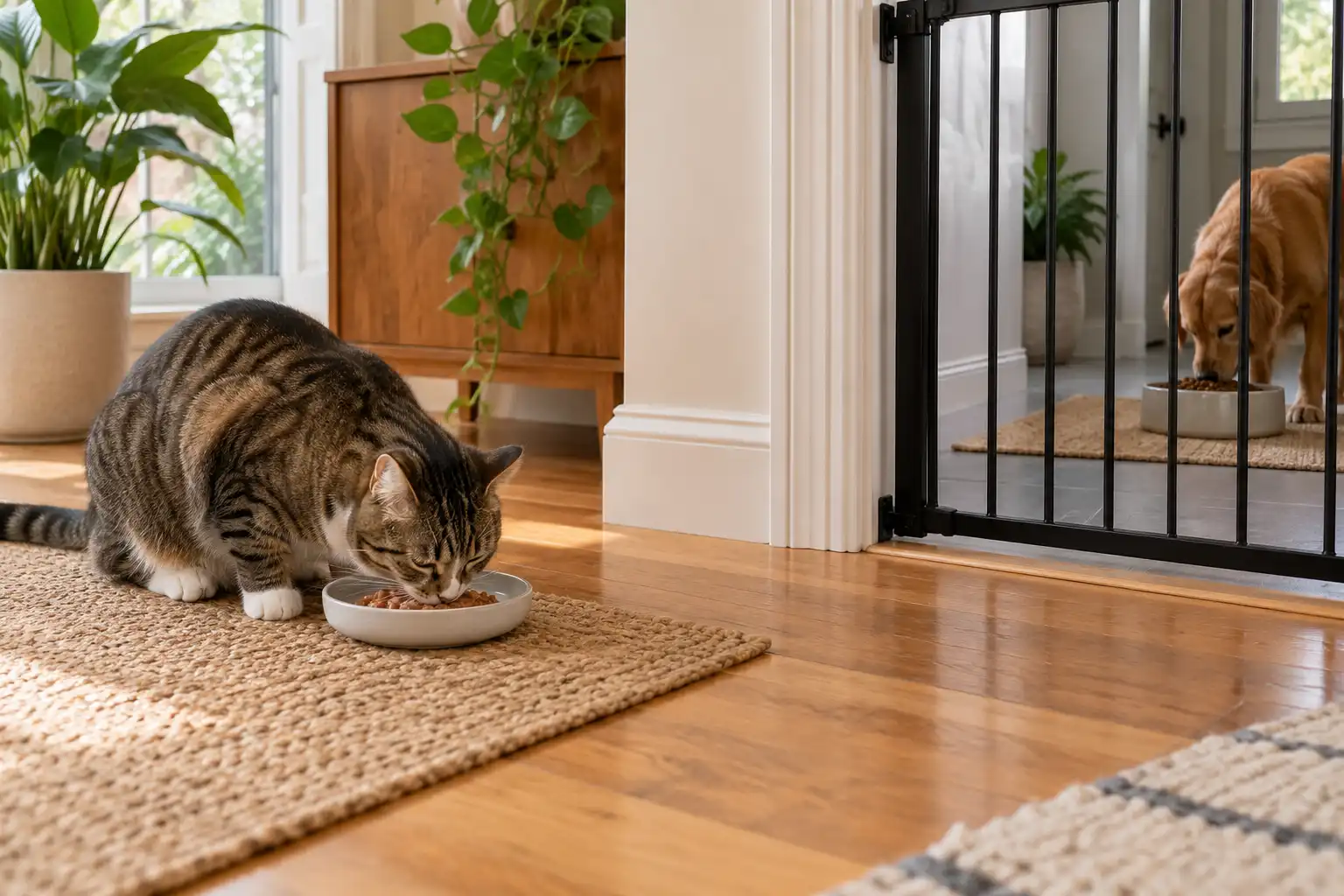
The simplest prevention method is to keep cat and dog feeding areas separate. This also makes it easier to track your cat’s actual food intake and identify appetite changes.
1. Use separate feeding locations
Place the cat’s food in a quiet area away from the dog’s meals.
If necessary, use separate rooms or a suitable physical barrier during feeding.
2. Avoid leaving dog food accessible
If the dog has finished eating, remove its remaining food when appropriate for its feeding plan.
Store dry dog food in a secure container that your cat cannot open.
3. Monitor your cat’s normal meals
Make sure your cat is eating the expected amount of complete and balanced cat food.
If your cat consistently leaves its normal meals to eat dog food, discuss possible appetite or feeding problems with your veterinarian.
4. Consider an access-controlled feeder
In households where food must remain available, a compatible microchip or access-controlled feeder may help separate feeding.
However, the device must be suitable for the household and reliably prevent the wrong animal from accessing the food.
Frequently Asked Questions
Can dog food hurt cats if they eat it every day?
Yes. Regular dog food consumption may leave cats without enough taurine, protein, and other essential nutrients, even if they initially appear healthy. A veterinarian should assess prolonged exposure and recommend appropriate feline nutrition.
What if my cat ate a whole bowl of dog food?
A single meal does not automatically cause a nutritional deficiency, but it may cause digestive upset. Resume appropriate cat food and contact your veterinarian if your cat develops symptoms or ate an unusually large amount.
Can kittens eat dog food?
Dog food should not replace kitten food because growing cats have specific nutritional requirements. A tiny accidental taste is usually less concerning, but contact your veterinarian promptly if your kitten refuses food or develops symptoms.
Why does my cat prefer dog food?
Some cats may be attracted to dog food’s smell, texture, or availability. However, preference does not indicate nutritional suitability, and a cat that consistently avoids its own food needs prompt veterinary attention.
Does adding taurine to dog food make it suitable for cats?
No. Taurine is only one essential nutrient, and adding it cannot correct every nutritional difference between cat and dog food. Supplements should not be used to convert dog food into a feline diet.
Is cat food good for dogs, or can you feed a dog cat food?
Cat food is not appropriate as a dog’s regular diet because nutritional requirements differ. An occasional small amount may be tolerated, but dogs that develop digestive symptoms or have medical conditions need veterinary advice.
Keeping Your Cat’s Diet Safe and Balanced
A few bites of ordinary dog food are unlikely to cause lasting harm to an otherwise healthy cat. However, that does not make dog food a suitable replacement for complete and balanced cat food.
The main concern is nutritional adequacy. Cats require specific amounts of taurine, protein, fatty acids, vitamins, and minerals. Dog food does not necessarily provide these nutrients in the correct balance, even when its ingredients appear similar.
The safest routine is straightforward. Choose cat food appropriate for your cat’s life stage, maintain separate feeding areas, and pay attention to appetite changes. If dog food has become a regular part of your cat’s diet, seek veterinary guidance. Prompt attention to food refusal or other concerning symptoms also helps protect your cat’s health.