
Can Cats Eat Watermelon? Safe Portions, Seeds, and Rind
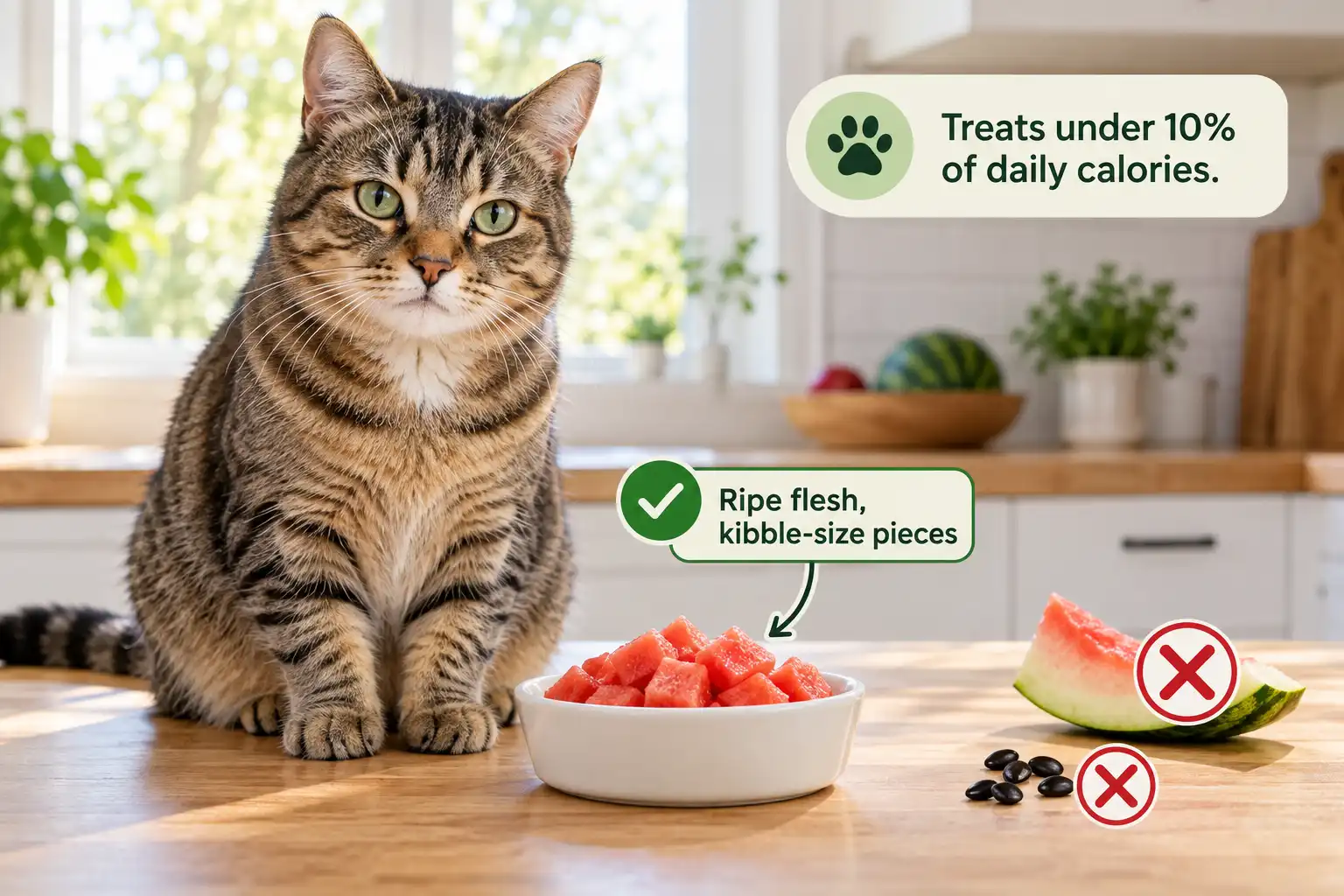
Summer fruit bowls put watermelon within easy reach of a curious cat. Can cats eat watermelon without trouble? That depends on which part of the melon, how much, and which cat. Below are the treat math, the prep steps, and the cats that should skip it.
Yes, cats can eat watermelon in small amounts. A healthy adult cat can have a few kibble-size pieces of ripe flesh as an occasional treat. Remove every seed and all the rind before serving.
Is Watermelon Bad for Cats?
No, ripe watermelon flesh is not toxic to cats. The trouble comes from the seeds, the rind, and oversized servings.
WSAVA’s 2025 guide to treats for cats lists the foods that are toxic to them. Onions, garlic, grapes, raisins, chocolate, xylitol, alcohol, raw yeast dough, and caffeinated drinks all make that list. Melon does not. Tufts Cummings School’s Petfoodology team also lists watermelon, honeydew, and cantaloupe as low-calorie treats for dogs and cats.
Safe is not the same as useful, though. Cornell Feline Health Center describes cats as obligate carnivores that rely on nutrients found only in animal products. A complete and balanced dry food already covers those needs. So watermelon is a treat, not a nutritional boost.
Tufts adds one caveat. Treats that suit a healthy cat may not suit one with a medical condition, so a cat under treatment gets the vet’s answer first.
What Watermelon Adds to a Cat’s Bowl
Mostly water, plus a little sugar. USDA FoodData Central lists raw watermelon at 91.45 percent water. Each 100 g holds 30 kcal, 6.2 g of sugar, and 0.4 g of fiber. Protein and fat barely register, at 0.61 g and 0.15 g.
That is close to the reverse of what a cat’s food is built on. As a result, watermelon adds nothing an adult cat on a complete and balanced food is missing. It is an extra for interest, not for nutrition.
Cats Can’t Taste the Sweetness
Cats lack a working sweet-taste receptor. A 2005 study in PLoS Genetics, available through NIH PubMed Central, found that the cat gene Tas1r2 is a pseudogene. That means one half of the sweet receptor never forms. Domestic cats, tigers, and cheetahs all carried the same defect.
So sugar is not what draws a cat to melon. The cool, wet texture or plain curiosity may be the appeal, but we found no study that pins down which. If your cat ignores watermelon, it misses nothing.
How Much Watermelon Can a Cat Have?
For a healthy adult cat, a few kibble-size pieces make a modest treat. That is about 10 g of flesh, or 3 kcal at USDA’s 30 kcal per 100 g. Weigh it once on a kitchen scale, as Tufts recommends for fruit treats, because volume measures are easy to misjudge.
No veterinary body sets a watermelon serving for cats specifically. What exists is the treat rule. WSAVA says treats should stay under 10 percent of a cat’s daily calories. Its 2025 guide then converts that into a daily treat ceiling for a healthy adult cat in ideal body condition. Tufts, for its part, counts 1/3 cup of diced watermelon (50 g) as 15 kcal.
Here is how both servings fit WSAVA’s ceilings, converted from kilograms to pounds.
| Healthy adult cat, ideal body condition | WSAVA daily treat ceiling | 10 g watermelon (3 kcal) uses | 50 g watermelon (15 kcal) uses |
|---|---|---|---|
| 6.6 lb | 20 kcal | 15% | 75% |
| 8.8 lb | 22 kcal | 14% | 68% |
| 11 lb | 25 kcal | 12% | 60% |
| 13.2 lb | 26 kcal | 12% | 58% |
| 15.4 lb | 28 kcal | 11% | 54% |
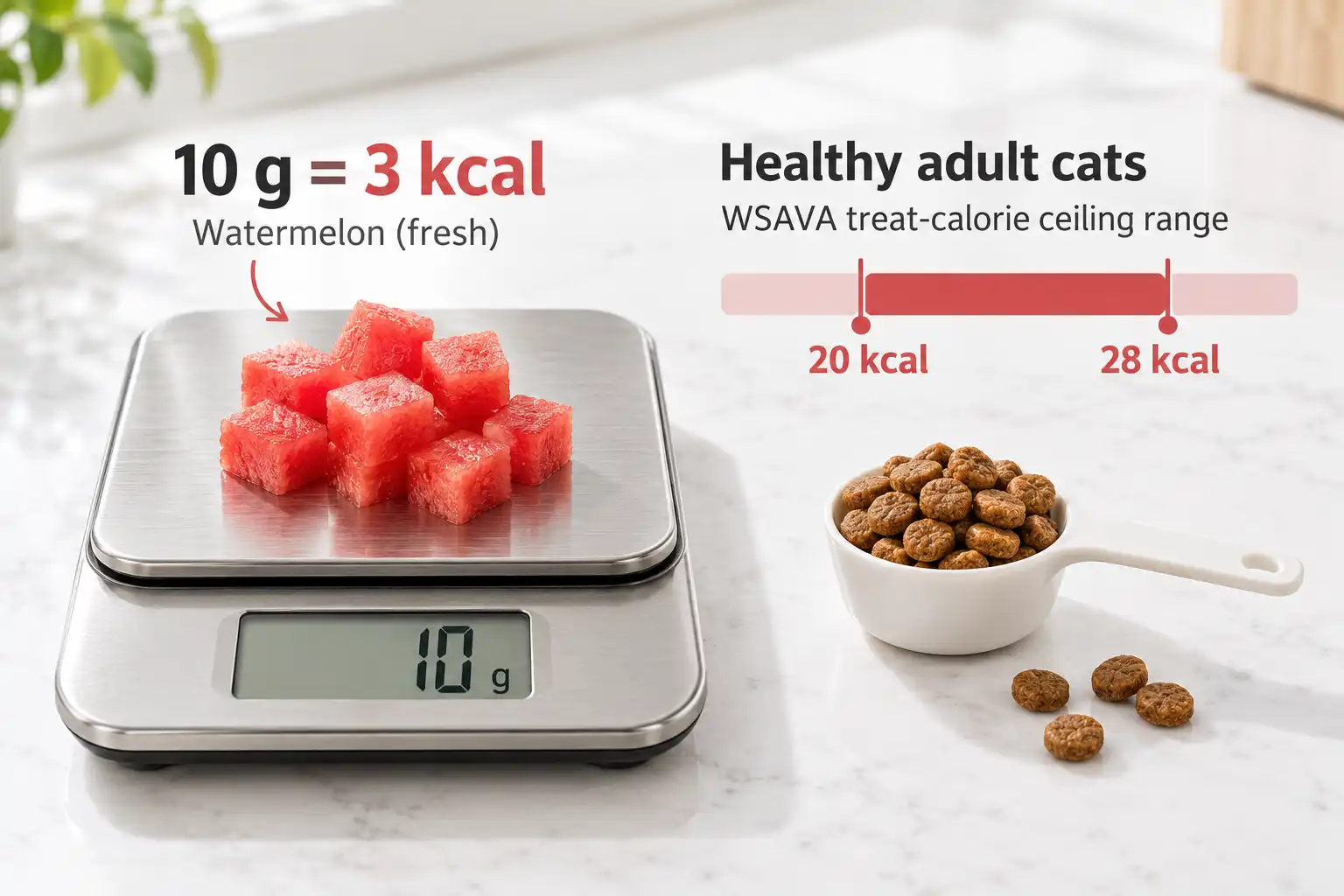
Ten grams leaves most of the allowance free. The 50 g portion, however, takes more than half of it at every weight. WSAVA bases its figures on an average adult cat and does not split them by neuter status or indoor life. Ask your veterinarian for your own cat’s number. An overweight cat’s treat budget comes from the vet’s weight-loss plan instead.
Run the Math for Your Cat
Two lines of arithmetic cover any cat and any serving:
- Treat ceiling (kcal) = daily kcal x 0.10
- Watermelon (kcal) = grams of flesh x 0.30
For example, a healthy adult cat near 10 lb has a WSAVA ceiling of 24 kcal. Twenty grams of watermelon would use 6 kcal, a quarter of it. If you don’t know your cat’s daily figure, the daily food calculator gives an adult starting estimate to confirm with your vet.
Trim the Kibble When Treats Add Up
A few pieces of melon need no change to the bowl. Three kcal is about 1 percent of the roughly 240 kcal behind WSAVA’s ceiling for a 10 lb adult cat. But if treats regularly approach the ceiling, take their calories out of the dry food.
On a food whose label lists 400 kcal per cup, 15 kcal of watermelon equals just under 2 teaspoons of kibble. Set the base portion first by working out daily cups of kibble from body weight and the label’s calorie statement.
How to Prepare Watermelon for a Cat
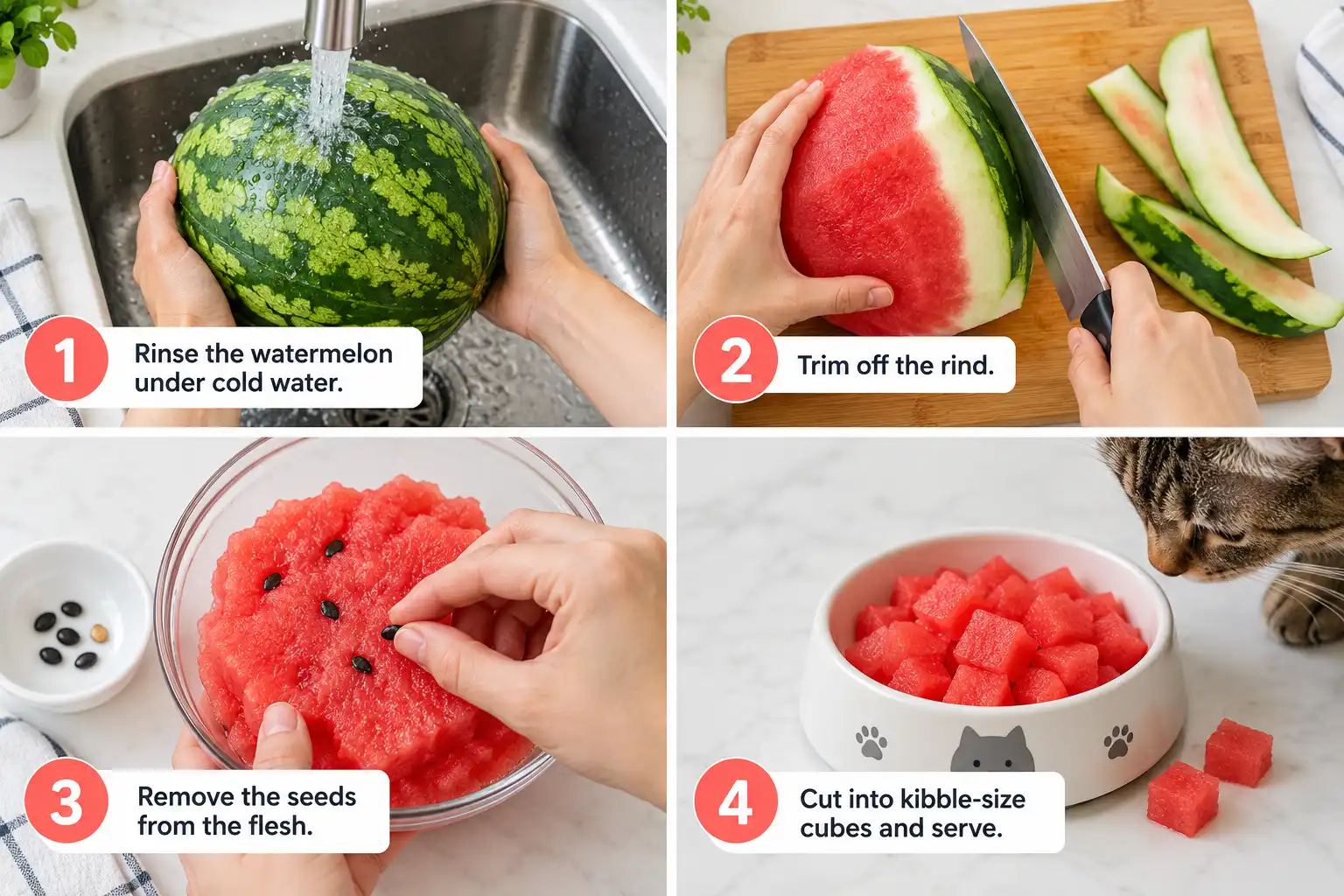
Six steps take a few minutes, and each one removes a specific risk.
- Wash the whole melon first. The FDA advises washing produce under running water before cutting, even when you won’t eat the peel. A knife can carry bacteria from the rind into the flesh.
- Cut off all the rind. Take the pale green layer under the red flesh too. It is tough and hard for a cat to chew.
- Pick out every seed. Check for the soft white seeds in “seedless” melons as well, since they are easy to miss.
- Dice kibble-size pieces. WSAVA asks owners to size treats to cut the risk of choking.
- Serve it plain. No salt, seasoning, yogurt, or syrup.
- Watch the next day. Loose stool or vomiting after a new food is a reason to stop offering it.
After that, store leftover cut melon covered in the refrigerator.
Seeds, Rind, and Watermelon Foods to Skip
Offer the red flesh only. WSAVA warns that an unsuitable treat can injure a cat or cause a blockage, and two parts of the melon fit that warning.
- Seeds: mature black seeds are hard and slippery, so a cat can choke on them or swallow them whole.
- Rind: it is firm and fibrous, and a cat may gulp pieces it can’t chew down.
Watermelon-flavored foods also carry their own problems:
- Candy and sugar-free gum may contain xylitol, which WSAVA lists as toxic to cats.
- Ice cream, sherbet, and fruit yogurt add dairy and sugar. WSAVA notes that many cats are lactose intolerant.
- Fruit salads and mixed melon cups can hide grapes, which are also on WSAVA’s toxic list.
- Salted, chili-lime, or syrup-packed watermelon adds seasoning and sugar a cat does not need.
If Your Cat Ate Rind or Seeds
Call your veterinarian, say what was eaten and roughly how much, and follow their advice. Get same-day care for repeated vomiting, refusing food, a painful belly, straining without passing stool, or weakness and hiding. Don’t try to make your cat vomit at home. Vomiting also has many causes beyond a food mishap, so let the vet sort out which one applies.
Which Cats Can Eat Watermelon, and Which Should Skip It
Most healthy adult cats can have a few pieces. Some cats, though, need the vet’s answer first. WSAVA notes that ordinary treats may not suit a cat on a veterinary-prescribed diet.
- Kittens: a growing kitten needs its growth formula, and every bite of fruit replaces some of it. WSAVA’s treat ceilings cover adult cats only, so ask the vet first.
- Cats with diabetes: sugar and carbohydrate intake are part of the vet’s treatment plan.
- Cats on a prescription diet or food trial: an elimination trial depends on the cat eating nothing else, so one bite of melon can spoil the result.
- Overweight cats: treat calories come out of the weight-loss plan the vet sets.
WSAVA publishes no separate treat figures for senior cats. A healthy older cat goes by the adult table, and one with a diagnosed condition goes by the vet’s plan.
Can Watermelon Hydrate a Cat on Dry Food?
Only a little, and wet food does the job better. Cornell Feline Health Center notes that cats eating dry food take in more of their daily water by drinking. Watermelon does carry water. At USDA’s 91.45 percent, 10 g holds just under 2 teaspoons, and Tufts’ 50 g portion holds about 1.5 fl oz.
Still, wet food delivers more water without the fruit sugar. Cornell puts canned cat food at a moisture content of at least 75 percent. A 3 oz can therefore supplies a little over 2 fl oz of water, along with complete nutrition.
Cornell’s own ideas for raising intake include fresh water in easy-to-reach spots, a water fountain for cats, wet food, and water added to food. Fruit is not among them. For a cat that drinks little on kibble alone, adding wet food to a dry diet is the stronger move.
Cats and Melon: Cantaloupe and Honeydew
Cantaloupe and honeydew follow the same rules: ripe flesh only, no rind or seeds, small portions. USDA FoodData Central puts all three melons close together on water and calories. Tufts also lists them at the same 15 kcal portion.
| Melon, raw flesh (per 100 g) | Water | Calories | Sugar | Rind |
|---|---|---|---|---|
| Watermelon | 91.5 g | 30 kcal | 6.2 g | Thick and smooth |
| Cantaloupe | 90.2 g | 34 kcal | 7.9 g | Netted, holds dirt |
| Honeydew | 89.8 g | 36 kcal | 8.1 g | Smooth and waxy |
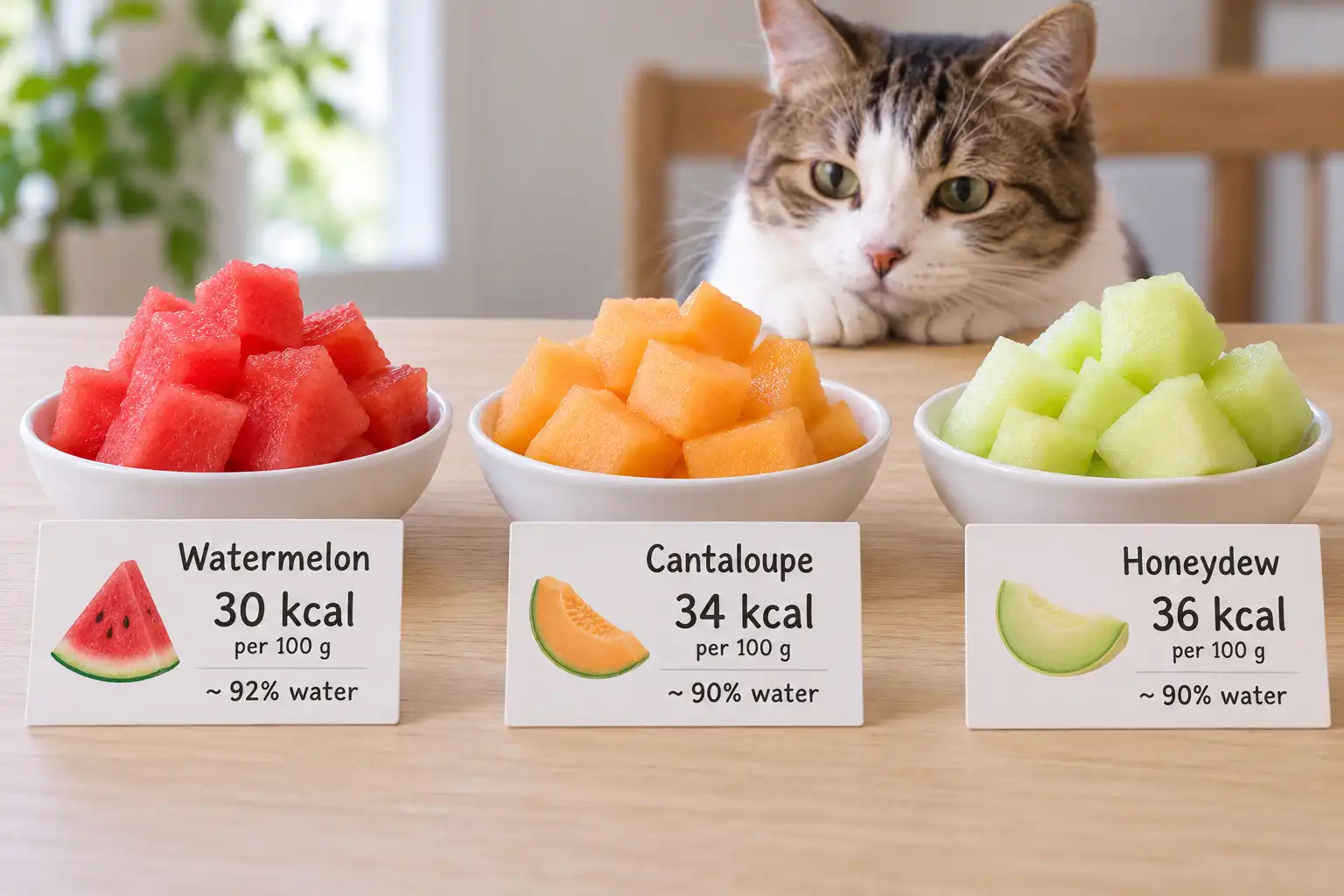
Cantaloupe’s netted rind needs the most care. The FDA has traced several multistate Salmonella and Listeria outbreaks to cantaloupe. It advises scrubbing firm produce, melons included, with a clean produce brush before cutting.
A common question is why some cats go for cantaloupe in particular. Cats can’t taste sugar, so sweetness isn’t the reason, and we found no published study that explains it. The same treat math works for any fruit, bananas included.
FAQs
Can I feed my cat watermelon every day?
Yes, a small daily piece is fine for a healthy adult cat if it stays within the treat ceiling. Ten grams adds about 3 kcal, roughly 12 percent of an 11 lb adult cat’s WSAVA allowance.
Can cats have watermelon rind?
No, the rind is tough and fibrous, so a cat may swallow pieces it cannot chew down. WSAVA warns that unsuitable treats can cause a blockage, so offer only the red flesh.
Can kittens eat watermelon?
Ask your veterinarian first, because a growing kitten’s calories should come from its growth formula, and treats crowd it out. WSAVA’s published treat ceilings cover healthy adult cats only, not kittens.
Can cats and dogs eat watermelon?
Both can have small amounts of seedless, rind-free flesh, and Tufts lists watermelon as a low-calorie treat for each. Portions don’t transfer, though, since a slice cut for a dog is far too big for a cat.
Why does my cat like watermelon?
It isn’t the sweetness, because a 2005 PLoS Genetics study found that cats lack a working sweet-taste receptor. The cool, wet texture or plain curiosity may explain it, though we found no study that confirms either.
What if my cat swallowed a watermelon seed?
Call your veterinarian, say how many seeds and how big your cat is, and follow their advice. Get same-day care for repeated vomiting, refusing food, a painful belly, or straining without passing stool.
Putting This Into Practice
Offer ripe watermelon flesh only, cut into kibble-size pieces, with every seed and all the rind gone. Weigh the serving and count it against the 10 percent treat ceiling. If treats add up, trim the kibble to match. Ask the vet before offering melon to a kitten or a cat with a medical condition. For water intake, wet food and fresh water do far more than fruit.

