Can Cats Eat Strawberries? Safe Portions, Prep, and Fruits to Skip
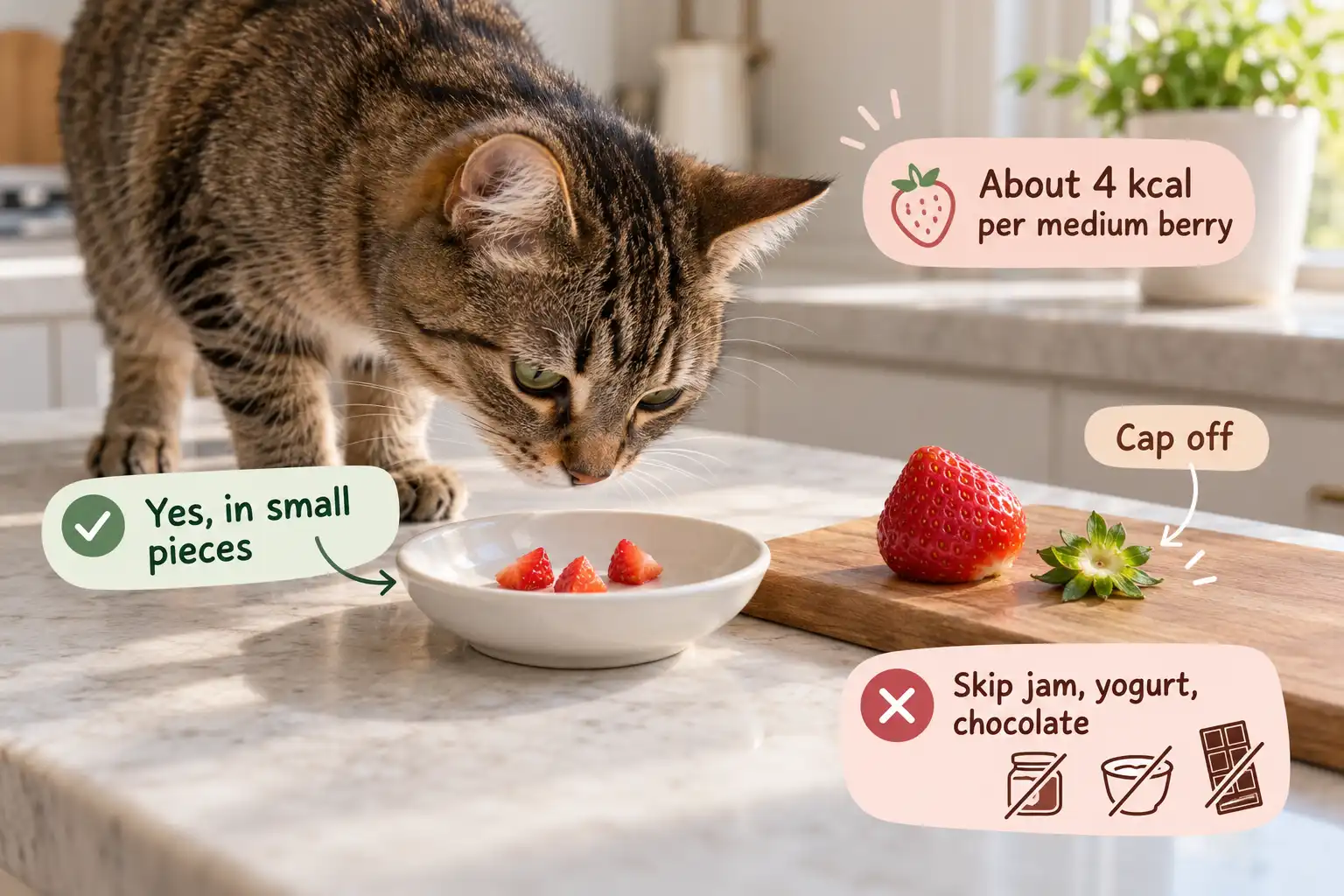
Can cats eat strawberries? Yes, but for a cat, a strawberry is a curiosity, not nutrition. Below: a safe portion worked from calories, how to prepare the berry, the strawberry foods to skip, and the other fruits that pass.
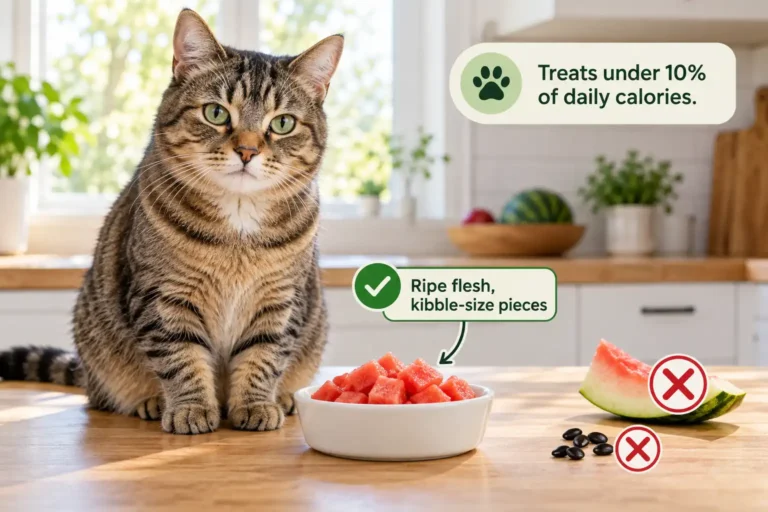
Yes, cats can eat strawberries as an occasional treat, and the ASPCA lists the plant as non-toxic to cats. Offer a healthy adult cat one or two pea-sized pieces of plain, rinsed berry with the leafy cap removed.
Can Cats Eat Strawberries Safely?
Yes. The ASPCA Animal Poison Control Center lists the strawberry plant (Fragaria species) as non-toxic to cats. Its food guide also puts strawberries on a short list of fruits to share sparingly, plain and cut into pieces.
Non-toxic isn’t the same as useful, though. Cornell Feline Health Center describes cats as obligate carnivores that rely on nutrients found only in animal products. So a strawberry adds nothing that a complete and balanced cat food doesn’t already supply.
Cats can’t taste its sweetness either. A 2005 study in PLoS Genetics, available on PubMed Central, found that cats carry a nonworking copy of Tas1r2. That gene builds half of the sweet taste receptor, so the receptor never forms. Whatever draws a cat to a strawberry, it isn’t the sugar.
How Many Strawberries Can a Cat Eat?
Give a healthy adult cat one or two pea-sized pieces at a time. Stop at about half a medium berry a day. No veterinary body publishes a strawberry serving for cats, so treat that cap as a cautious starting point.
Calories don’t set the cap. Tolerance does.
Any unfamiliar food can upset a cat’s stomach. A single small piece shows how this cat handles fruit before you offer more. If loose stool or vomiting follows, stop there.
How a Strawberry Fits a Cat’s Daily Calories
AAHA’s 2021 nutrition guidelines start a spayed or neutered adult cat at 1.0 to 1.2 times its resting energy requirement (RER). The formula is RER = 70 x (body weight in kg)^0.75. A 10 lb spayed or neutered indoor adult weighs 4.54 kg, so its RER is about 218 kcal. That adult cat needs about 220 to 260 kcal a day.
Treats come out of that total, but the sources set different ceilings. AAHA caps treats at 10 percent of daily calories, table scraps included. Cornell Feline Health Center allows 10 to 15 percent. For this 10 lb adult, that’s about 22 to 26 kcal under AAHA’s rule. Cornell’s allows up to 33 to 39 kcal.
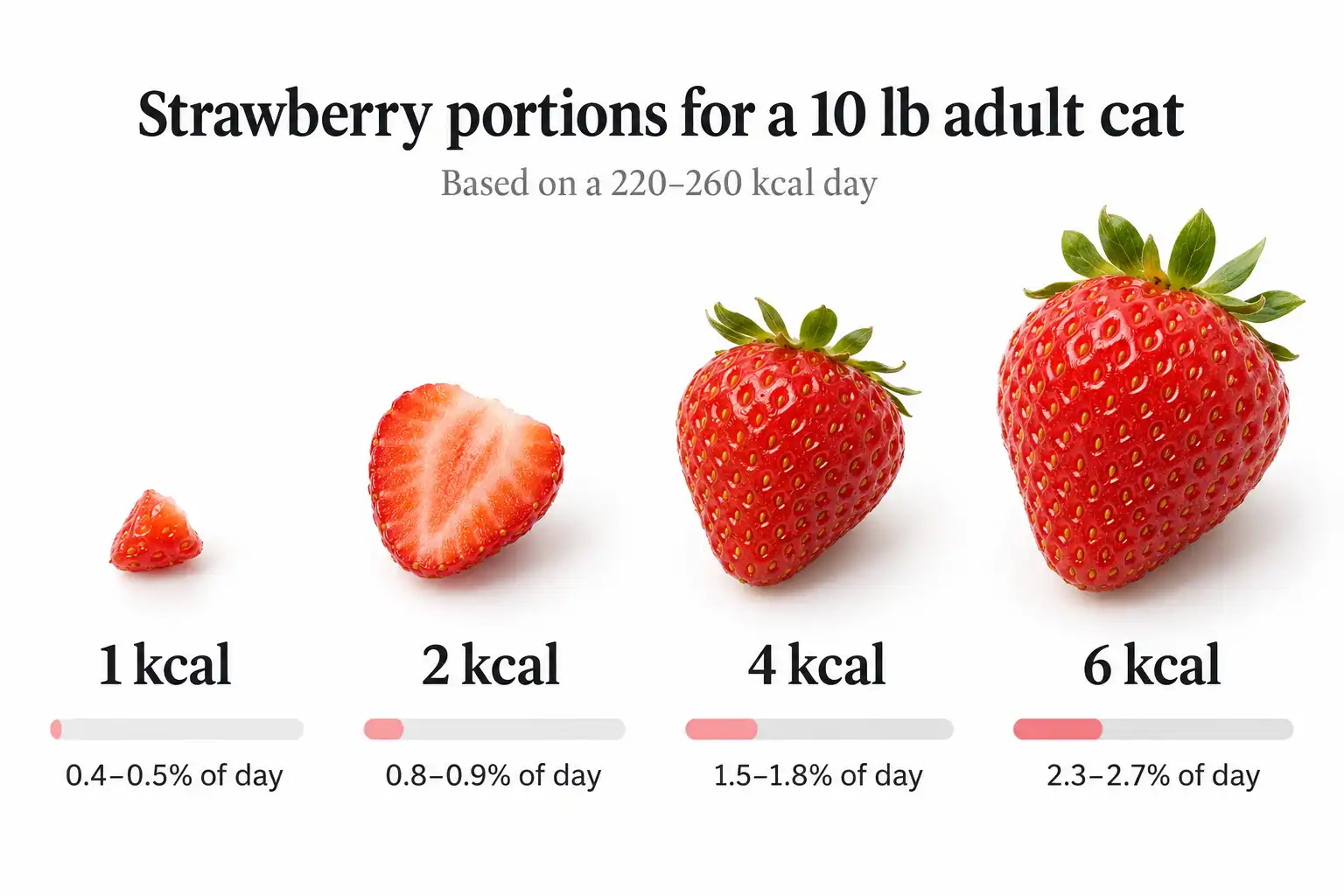
USDA FoodData Central puts a medium strawberry (about 12 g) at 4 kcal. Here’s how portions compare for the same 10 lb adult cat.
| Portion | Weight | Calories | Share of a 10 lb adult’s day | Share of AAHA treat limit |
|---|---|---|---|---|
| One pea-sized piece (¼ berry) | 3 g | About 1 kcal | Under 0.5% | About 4% |
| Half a medium berry | 6 g | About 2 kcal | Under 1% | 8 to 9% |
| One medium berry | 12 g | About 4 kcal | 1.5 to 1.8% | 15 to 18% |
| One large berry | 18 g | About 6 kcal | 2.3 to 2.7% | 23 to 27% |
On a dry food listing 400 kcal per cup, one medium berry equals about 1 percent of a cup. So a piece or two needs no change to the kibble. If your cat also gets commercial treats, the daily food calculator gives your adult cat’s total. Keep every extra inside it.
Do Strawberries Add Water for a Cat on Dry Food?
Hardly. USDA FoodData Central puts raw strawberries at about 91 percent water. Still, half a medium berry holds only about 5.5 g of it, roughly a teaspoon.
That matters for a cat that eats kibble. Cornell Feline Health Center puts dry food at 6 to 10 percent water. So a kibble-fed cat gets most of its water by drinking. Cornell also advises clean, fresh water at all times. A clean bowl or a fountain made for cats does that job. Fruit doesn’t.
How to Prepare a Strawberry for Your Cat
Fresh, plain fruit is the only form worth sharing. Follow these steps for each serving:
- Choose a ripe, plain berry. Skip any that are soft, moldy, sugared, or packed in syrup.
- Rinse it under running water. That washes off soil and residue from the field.
- Cut off the leafy cap and stem. The ASPCA lists the plant as non-toxic. Still, the leaves are tough and offer a cat nothing.
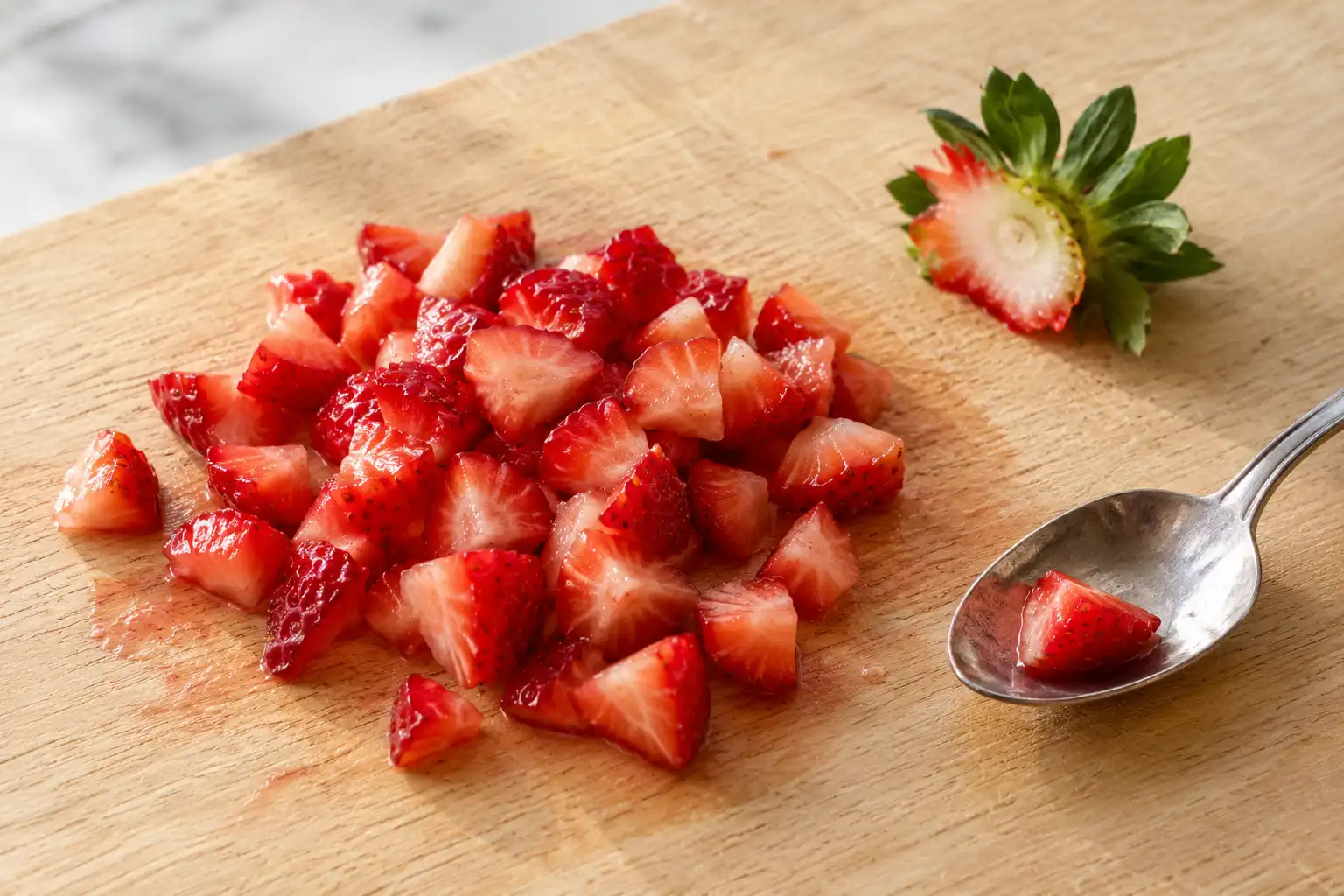
- Chop it into pea-sized pieces. The ASPCA’s food guide calls for cutting shared fruit into pieces. A whole berry is too big to chew safely.
- Offer one piece on its own. Leave out cream, sugar, yogurt, and whipped topping.
- Wait a day before offering more. If vomiting or loose stool follows, strawberries don’t suit this cat.
Strawberry Foods Cats Should Skip
Most strawberry products bring along ingredients cats handle poorly. Skip these:
| Product | Why it’s a poor choice for cats |
|---|---|
| Strawberry yogurt, ice cream, milkshakes | Dairy, plus added sugar and fat. Cornell Feline Health Center notes many cats are lactose intolerant. |
| Jam, jelly, syrup, pie filling | Mostly added sugar. Sugar-free versions may contain xylitol, which Cornell lists as off-limits for cats. |
| Chocolate-covered strawberries | Chocolate is on Cornell’s list of foods off-limits for cats. |
| Dried or sugar-coated strawberries | Drying shrinks the fruit, so a small bite packs more sugar. Many are coated in added sugar. |
| Strawberry candy, gum, gummies | Little or no fruit. Sweeteners may include xylitol. |
Strawberry yogurt and milkshakes fail for the same reason milk upsets so many adult cats.
Which Cats Should Skip Strawberries?
Strawberries suit healthy adult cats best. A few cats should skip them, or get their veterinarian’s okay first:
- Cats with diabetes. A diabetic cat eats on a feeding plan its veterinarian sets. Ask before adding any food, fruit included.
- Cats on a prescription or therapeutic diet. A veterinarian chose that diet for a specific job. Extra food can work against it.
- Cats in a food elimination trial. One bite of anything outside the trial diet can spoil the result.
- Cats on a weight-loss plan. Every treat counts against the calorie target your veterinarian set.
- Cats with a sensitive stomach. If new foods tend to bring vomiting or loose stool, skip the experiment.
What If Your Cat Ate a Strawberry?
A stolen bite of plain strawberry isn’t a poisoning concern, because the ASPCA lists the plant as non-toxic to cats. Pick up any leftovers. Then watch for vomiting or loose stool over the next day.
What came with the berry matters more. If it was dipped in chocolate or the snack contained xylitol, call right away, even if your cat seems fine. Reach your veterinarian or the ASPCA Animal Poison Control Center at (888) 426-4435. A consultation fee may apply.
Call your vet the same day for repeated vomiting, refusing food, sudden weakness, or diarrhea that doesn’t settle. Don’t wait out a missed meal, either. Cornell Feline Health Center warns that a cat that refuses to eat can develop serious medical problems. Gagging, pawing at the mouth, or labored breathing after a large piece needs an emergency clinic right away.
What Fruits Can Cats Eat?
Cats can eat a few plain fruits in small pieces, with seeds, pits, cores, stems, and peels removed. The ASPCA Animal Poison Control Center’s food guide names strawberries, blueberries, apples, and bananas as fruits to share sparingly. Its plant database also lists cantaloupe as non-toxic to cats.
| Fruit | Prep for an adult cat | Calories per 100 g | Sugar per 100 g |
|---|---|---|---|
| Strawberries | Rinse, cut off the cap, chop pea-sized | 32 kcal | 4.9 g |
| Cantaloupe | Remove rind and seeds, dice small | 34 kcal | 7.9 g |
| Apple | Flesh only, no seeds, core, or stem | 52 kcal | 10.4 g |
| Blueberries | Rinse, cut each berry in half | 57 kcal | 10.0 g |
| Banana | Peel, slice thin | 89 kcal | 12.2 g |
Calorie and sugar figures come from USDA FoodData Central for raw fruit. Strawberries carry the least sugar of the group. Banana sits at the other end, so a slice of banana should stay thin and rare.
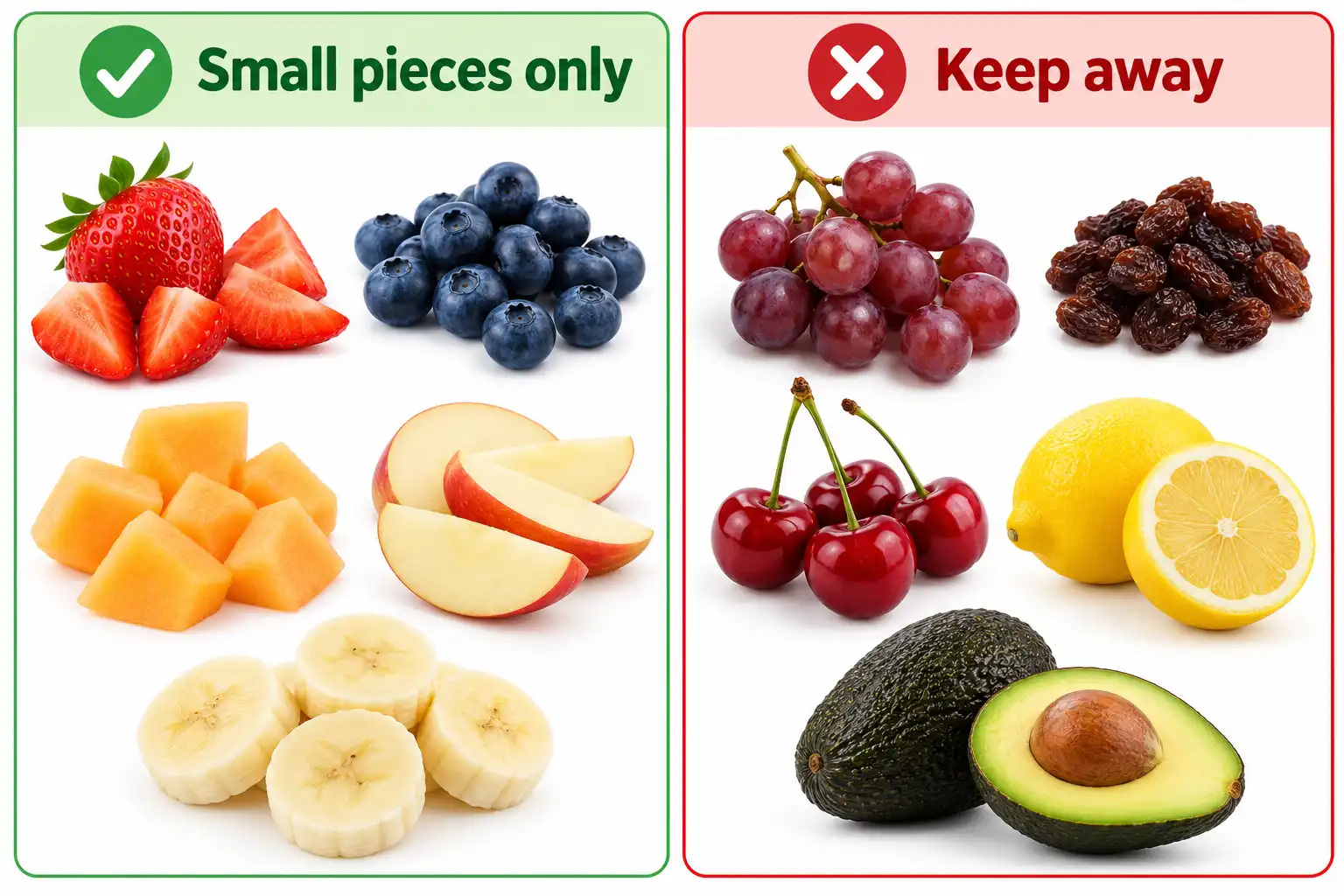
Can Cats Have Blueberries?
Yes, cats can have blueberries in small amounts. The ASPCA’s food guide lists them beside strawberries as fruit to share sparingly.
Per USDA FoodData Central, blueberries hold about twice the sugar of strawberries per 100 g. Each berry is tiny, though, at under 1 kcal. Cut each one in half, because a small, round berry is easy for a cat to gulp whole. One or two halves is a sensible first offer for a healthy adult cat.
Is Cantaloupe Good for Cats?
Cantaloupe is safe for cats, but it does them no particular good. The ASPCA lists true cantaloupe (Cucumis melo) as non-toxic to cats. Still, it adds nothing a complete and balanced cat food lacks.
Remove the rind and seeds first. Then offer a pea-sized cube of flesh to a healthy adult cat.
Cantaloupe also has a reputation for drawing cats in. A popular theory credits a meat-like aroma, but no published study has tested it.
Fruits to Keep Away From Cats
Some fruits are toxic to cats, or have toxic parts that are easy to miss:
- Grapes and raisins. Cornell Feline Health Center lists both among the human foods off-limits for cats.
- Avocado. It’s on the same Cornell list.
- Cherries. The ASPCA lists cherry as toxic to cats. Its pits, stems, and leaves contain cyanogenic glycosides.
- Lemons and other citrus. The ASPCA lists lemon as toxic to cats, citing its essential oils and psoralens.
Frequently Asked Questions
Can kittens eat strawberries?
A nibble isn’t toxic, but kittens don’t need fruit or the stomach upset it can bring. A growing kitten needs its calories from a food labeled complete and balanced for growth.
Are strawberry leaves toxic to cats?
No, the ASPCA lists the strawberry plant as non-toxic to cats. Still, the leafy cap is tough and fibrous, so cut it off and keep garden plants from becoming a chew toy.
Can cats eat strawberry seeds?
Yes, the tiny surface seeds are part of the fruit, which the ASPCA lists as non-toxic to cats. Unlike apple seeds or cherry pits, they need no removal before you chop the berry.
Can cats eat frozen strawberries?
Yes, if they’re unsweetened and fully thawed before serving. Check the bag for added sugar, then chop each thawed berry into pea-sized pieces, since frozen chunks are hard to chew.
Can cats eat strawberries every day?
They shouldn’t, even though a tiny daily piece fits a healthy adult cat’s calorie budget. Cornell Feline Health Center says treats should be fed only occasionally, and daily fruit brings a cat no benefit.
Why does my cat like strawberries?
Not for the sweetness, because a 2005 PLoS Genetics study found cats lack a working sweet taste receptor. Curiosity, texture, or a cold berry from the fridge may explain it, but no study has tested which.
Putting This Into Practice
Treat a strawberry as a curiosity, not a food group. Rinse it, cut off the cap, and offer one pea-sized piece to a healthy adult cat. Watch for a day, then keep any repeats small and occasional.
Skip anything dipped, sweetened, or made with dairy. Ask your veterinarian first if your cat has diabetes, eats a prescription diet, or is losing weight on a plan.