How Long Do Cats Live? From the Teen Years to 20 and Beyond

How long do cats live? Many house cats live into their teens, while some reach 20 years or more. Lifespan varies with genetics, health, living conditions, and veterinary care. Research also shows why average life expectancy differs between cat populations.
Many domestic cats live for 12 to 18 years, and some live beyond 20. However, published life expectancy estimates vary by population. Indoor and outdoor living conditions, genetics, health, and preventive care can all influence how long a cat lives.
Contact a veterinarian about appetite loss, unexplained weight changes, or unusual behavior. Do not assume these changes are simply aging.
How long do cats live on average?
There is no single average lifespan that applies to every house cat. Studies use different populations and different ways of calculating longevity.
These findings provide useful reference points:
| Research population | Reported figure | What the figure measures |
|---|---|---|
| England, Royal Veterinary College study published in 2015 | 14.0 years | Median age at death among 4,009 cats. |
| United States, Banfield records analyzed in a 2023 study | 11.18 years | Estimated life expectancy at birth across records from 2013 to 2019. |
| United Kingdom, Royal Veterinary College study published in 2024 | 11.74 years | Estimated life expectancy at birth using 7,936 confirmed deaths. |
Median age at death means half the cats died younger and half older. Life expectancy at birth uses mortality patterns to estimate average years of life.
Neither measure tells you how long a healthy cat already living in your home will survive. These figures also do not demonstrate that cat lifespan is declining. The populations and calculations differ.
The US study received Royal Canin funding and used Banfield records. Its findings describe that clinical population, not every American house cat.
How long do indoor cats live compared with outdoor cats?
Indoor cats can reach their teens and 20s, but indoor housing does not guarantee a particular age. Outdoor exposure also varies substantially.
A 2022 UC Davis study illustrates why indoor versus outdoor lifespan claims need context:
| Housing recorded in the study | Median age at death |
|---|---|
| Indoor only | 9.43 years |
| Indoor and outdoor | 9.82 years |
| Outdoor only | 7.25 years |
These were cats receiving postmortem examinations at a veterinary teaching hospital. They were not a representative sample of healthy house cats. Among cats aged one year or older, housing-related differences were not statistically significant.
Therefore, these numbers cannot establish exactly how many years outdoor access removes from a cat’s life. Nor does the slightly higher mixed-housing figure prove that roaming improves survival.
How long do outdoor cats live?
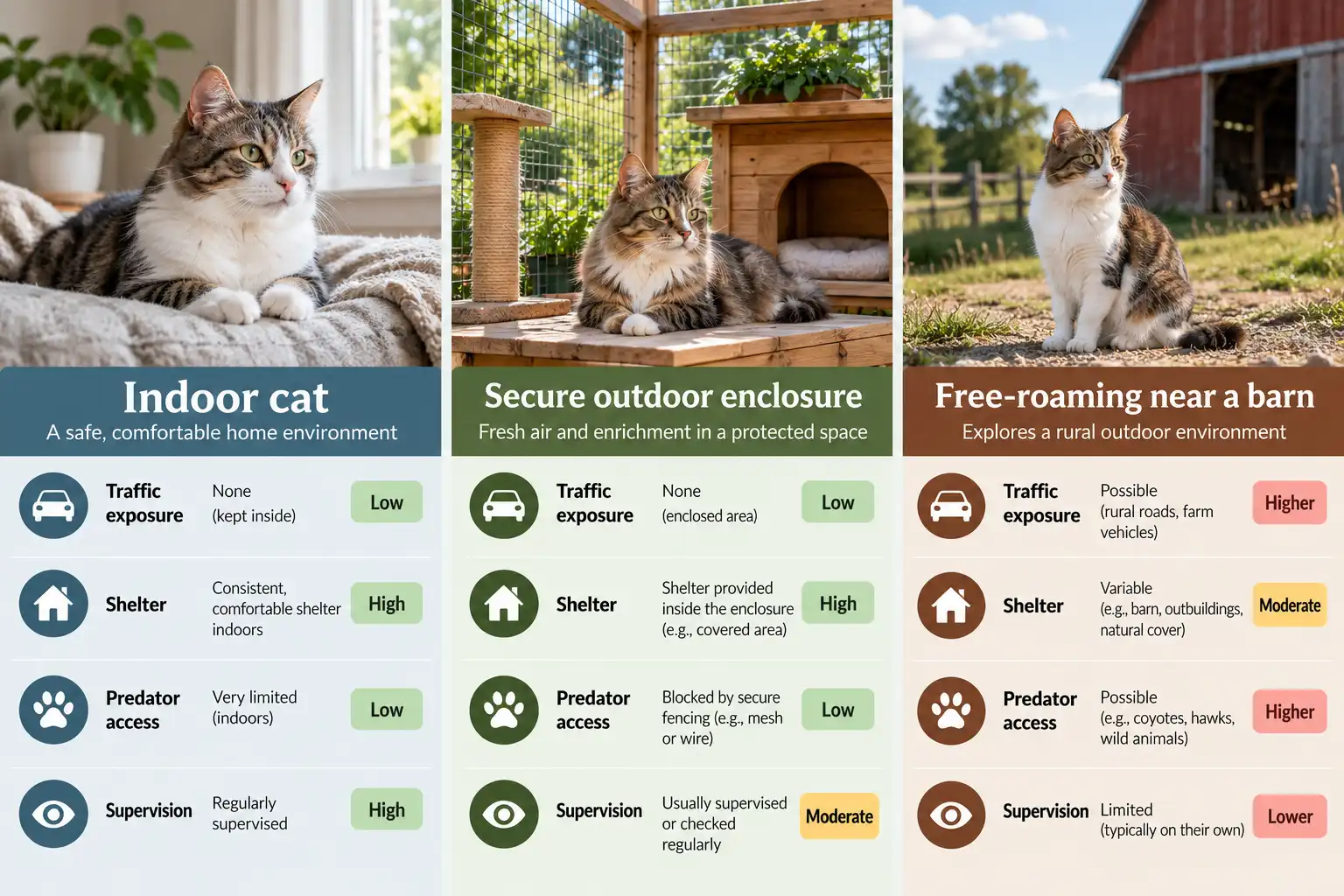
Outdoor cats do not share one reliable lifespan estimate. A cat using an enclosed patio faces different risks from a cat roaming near busy roads.
The AAHA/AAFP guidelines recommend assessing actual exposure rather than relying only on an indoor or outdoor label. Traffic, predators, poisoning, infectious disease, and parasites all belong in that assessment.
Consider where your cat travels, which cats it encounters, and whether you can notice injuries or illness promptly. Secure enclosures and supervised access can reduce some hazards, although no setup guarantees longevity.
How long do barn cats live?
The research above does not establish a separate average for barn cats. “Barn cat” describes a living arrangement, not a breed or uniform level of care.
For example, a regularly monitored barn cat with shelter and veterinary care differs from an unmonitored roaming cat. Both may appear in broad discussions of outdoor cats.
AAHA’s outdoor-cat guidance supports providing dependable meals, fresh water, suitable shelter, and veterinarian-directed parasite protection. Hunting does not replace regular feeding. Also secure chemicals and check that the cat can escape excessive heat or severe weather.
Judge the individual environment instead of assigning every barn cat the same expected age.
How long do Maine Coon cats live?
The International Cat Association, or TICA, lists a general Maine Coon life expectancy of 12.5 years or more. However, the 2024 UK study estimates 9.71 years at birth, based on 69 Maine Coon deaths.
These figures are not interchangeable. TICA provides breed guidance, while the study calculates an estimate from a particular population. Neither figure is a maximum age, and averaging them would create a misleading number.
TICA also highlights screening for hypertrophic cardiomyopathy, a heart muscle disease associated with the breed. Discuss appropriate heart screening with your veterinarian. A negative genetic test does not rule out every form of this condition.
How long do senior cats live?
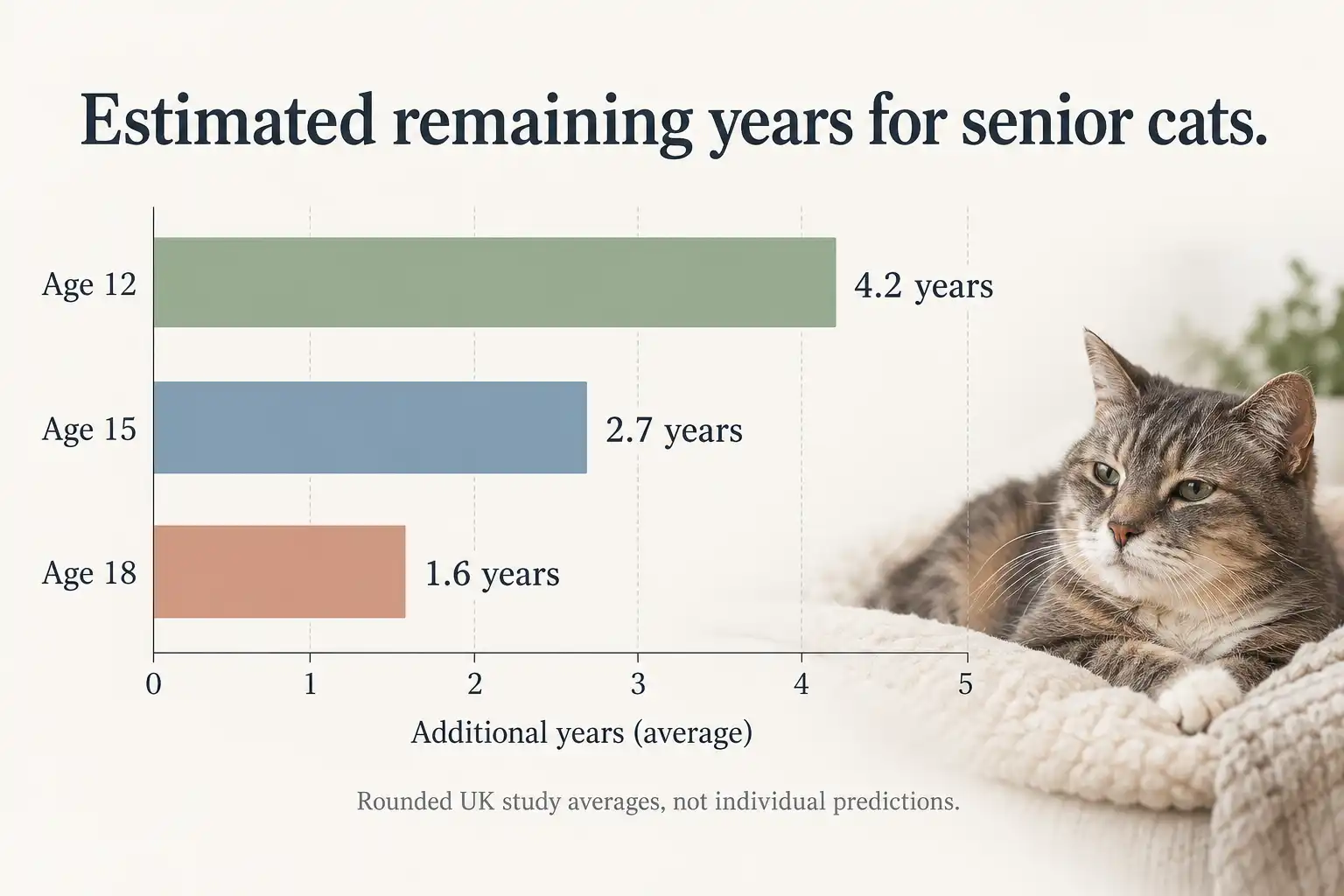
Senior cats may have several years ahead. Their remaining life expectancy depends partly on the age they have already reached.
The 2024 UK life table provides these estimates, rounded to one decimal place:
| Age already reached | Estimated additional years |
|---|---|
| 12 years | 4.2 years |
| 15 years | 2.7 years |
| 18 years | 1.6 years |
Read these as additional years, not total lifespan or individual deadlines. You cannot calculate remaining life by subtracting your cat’s age from an average measured at birth.
At what age is a cat considered senior?
AAHA/AAFP classifies cats as senior after age 10. Its earlier stages are kitten, from birth to under one year; young adult, ages one through six; and mature adult, ages seven through 10.
These stages help organize care. They do not determine when a cat becomes ill or reaches the end of life.
A senior cat therefore needs age-appropriate monitoring, not an assumption that decline is unavoidable. Cornell emphasizes that aging itself is not a disease. New problems still deserve investigation.
How can you support a longer, healthier life?
You cannot guarantee a particular lifespan. However, you can address preventable hazards, support appropriate nutrition, and seek help when your cat’s normal habits change. AAHA/AAFP organizes preventive care around these individual needs.
What should routine veterinary care cover?
Plan regular examinations before obvious illness develops. AAHA/AAFP recommends at least annual examinations for all cats and examinations at least every six months for seniors. Some cats need more frequent visits.
Your veterinarian can tailor dental care, vaccination, parasite prevention, and testing to your cat’s risks. Senior assessments may include blood tests, urine testing, blood pressure measurement, and thyroid evaluation. Not every cat needs an identical testing schedule.
Bring notes about appetite, thirst, activity, litter-box habits, and weight changes. These details help explain what happens between appointments.
At home, make food, water, resting places, and litter boxes easy to reach. Lower-sided litter boxes may help cats with reduced mobility, but new difficulty moving still needs veterinary assessment.
Does wet or dry food affect cat lifespan?
Neither food format guarantees a longer life. Cornell explains that appropriately formulated wet and dry foods can meet a cat’s nutritional needs. The choice depends on the cat and the complete feeding plan.
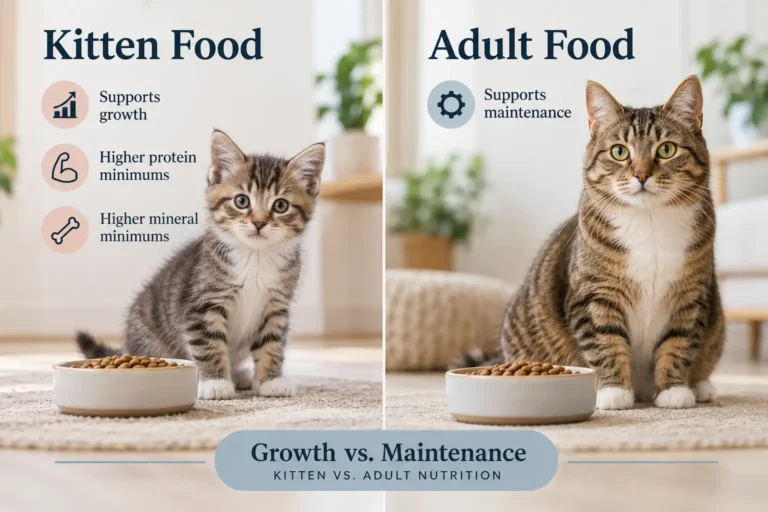
Start with a complete and balanced diet appropriate for your cat’s life stage. Check the life-stage wording on the food label rather than choosing by package claims alone. Growing kittens and adult cats have different nutritional requirements.
Then consider the moisture differences between wet and dry feeding alongside intake, preferences, and medical needs. Mixing formats still requires controlling the total amount fed.
A disease-specific diet should follow veterinary assessment. Age alone does not establish which nutritional changes a cat needs.
How can portions support a healthy weight?
Use body condition and an individual feeding target, not age alone. AAHA recommends nutritional assessment and feeding plans matched to the cat’s needs.
Suppose a veterinarian sets a target of 240 kcal/day for a healthy, neutered indoor adult cat. For illustration, assume that adult cat’s dry food supplies 400 kcal/cup.
For that healthy, neutered indoor adult cat:
240 kcal/day ÷ 400 kcal/cup = 0.6 cup/day
These are hypothetical figures, not a recommended portion for every adult cat.
Subtract calories from wet food, treats, and calorie-containing supplements before allocating dry food. Compare portions based on weight and food calories, then adjust with veterinary guidance and body-condition checks. Bag charts provide starting amounts, not individualized prescriptions.
Also remember that senior cats can lose muscle or become underweight. Do not assume every older cat needs fewer calories. Any weight-loss plan should be veterinarian-led, without fasting or abrupt food restriction.
Which changes need veterinary attention?
New symptoms deserve attention at any age. Dental disease, arthritis, kidney disease, thyroid problems, and other conditions can affect older cats. Their signs can overlap, so symptoms alone cannot identify the cause.
Use the urgency of the change to guide your next step:
- Seek emergency care now for breathing trouble, collapse, sudden severe weakness, or straining to urinate with little or no urine.
- Contact your veterinarian the same day if your cat stops eating or vomits repeatedly. Food refusal can lead to serious complications; do not wait because the cat is older or overweight.
- Arrange a prompt appointment for unexplained weight loss, increased thirst, reduced grooming, difficulty jumping, or persistent behavior changes.
A lifespan estimate cannot tell you whether a symptom is harmless. Your cat’s current condition should determine the response.
FAQs about Cats Lifespan
Can my cat live past 20?
Some domestic cats reach their 20s, although that is not a promise for any individual cat. Cornell describes cats living beyond 20, but current health and comfort matter more than matching a very old age.
Do female cats live longer than male cats?
Female cats had higher life expectancy at birth in the US Banfield study: 11.68 years versus 10.72 for males. These population averages do not predict the lifespan of an individual female or male cat.
Does spaying or neutering affect cat lifespan?
Spayed and neutered cats lived longer in the UC Davis study, but this shows association rather than a guaranteed benefit. Discuss procedure timing and ongoing care with your veterinarian, including appropriate feeding after recovery.
Should I automatically switch my senior cat to senior food?
No, a healthy senior cat does not automatically need a different food because of age. AAHA notes there is no separate AAFCO senior nutrient profile, so changes should follow individual nutritional or medical needs.
Is one cat year really seven human years?
No, the seven-year rule does not accurately describe how cats age across their lives. Cornell explains that early development is faster, but human-age comparisons are rough illustrations rather than tools for predicting remaining lifespan.
What matters more than a lifespan estimate?
A lifespan estimate helps you plan, but it cannot tell you how much time your cat has left. Keep attention on appetite, weight, movement, litter-box habits, and comfort. Record changes so your veterinarian can compare them over time. For an older cat, practical support may include easier access to food, water, resting places, and litter boxes.
For a roaming cat, better shelter and fewer environmental hazards may be priorities. Long life is not completely under anyone’s control. The useful goal is consistent care and comfortable days, rather than trying to make your cat match an average.